Quick Take
- Narration: George M. Johnson reads his own memoir with intimate authority, the grandmother letters especially benefit from his direct voice.
- Themes: Black boyhood and brotherhood, the role of grandmothers in Black family life, vulnerability as strength
- Mood: Warmhearted and emotionally generous, with honest passages about racism and loss
- Verdict: A striking follow-up to All Boys Aren’t Blue that centers the family system rather than the individual, Johnson’s best-realized work.
I finished We Are Not Broken on a Saturday afternoon, sitting with my coffee going cold, because I kept not wanting to put it down to refill the cup. George M. Johnson reads his own memoir, just as he did with All Boys Aren’t Blue, and that decision shapes the entire listening experience. You’re not receiving an interpretation. You’re hearing the writer’s own memory of his own childhood, his own grandmother, his own brothers. That proximity changes what the book can do.
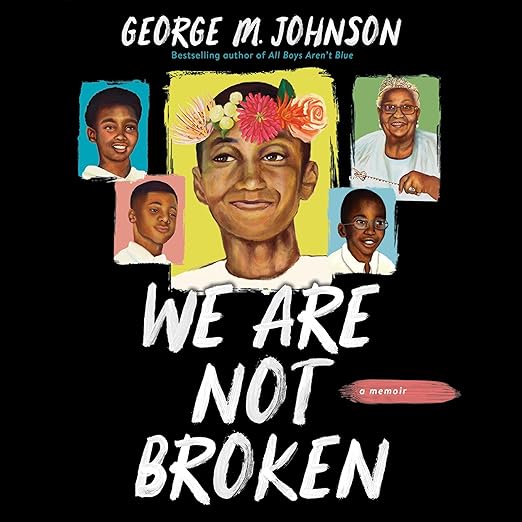
We Are Not Broken is not a solo memoir. It’s the story of four boys: George, Garrett, Rall, and Rasul, raised together by their grandmother Nanny, who is as central to this book as any of the four grandchildren. The narrative moves through early brushes with racism, the family barbershop as a space of community and identity, first losses and loves, and the particular texture of growing up as a Black boy in America when your family anchor is a woman of extraordinary devotion and will. Interspersed throughout are letters from the grandchildren to Nanny, a structural choice that gives the memoir unusual emotional depth and becomes, by the end, one of the most affecting devices I’ve encountered in recent YA nonfiction.
Our Take on We Are Not Broken
Johnson’s self-narration has a quality that’s difficult to manufacture: the specific cadence of a person recounting something they lived through, rather than something they imagined. In the letter sections particularly, his voice carries weight that no hired narrator could fully replicate. One reviewer wrote that she was “blessed by this book” and that it reminded her of how important elders are in Black family life. Another described the author as someone who “writes in color,” which is as accurate a description of his style as I’ve encountered. Johnson’s prose in All Boys Aren’t Blue had a similar quality, he doesn’t describe emotion, he renders it.
The reviews, while brief, are consistent: readers describe the book as exceptional, meaningful, necessary. A reviewer who works in a community context noted that We Are Not Broken offers insight into a community experience that is underrepresented in mainstream YA memoir. Another called it a great gift for young Black men specifically, which is both accurate and undersells the book’s reach, the portrait of Nanny as a family center speaks to any reader who has been shaped by a grandmother’s love.
Why Listen to We Are Not Broken
The decision to tell four boys’ stories rather than one gives the memoir a breadth that distinguishes it from standard coming-of-age autobiography. Each brother represents a different relationship to the family center that Nanny provides, different coping strategies, different paths, different ways of carrying the early experiences of racism and expectation. Johnson weaves between their perspectives with structural intelligence, never losing the thread of the collective story even as the individual portraits deepen. The barbershop scenes are particularly good: Johnson understands what that space meant as both a physical location and a cultural institution.
What to Watch For in We Are Not Broken
At four hours and three minutes, this is a compact memoir, one of the more economical in terms of runtime, and it shows in places where additional depth would have been welcome. The racism sequences are direct but not fully expanded; some readers will want more time with the incidents Johnson describes and their long-term effects on each brother. The book is classified as YA but speaks most fully to adult readers who have distance from their own upbringing and can recognize what Johnson is doing structurally with the grandmother-as-center framing. Younger readers will find it meaningful, but some of the resonance deepens with life experience.
Who Should Listen to We Are Not Broken
Anyone who read and valued All Boys Aren’t Blue. Listeners interested in Black family memoir, particularly accounts that center grandmothers as primary figures rather than background support. Adults who have processed complex relationships with their own family of origin and recognize the kind of emotional archaeology Johnson performs. The author’s narration is specific enough that it functions best for listeners willing to slow down and receive what he’s offering rather than consuming it quickly. Let the letter sections breathe.
Frequently Asked Questions
Do I need to have read All Boys Aren’t Blue to appreciate We Are Not Broken?
No. We Are Not Broken is a standalone memoir about Johnson’s family and childhood, not a continuation of All Boys Aren’t Blue. The earlier book focused more on Johnson’s LGBTQ+ identity and experiences of trauma. This one focuses on the collective family story. They are companion works rather than sequential volumes.
How does Johnson’s self-narration compare to the narration of All Boys Aren’t Blue?
Johnson narrated both books himself, which gives the two audiobooks a shared intimacy. We Are Not Broken has a somewhat different emotional register, more reflective and familial, less urgently confessional. His voice suits both modes but seems particularly at home in this book’s quieter, more celebratory sections.
What are the letters from grandchildren to Nanny, and how are they integrated into the audiobook?
The letters are a structural device running through the memoir, personal addresses from each of the four brothers to their grandmother, reflecting on specific memories and what she meant to them. In the audiobook, Johnson reads these sections himself, and they carry a different emotional quality from the narrative chapters.
Is We Are Not Broken primarily a book about racism, or is it more focused on family?
Both, inseparably. Johnson is honest about early brushes with racism and what it meant to grow up Black in America, but the book’s organizing principle is family love and the specific sustaining power of Nanny as a matriarch. The racism is present and not minimized, but it exists within the larger frame of what the family built together.