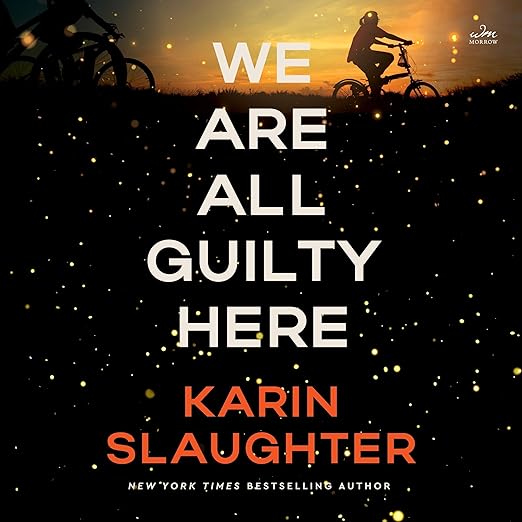
I started We Are All Guilty Here on a long weekend, which turned out to be exactly the right choice. At sixteen and a half hours, this is a substantial commit, and Karin Slaughter does not hurry it. The first hundred pages, or the first few hours in audio, are deliberate and atmospheric, the town of North Falls assembled slowly, character by character, secret by secret. One reviewer was nervous they would get bored. They didn't. I didn't either, though I understand the hesitation: Slaughter is building something here, and the weight of it only becomes clear once the foundation is in place.
The setup is both specific and resonant. Two teenage girls vanish on the night of the town's fireworks display. Officer Emmy Clifton, who knew the best friend's daughter and looked away when she should have acted, now has to find her. The premise is about guilt in the most practical sense: what did you see, what did you do, what did you let happen. But Slaughter's title names something larger, the collective moral liability of a community that creates the conditions for its secrets to fester. North Falls is a town where everyone knows everyone, which is another way of saying that everyone protects everyone, which is another way of saying that no one is truly safe.
Emmy's Own Failure Shapes This Investigation
Slaughter has been writing crime fiction since 2001 and has a Will Trent series with a devoted following. This is a new series, new characters, new setting, a decision that requires an author to rebuild trust with readers who might resist being asked to care about new people. She earns that trust quickly. Emmy Clifton is a protagonist shaped by a specific failure rather than by generic competence, which immediately distinguishes her from the procedural heroine template. The guilt of the title is, in part, hers, and that complicates her position in ways that give the investigation genuine moral weight.
A reviewer praised the light touch with revelations, the book "lightly sprinkled" implications rather than ramming them at the reader. This is accurate and worth emphasizing because it describes an authorial restraint that is rarer than it should be in commercial crime fiction. Characters have histories that matter without those histories being delivered in information dumps. The small-county setting, the sheriff's department, the large family dynamics, all of it accretes into something that feels genuinely inhabited.
Early Paces the Slow Build Without Sagging
Kathleen Early's narration is the right match for this material. She works at a measured pace that suits the atmospheric first half without making the second half feel slow, and she manages the ensemble cast, which includes Emmy's colleagues, the missing girls' families, and the townspeople with things to protect, with clarity throughout. At sixteen-plus hours, the consistency of her performance is genuinely impressive. The transition from buildup to payoff in the back third requires a narrator who can hold the listener's attention through both registers, and Early manages it.
This is published by William Morrow and reached instant #1 New York Times bestseller status, which is context worth having. The endorsement from Dervla McTiernan, one of crime fiction's sharper contemporary voices, is not the kind of blurb that gets attached to books undeservingly.
Telegraphed Reveals Land Softer Than Slaughter's Best
The pacing genuinely is slow to start, and the reviewer who noted figuring out two of the primary antagonists early should be taken seriously: some of the reveals are more telegraphed than Slaughter's best work in the Will Trent series. For readers who engage with crime fiction primarily as puzzle, the satisfaction of the solution may feel partial. For readers who engage with it as character study and social anatomy, the experience holds fully. The two readerly experiences of this book are somewhat different, and knowing which one you are going in will calibrate your expectations correctly.
Existing Slaughter Readers Get a Fresh Canvas
Essential for existing Karin Slaughter readers who want to see what she does with a fresh canvas. Also recommended for listeners drawn to crime fiction that takes female guilt and complicity seriously as subject matter, Tana French's Dublin Murder Squad has a similar preoccupation with what communities know and choose not to act on, and the North Falls series appears to be working in adjacent territory. Not recommended for listeners who need plot to drive at pace from the first chapter; the investment pays off, but it takes time. Also a series opener, so the expectation of some continuation is baked in.
Questions Listeners Ask
Is We Are All Guilty Here a standalone mystery or the start of a series?
It is the first book in the North Falls Thriller series, featuring Officer Emmy Clifton and the town of North Falls. The central mystery of the missing girls is resolved within this book, but Emmy and North Falls are established as the ongoing frame for future installments.
How does this compare to Slaughter's Will Trent series, do fans of that series need to read in a particular order?
The North Falls series is entirely separate from Will Trent, with different characters, setting, and tone. No familiarity with the Will Trent books is required or assumed. Fans of that series can begin here without any prior reading.
Is the slow start to We Are All Guilty Here typical of Slaughter's work, or is this pacing unusual for her?
Slaughter's crime novels generally invest in character and setting before the central tension escalates, but this book's opening is particularly deliberate. The payoff in the second half is broadly agreed to justify the patience, but readers who found her earlier books pacy should be prepared for a more atmospheric opening here.
How does Kathleen Early handle the large ensemble cast across sixteen-plus hours?
Early maintains clear character differentiation across the ensemble without resorting to exaggerated vocal performance. Her pacing is measured throughout, and she handles the shift from atmospheric buildup to tense procedural payoff in the book's second half with consistency that sustains listener engagement across the full runtime.