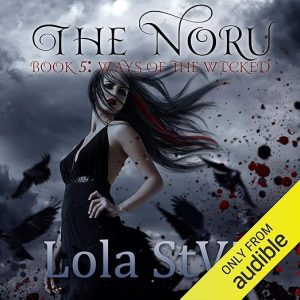
Pryor, Key, Bex, Swoop, and the rest of the Noru guardians have been fighting for each other across four previous audiobooks in Lola StVil's series, and Ways of the Wicked opens with the weight of everything that has already been lost. Aiden and Diana's child is dead. Aiden has disappeared. Pryor is broken. And the Raven, the fifth book's primary antagonist, has reached full strength: her darkness and brutality unmatched, Noru blood promised to spill before the battle concludes. That is the territory StVil stakes out in the opening pages, and Jennifer O'Donnell's narration communicates the accumulated grief of these characters without requiring listeners who know them to be reintroduced to it.
This is a series that rewards loyalty. The emotional impact of the fifth volume is genuinely predicated on the reader's history with these characters across the preceding books. Key's relationship with Randy, which one reviewer described as finally landing Key in seventh heaven, lands differently if you have watched Key navigate love and responsibility across the earlier volumes. Bex's continued pursuit of Pryor carries a weight that five books of history supplies and a synopsis cannot. The Raven herself, as an antagonist, functions as a culminating threat rather than an introduction, her presence representing what happens when the darkness the Noru have been fighting finally arrives at its most concentrated form.
StVil's primary strength as a writer in this series has always been the ensemble. The Noru are not a superhero team in the conventional sense; they are a found family with supernatural obligations, and the interpersonal dynamics within the group are as narratively load-bearing as the battle sequences. Ways of the Wicked picks up Swoop's subplot with the attention and specificity it has been building toward, and a reviewer who noted Swoop's alter-ego development as a highlight was responding to real character work rather than peripheral plot texture.
The synopsis for this volume is minimal, reflecting the book's position deep within a series arc where detailed plot description would constitute spoilers for listeners who have not yet reached book five. Working from what is available: the Raven's arrival at full strength, the grief that has fractured the Noru's cohesion, and the promise of blood before the battle ends, the book clearly functions as an escalation point rather than a resolution. Series reading and listening in this genre builds toward crucible moments that put everything the preceding books established at genuine risk, and StVil appears to structure this volume around exactly that intention.
What Stands Out
Jennifer O'Donnell's consistency across a series of this length is a production asset that should not be understated. The Noru series requires a narrator who has internalized the specific emotional frequencies of each character, who can move between Key's warmth and Pryor's grief and Bex's determination without audible effort. O'Donnell has built that familiarity across the preceding volumes, and it shows in how naturally this audiobook carries the series' emotional register forward.
One reviewer described being a huge fan of both the Noru and Guardians series and found this book did not disappoint, noting the consistent characterization as a specific virtue. Another described an obsessive investment in StVil's characters that led them to reread the Guardians series in preparation for the final Noru volumes. That level of series commitment is only possible with characters built to the depth StVil achieves, characters specific enough to sustain long-form reader attachment without becoming familiar in the tired sense.
The ten-hour-and-thirty-one-minute runtime is appropriate for a series entry at this stage. StVil does not rush the grief sequences or the action choreography, and the audiobook format enforces an immersion that suits both the emotional weight of the material and the propulsive plotting that has made this series find such an ardent audience.
Before You Commit to Ways of the Wicked
The Raven as antagonist represents a different category of threat from what the Noru have faced before. StVil's construction of her as someone who has been hiding among them all their lives introduces a paranoid retrospective texture to the series' earlier friendships and alliances. Listening with that knowledge active, wondering which interactions in prior books now read differently in light of the Raven's concealed presence, is part of the fifth volume's specific pleasure and horror.
Key and Randy's relationship arc in this volume is worth tracking carefully alongside the battle narrative. StVil uses romantic relationships in this series as structural anchors for the characters' humanity, and Key's particular journey through the series has been one of the more emotionally complex subplots. A reviewer noted it as one of the high points of this book, suggesting StVil brings it to a genuinely satisfying moment rather than treating it as secondary texture.
Pryor's brokenness in the wake of the child's murder is the emotional center of the volume. Listeners who have followed Pryor's arc across the series will find that grief particularly resonant, and O'Donnell's performance of those passages is, based on reviewer response, one of the audiobook's most affecting elements.
Best Suited For
This audiobook is written for listeners already invested in The Noru series. Starting at book five without the context of the preceding volumes would deprive you of the character history that gives the emotional payoffs their weight. If you have followed the series to this point, the fifth installment delivers the kind of high-stakes escalation that long-series readers want from a penultimate or near-penultimate entry. New listeners to StVil's work should begin at the start of the Noru or Guardian series; the investment pays dividends that are simply unavailable from a single entry point.
Can I start the Noru series audiobooks with Ways of the Wicked?
Not advisably. This is the fifth book in a series with deep ensemble characterization and accumulated plot history. The emotional payoffs in this volume, including the grief around the child's death and the Raven's revelation as a hidden antagonist, only function with the full context of the preceding audiobooks.
How does Jennifer O'Donnell's narration handle the tonal range of this audiobook?
O'Donnell has narrated the preceding volumes in the series and brings accumulated familiarity with each character's emotional register. That continuity is a significant asset in a book that moves between grief, battle urgency, and moments of warmth within single chapters.
Is the Raven storyline resolved in this audiobook or does it carry forward?
The synopsis indicates the battle with the Raven reaches a critical point in this volume, with Noru blood promised to be spilled before it ends. The specific resolution or continuation into further volumes is not clear from available information, and the series has additional entries beyond this one.
What makes The Noru audiobook series different from other supernatural YA series?
StVil's emphasis on the ensemble as a found family rather than a superhero team produces unusually specific and sustained character investment. The romantic subplots are structurally integrated with the battle narrative rather than peripheral to it, and the emotional cost of the supernatural conflict is tracked across books rather than reset between them.