Quick Take
- Narration: Alex Jennings brings real warmth and fine comic timing to John Preston’s prose; his ability to distinguish between the flamboyant world of Elton John and the gruff pragmatism of Graham Taylor within a single narrator performance is a genuine skill.
- Themes: Unlikely partnership and mutual respect, working-class English football culture in the 1970s, what loyalty to a place actually costs
- Mood: Affectionate and bittersweet, with flashes of genuine comedy and a nostalgia that earns its sadness
- Verdict: A beautifully told account of one of English football’s stranger stories, genuinely readable for people with no prior interest in soccer, which is the highest compliment a sports book can receive.
I am not a football person. I came to Watford Forever because I have been a John Preston reader since his biography of Robert Maxwell and because a book about Elton John buying a struggling soccer club in 1976 while wearing six-inch platforms sounded like exactly the kind of British cultural document that my literary background has trained me to love. Eight hours later, I had also, somewhat unexpectedly, developed an opinion about the 4-4-2 formation and Graham Taylor’s career trajectory. That is what a good sports book does to you.
Preston is a skilled biographer with a particular gift for finding the emotional architecture inside institutional stories. The two previous biographies of his I have read both located the human stakes inside a story that could have been told as pure organizational history. Watford Forever does the same thing, this is not primarily a book about football, it is a book about two men who should have had nothing in common discovering that they were exactly what the other needed.
Our Take on Watford Forever
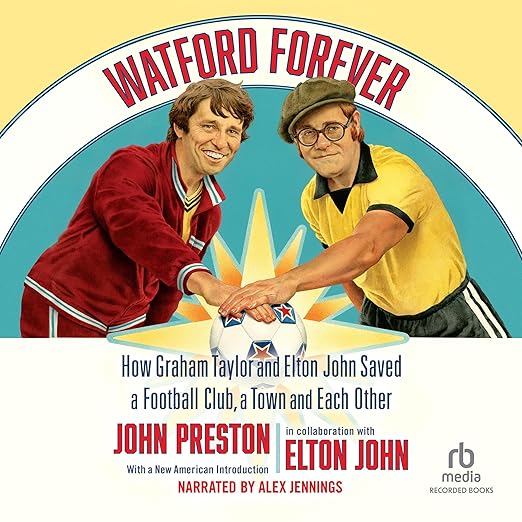
Elton John, born Reginald Dwight in the Pinner area of Greater London, a Watford supporter since childhood, bought the club in 1976 at the height of his global stardom. He was, in Preston’s phrasing, glamorous, gay, and seemingly a universe away from the village where he had supported Watford FC. Graham Taylor was his opposite in almost every register: a straight-talking former fullback with literally no interest in rock music, whose managerial philosophy centered on work rate, directness, and a refusal to romanticize the game.
The Seventies Britain that forms the backdrop of the story was, as one reviewer noted, surprisingly brutal, the economic crisis, the industrial action, the specific texture of working-class life in a town that prosperity had passed by. Preston captures that context without turning it into sociology. The football club is a community institution in the way that many English clubs were before money transformed the game, and the stakes of Watford’s rise are not just sporting but social.
Why Listen to Watford Forever
The book’s widest appeal is the partnership story at its center. A reviewer who described themselves as not a soccer fan found it easy to follow and never confusing, a meaningful test. The football mechanics are explained when relevant and not belabored when the human story is more important, which is the correct prioritization for a biography that hopes to speak to readers outside the sport.
Alex Jennings as narrator is an excellent match for Preston’s prose. His range allows him to move between Elton’s world, the excess, the humor, the genuine vulnerability behind the spectacle, and Taylor’s world, the tactical discussions, the locker room directness, the complicated personal struggles Taylor faced during the period, without the tonal whiplash that a less skilled narrator would produce. A UK reviewer who was there called the book a reminder of how football was back in the 70s and 80s before the big money arrived, and Jennings captures exactly the right quality of elegy without tipping into sentimentality.
What to Watch For in Watford Forever
The book covers a specific and bounded period, Elton’s ownership through Watford’s remarkable rise to the First Division and the events that followed. Readers hoping for a broader account of Elton John’s life and career will find the frame deliberately narrow. This is Watford’s story, not a rock biography, and the Elton of the later decades appears only in passing. Similarly, Graham Taylor’s subsequent career with the England national team is touched on but not the subject here.
The heartbreaking dimension that the synopsis hints at comes in the later sections as personal circumstances and the economic realities of football in the 1980s begin to complicate what had seemed like an uncomplicated triumph. Preston handles these turns with care, and the final emotional register of the book is genuinely moving rather than manufactured. Listeners who have invested eight hours in the relationship between these two men will feel the ending appropriately.
Who Should Listen to Watford Forever
English football fans and Watford supporters in particular will find this the definitive account of an era they may have personal memories of or have heard discussed since childhood. Elton John listeners who want context for his attachment to the club, an attachment that has never fully left him, will find the backstory both surprising and clarifying.
Non-soccer readers who enjoy biography and social history will find Watford Forever one of the more accessible sports books written in recent years. If you have ever enjoyed Nick Hornby’s Fever Pitch for its emotional rather than footballing content, this book operates in a similar register with the added dimension of being true and stranger than fiction.
Frequently Asked Questions
Do you need to know anything about English football to enjoy Watford Forever?
No. Multiple reviewers who described themselves as non-soccer fans found the book entirely accessible. Preston explains the divisional structure and tactical context where needed but never loses the non-fan reader in technical football discussion. The human story is always the primary subject.
How does Alex Jennings handle the challenge of narrating both Elton John’s flamboyant world and Graham Taylor’s gruff pragmatism?
Reviewers who addressed the narration found it excellent. Jennings has the tonal range to move between two very different registers within a single sustained performance, and the book received consistent five-star ratings across reviewers who mentioned listening quality. His background as a stage actor gives him the technical control to differentiate characters without caricaturing either of them.
Is Watford Forever more a biography of Elton John or a football history?
Neither primarily, it is a partnership biography, focused on the specific relationship between Elton John and Graham Taylor and what that partnership made possible. Elton’s broader music career and Taylor’s later work managing England are present as context but not treated in depth. The subject is the club and the decade they shared running it.
Does the book cover Elton John’s personal struggles during this period, including his public coming-out and his substance use?
Yes, Preston addresses Elton’s personal demons during the period, including what he was navigating privately while publicly managing a football club and continuing a demanding music career. These elements are handled with the same care Preston brings to Taylor’s struggles, and they are central to understanding why the partnership between two such different men meant as much as it did.