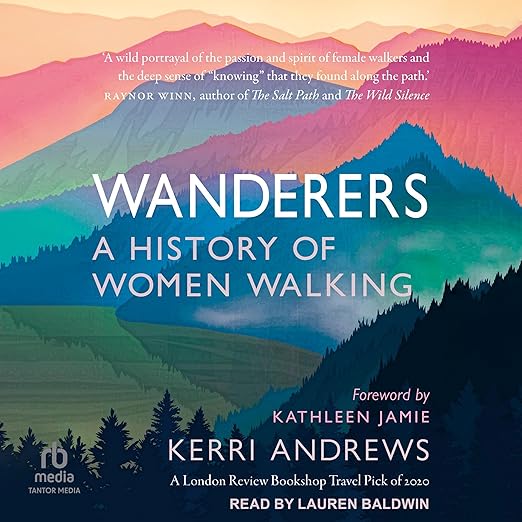
Quick Take
- Narration: Lauren Baldwin reads with a contemplative steadiness that suits the subject perfectly, giving the historical profiles enough space to breathe without losing forward momentum.
- Themes: Women walking as self-determination, literary creativity and physical movement, recovery of overlooked women’s history
- Mood: Meditative, quietly feminist, and literary without being academic
- Verdict: A beautifully assembled work of literary history that will send you straight to the hills, the archives, or both.
I started Wanderers on a morning when I had not left the house in three days due to a deadline that kept extending itself. I remember pressing play while still in my desk chair, and then finding myself an hour later standing at the window, coat half on, genuinely compelled to go outside. Kerri Andrews does something rare in nonfiction: she makes you feel the physical pull of the thing she is describing. Walking, by the end of this book, does not feel like exercise. It feels like a practice of self-constitution.
The book follows ten women across three centuries, each of whom made walking central to their lives and their writing. They range from Elizabeth Carter, an eighteenth-century parson’s daughter who wanted nothing more than to be taken for a vagabond, to Virginia Woolf pacing the streets of Bloomsbury with a novel forming, to Cheryl Strayed on the Pacific Crest Trail processing grief through motion.
Our Take on Wanderers
Andrews, a Reader in Women’s Literature at Edge Hill University and a leader of the Women in the Hills project, brings genuine scholarly depth to figures who have largely been written out of the walking tradition. The literature of walking has historically been dominated by male voices: Wordsworth, Thoreau, the Romantic peripatetics. Andrews does not make this point polemically; she simply traces the footsteps of Sarah Stoddart Hazlitt rambling for miles across the Highlands, or Ellen Weeton walking England alone in ways that made her contemporaries deeply uncomfortable, and lets the contrast speak for itself.
What prevents this from feeling like an academic exercise is Andrews’s eye for the physical and emotional particularity of each woman’s experience. Harriet Martineau walks as therapy, navigating a world that was not designed for her deaf body. Nan Shepherd moves through the Cairngorms as a form of perception rather than conquest, a philosophy she articulates in The Living Mountain with a precision that Andrews illuminates beautifully. Each portrait is distinct, and the cumulative effect is of a tradition being woven together from fragments that had never quite been assembled this way before.
Why Listen to Wanderers
Lauren Baldwin’s narration is a significant part of why this works in audio. Her voice is calm without being flat, and she handles Andrews’s more lyrical passages with the restraint they require. Some books about walking feel like they are trying to replicate the sensation through prose density; Andrews writes with more space, more air, and Baldwin matches that quality. One reviewer noted that reading the book inspired them to take solo hikes in Yorkshire and the Cairngorms, and I find that entirely believable. Baldwin’s reading contributes to that impulse.
The book also benefits from what it does not do. It does not try to tell us that walking will solve our problems, cure our anxiety, or make us better people in some prescribed way. It observes, with precision and affection, how particular women in particular circumstances found in walking something they could not find elsewhere. That modesty of claim makes the book more persuasive than a dozen wellness titles that overpromise.
What to Watch For in Wanderers
At just under seven hours, this is a listening commitment that asks for the right moment. It is not a book you can half-hear while doing something else. The historical and literary references accumulate, and if you are unfamiliar with Nan Shepherd or Harriet Martineau going in, you will get more from the portraits if you can give them your attention. Andrews does enough contextualizing that prior knowledge is not required, but attentiveness is.
Some listeners who come to it expecting hiking memoir in the vein of Cheryl Strayed’s Wild may find the literary-historical framing more academic than anticipated. This is a work of criticism and recovery as much as personal essay, and the emotional register is more studied than confessional.
Who Should Listen to Wanderers
Ideal for readers drawn to literary history, women’s biography, or the literature of place and landscape. Equally valuable for walkers who suspect the practice means more than fitness and want a language for what it means. Less suited for listeners seeking a propulsive walking adventure narrative. If you have ever loved Nan Shepherd’s work and wanted to understand who else was out there, moving through landscapes in ways history chose not to record, this is precisely the book for you.
Frequently Asked Questions
Does the book focus equally on all ten women or are some profiles more developed than others?
The depth varies somewhat. Nan Shepherd and Virginia Woolf receive particularly rich treatment given the volume of available source material, while some earlier figures like Elizabeth Carter are briefer by necessity.
Is prior familiarity with Nan Shepherd or Cheryl Strayed required to appreciate the book?
Not at all. Andrews contextualizes each woman’s work and life thoroughly enough that newcomers to any of the profiles will find them accessible.
How does Andrews handle the historical obstacles these women faced in walking alone?
She addresses the social hostility directly without letting it become the whole story. The women’s responses to those obstacles, ranging from defiance to strategic negotiation, are as interesting to Andrews as the obstacles themselves.
Does Lauren Baldwin’s narration distinguish well between Andrews’s own voice and the quoted passages from the walkers’ writings?
Yes. Baldwin shifts register subtly when moving into extended quotations, giving the historical voices enough distinction to feel like genuine presences rather than footnotes.