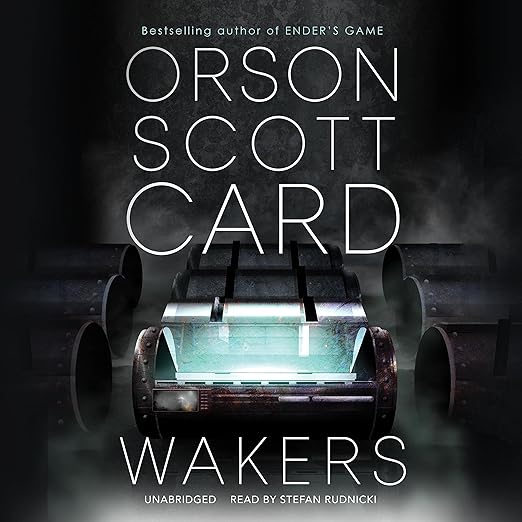
Orson Scott Card's Wakers audiobook opens the Side Step Trilogy and introduces Laz, a teenager who wakes up in a cloning facility on what appears to be a completely abandoned Earth. Stefan Rudnicki narrates, which is an interesting casting choice for a YA novel: Rudnicki is one of the most recognized voices in science fiction audio, having narrated adult works across multiple series, and his presence here signals that Card is working with ideas that have more weight than the YA packaging might suggest. At eleven hours and twenty-two minutes, this is a substantial listen for the genre, and Card uses that space to develop a premise that is more philosophically loaded than a clone-survival story needs to be.
The context that matters most here comes from one reviewer who noted this is a return to a less dark period for Card - not without darkness, but without the overwhelming evil that characterized some of his more recent adult science fiction. Laz is a side-stepper, meaning he can shift his consciousness to alternate versions of himself in parallel worlds. That ability, which has always been his escape hatch for ordinary mistakes, cannot solve the central problem he wakes into: he is a clone, his original self is somewhere or nowhere, the hundreds of other clones around him are dead, and one single other clone remains alive but asleep. The question haunting him is not why he was created - it is who woke him up, and why.
Card structures the mystery with layered questions rather than a single driver: why was Laz cloned, what happened to the world, who activated him, and what does the sleeping girl represent? These are good questions, and Card knows how to let them work on a listener without answering them prematurely. The review from the reader who called it a great premise but not a great story reflects a real tension in the book - the conceptual architecture is strong, but the execution can feel mechanical in places, particularly in the expository stretches where Laz processes his situation through internal monologue.
Rudnicki handles those internal passages by maintaining a quieter, more genuinely curious register than his typically authoritative adult SF delivery. He does not simplify the voice for YA, which could have been condescending, but he does soften the edges of his characteristic gravity. The result is a Laz who sounds like a teenager grappling with genuine philosophical enormity rather than a miniature adult narrating an action-adventure. That calibration matters for the book's central tension: Laz is a clone who has all the memories of his original self but is now definitionally someone else, and Rudnicki gives that identity question the careful handling it deserves.
What Makes Wakers Worth Hearing
The audiobook format works particularly well for the isolation sequences that take up a significant portion of the runtime. Laz is alone on an empty Earth, and Rudnicki's voice in those stretches carries a quality of being heard in a large empty space - not an acoustic effect, just a tonal one, but effective. The descriptions of the cloning facility, the dead clones, and the barren landscape outside are rendered with enough specificity that the audio experience creates genuine atmosphere without needing visual support.
Card's pacing in this book is methodical. He is not writing an action-oriented YA novel, despite the thriller-adjacent premise. Listeners expecting rapid plot movement through the eleven-hour runtime will need to recalibrate. The discoveries come steadily, but the novel is more interested in Laz's processing of his situation than in the sequence of reveals itself. Rudnicki's narration is well suited to that measured approach, and the side-stepping concept gives the story enough conceptual novelty to sustain attention across a runtime that could feel thin under a less committed narrator.
Things to Know Before Starting Wakers
The romantic interest in the book is deliberately contained - the reviewer who noted it goes no further than kisses is accurately describing the author's choice. Card is building a series and the relationship arc between Laz and the sleeping girl is clearly a long game. Listeners who come to YA primarily for the romantic dimension may find this first volume prioritizes concept over emotional development in that register.
The side-stepping ability is established but not fully deployed in book one. Card introduces it as a character trait and a problem-solving instinct before complicating it with the recognition that consciousness-shifting across parallel worlds does not solve a problem that exists across all versions of yourself simultaneously. This is the kind of science fiction premise that rewards attention: the ability that defines Laz is also the ability that most clearly fails him, and that irony is the structural core of the series opener. Rudnicki handles the internal logic of side-stepping with the same care he brings to the identity passages, keeping the concept clear without over-explaining.
Who Orson Scott Card Is Writing For
YA science fiction readers who enjoyed Ender's Game and want something with comparable conceptual ambition but a less brutal emotional register will find Wakers a satisfying entry into Card's lighter mode. Listeners who enjoy parallel-worlds and clone-identity premises will find the Side Step Trilogy setup rewards the investment. Stefan Rudnicki fans who typically follow him into adult SF should find his YA work here holds up across the full runtime.
Skip this if you need rapid plot momentum or a romance-forward YA experience. Also be aware that book one ends without resolution of the central mysteries - this is a series opener designed to generate investment in subsequent volumes rather than to satisfy independently. The concept is stronger than its current execution, but the concept is good enough to carry the first book.
The series opener format also gives Rudnicki space to establish Laz's voice before the character encounters the pressures that will presumably define later volumes. That establishment work - the unhurried process of learning who Laz was before he became what the story will make him - is where the audio performance does its most essential long-term work. Listeners who invest in these early hours are building the reference point that will make future volumes in the Side Step Trilogy carry their full emotional weight.
Key Details
- Narration: Stefan Rudnicki brings his signature gravitas to a YA protagonist, which creates an interesting friction - his voice has more weight than the material sometimes calls for, but it steadies the more existential passages about cloning and identity with quiet authority.
- Themes: Clone identity and selfhood, parallel worlds, survival without context
- Mood: Unsettling and curious, lighter than Card's adult SF but with genuine philosophical texture
- Verdict: A well-constructed YA series opener that benefits from Rudnicki's narration more than you might expect from a voice better known for adult SF.
Questions Listeners Ask
Is the Wakers audiobook suitable for younger listeners, given Stefan Rudnicki's typically adult SF narration style?
Rudnicki adjusts his delivery for the YA context - he maintains his characteristic quality but softens the authority-register that characterizes his adult work. The content is appropriate for YA audiences; Card keeps violence and romance within the genre's conventions. The narrator's voice reads older than the protagonist but not jarringly so.
Do I need to have read Ender's Game or other Orson Scott Card series before starting the Wakers audiobook?
No - Wakers is the first book of a new standalone trilogy with no connections to the Ender universe or other Card series. It works as a complete entry point for readers new to Card's science fiction.
Does the audiobook version of Wakers end on a cliffhanger, and is the rest of the Side Step Trilogy available?
Book one ends at a significant turning point without resolving the central mysteries about what happened to Earth or who woke Laz. As book one of a planned trilogy, it is designed to build investment in subsequent volumes rather than close its own arc.