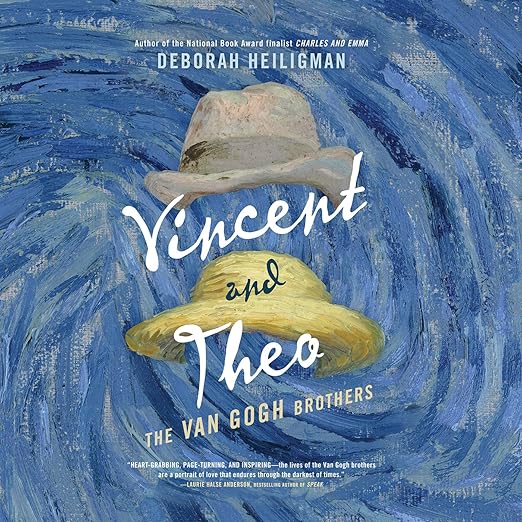
Quick Take
- Narration: Phil Fox delivers Heiligman’s carefully researched prose with a gentleness that suits the emotional weight of the subject without overcooking the inherent tragedy. He handles the book’s structural variety, standard biography alternating with letter excerpts and brief vignettes, with consistent clarity.
- Themes: brotherhood and artistic sacrifice, mental illness before treatment existed, the relationship between emotional support and creative achievement
- Mood: Tender and increasingly sad, like watching something beautiful move toward an ending you cannot stop
- Verdict: A Printz Honor biography that earns its reputation: genuinely moving, meticulously sourced, and more emotionally precise than most adult biographies of the same subject.
I was on a train to a conference when I started Vincent and Theo, and I spent the last forty minutes of the journey pretending to look out the window because I did not want the other passengers to see that I had been crying over a young adult biography. Deborah Heiligman has done something with this book that I did not expect: she has taken a subject I thought I knew, Vincent van Gogh, and made him new by approaching him from his brother’s side.
Most Van Gogh biographies, and there are many of them, treat the painter as the subject and everyone else as context. Theo appears in these accounts as the loyal supporter, the financial lifeline, the correspondent. Heiligman’s insight is to treat the relationship itself as the subject, which immediately produces a different kind of book. The 658 letters Vincent wrote to Theo over the course of his life are the primary source, and Heiligman draws on them with a skill that makes the biography feel simultaneously deeply researched and emotionally immediate. You hear both brothers’ voices throughout.
Letters as Architecture
The structural choice Heiligman makes is worth examining because it drives the entire audiobook experience. She weaves between standard chronological biography, direct quotation from the correspondence, and brief impressionistic vignettes that render specific moments with novelistic intensity. A reviewer described this as having a staccato feel, like stop-action photography, which is an accurate observation. The rhythm is unusual for biography, and in audio format it creates a distinctive listening experience where the shifts between registers are managed by Fox’s consistent tone rather than by visual formatting.
Fox’s narration is the right choice for this material. He is a patient, attentive reader who does not impose emotion on passages that already carry it, which is the correct approach for a biography of this emotional intensity. The letter excerpts in particular require a quality of restraint: Vincent’s correspondence alternates between practical detail, artistic theory, and passages of raw vulnerability that should land on their own terms without narration adding weight they do not need. Fox consistently trusts the material.
What Heiligman Adds to the Standard Account
The book’s primary contribution to Van Gogh literature is the sustained attention to Theo’s life as a parallel story rather than a supporting narrative. Theo was himself seriously ill for much of his adult life, a fact that several reviewers note they did not know from previous reading, and his death, which came only six months after Vincent’s, receives the treatment it deserves. The Van Gogh story is usually told as a tragedy about one man. Heiligman tells it as a tragedy about two people who were so deeply connected that one could not survive the other by very long.
The book is categorized as young adult biography and received a Printz Honor in 2018, and this classification is worth addressing for adult listeners who might dismiss it. Heiligman is writing for sophisticated readers rather than for a specific age, and the Printz Honor recognizes literary achievement in writing for young people rather than imposing age-appropriate restrictions on complexity or emotional depth. Adult readers who love art history, biography, or the literature of brotherhood and friendship will find this book fully satisfying.
The Weight of Mental Illness Without Treatment
Heiligman does not shy from what one reviewer called the sadness of no medications being available for people with mental illnesses. Vincent’s episodes, hospitalizations, and deteriorating condition are described with clinical precision drawn from the historical record and emotional accuracy drawn from the letters. The specific horror of watching someone you love suffer from something you cannot name, cannot treat, and can only respond to with money and letters and the occasional visit, is what Theo’s story gives access to that Vincent’s story alone cannot provide.
The nine-and-a-half-hour runtime is appropriate for a subject of this complexity and emotional weight. Heiligman earns every hour: the chronological depth, from both brothers’ childhoods through Vincent’s death and Theo’s almost immediate decline, is necessary for the book’s cumulative impact. Reviewers describe being unable to stop listening, kept awake by the need to finish, which is the highest compliment this kind of biography can receive.
Who Should Listen and Who Should Skip
Listen to this if you have any interest in Van Gogh, in the relationship between artistic genius and the people who sustain it, or in biography that is emotionally honest about illness, loss, and the limits of love. It is a strong choice for adult listeners who want the literary quality of the Printz category without being interested in YA fiction. Skip it if you want a comprehensive survey of Van Gogh’s artistic technique and influence rather than a portrait of a relationship. This is a human book first and an art book second.
Frequently Asked Questions
Is Vincent and Theo appropriate for adult readers, or is the young adult classification a meaningful limit on its complexity?
The YA classification reflects the intended audience for the Printz Award category, not a limit on the book’s intellectual or emotional complexity. Adult readers who enjoy literary biography will find this fully satisfying. The writing assumes a sophisticated reader throughout and does not simplify the historical, psychological, or artistic material.
How extensively does the book draw on the 658 letters Vincent wrote to Theo, and are they quoted at length in the audio?
The letters are the primary source material throughout and are quoted regularly, from brief phrases to extended passages. Heiligman uses them to anchor the biographical narrative in both brothers’ voices rather than substituting her own paraphrase. The result is a biography that feels built from the inside out rather than imposed from a biographical distance.
Does the book cover Vincent’s artistic development in detail, or does it focus primarily on the brothers’ relationship?
The artistic development is present and specific, including references to many individual paintings and periods in Vincent’s work, but it is consistently framed through the relationship rather than treated as a separate art-historical narrative. Listeners who want deep technical analysis of Van Gogh’s technique will want to supplement with a dedicated art history source.
Is Phil Fox’s narration suitable for the emotional material in the book, particularly the later chapters dealing with Vincent’s deterioration and death?
Yes, and his restraint is specifically what makes the emotional material effective. Fox does not perform grief in the later chapters; he maintains the consistent, attentive tone established throughout and allows the accumulated biographical weight to produce its own emotional response. The final hour is among the most affecting passages in the audiobook precisely because Fox stays out of the way.