Quick Take
- Narration: Jim Frangione brings a measured authority to Albert Marrin’s historical prose, handling both the science and the human tragedy with appropriate gravity.
- Themes: pandemic history and public health, the intersection of war and disease, the fragility of modern civilization
- Mood: Sobering and precise, carrying the weight of documented catastrophe
- Verdict: One of the strongest works of narrative nonfiction for young adults about the 1918 influenza pandemic, made newly urgent by COVID-era readers who discovered it during lockdown.
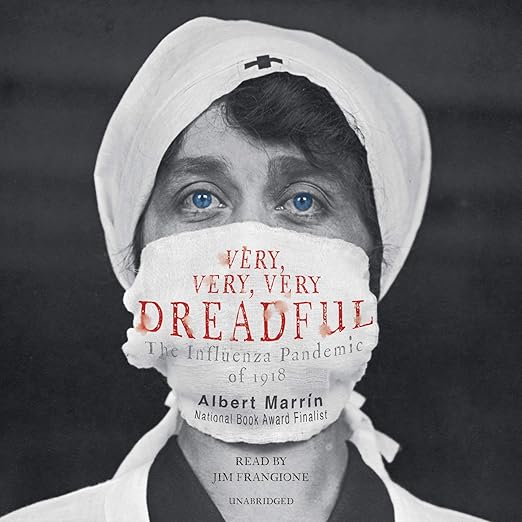
I picked up Very, Very, Very Dreadful during the first spring of COVID-19, along with what seemed like half the English-speaking world. Albert Marrin had written it in 2018, a century after the events it describes, and it arrived in bookstores with what felt like terrible timing that turned out to be perfect timing. I returned to the audiobook recently to hear how it reads without the specific anxiety of a live pandemic pressing on every paragraph. It holds up, and in some ways is more disturbing at a remove.
The subject is the 1918 influenza pandemic, which Marrin calls by far the worst disease that has ever afflicted humankind. He does not hedge this claim. He establishes it by comparison: not even the Black Death comes close in sheer numbers. Five hundred million people infected, roughly one-third of the global population. Between fifty and one hundred million dead. These figures are not approximate because they cannot be. The full toll will never be known, and that unknowability is part of what Marrin wants his readers to feel.
Our Take on Very, Very, Very Dreadful
Marrin is a National Book Award finalist who writes nonfiction for young adults with a rigor that does not condescend. He is willing to describe, often in disturbing detail as one reviewer put it, both the medical reality of the disease and the social devastation it produced. The opening setting at Fort Riley, Kansas, in spring of 1918, grounds an abstract catastrophe in a specific place and moment. The tracing of the second wave through the summer and into the fall, as it exploded from highly contagious epidemic into pandemic and began killing more soldiers than warfare itself, has a narrative clarity that serves both historical understanding and emotional impact.
One reviewer with an epidemiology background called it a fantastic read for the general population, a nice mix of history and science without heavy technical language. That balance is real and is one of Marrin’s core achievements here. He is not oversimplifying; he is translating. Another reviewer who read it to homeschooled middle-school children noted its relevance to the COVID reality they were then living through. The prediction of future pandemics embedded in the text, written in 2017-2018, reads as chillingly as prophecy.
Why Listen to Very, Very, Very Dreadful
Jim Frangione is a reliable narrator for serious nonfiction aimed at younger audiences, and he brings appropriate gravity to a subject that could easily be overdramatized. The weight of the material does not require theatrical emphasis, and he does not provide it. Listening Library’s production quality is solid. The book was recognized as a Chicago Public Library Best Book of the Year, which reflects a broad critical consensus about its quality and accessibility.
The framing for a teen audience is honest rather than protective. Marrin does not spare the horror of what the pandemic did to human bodies and communities. One reviewer explicitly noted that the title is absolutely suitable for older adults, not just the younger readers it is positioned for. The subject matter, the scale of the catastrophe, and the quality of the analysis make this genuinely useful for any listener willing to engage with pandemic history as a serious topic.
What to Watch For in Very, Very, Very Dreadful
The World War I context occupies a significant portion of the book, more than some reviewers expected. One reviewer noted that there is a lot of historical information regarding the events leading up to the 1918 pandemic, especially about the war. This is a genuine structural characteristic of the book: Marrin argues that the war was not merely context but causation, and he makes the case at length. Listeners who want pandemic science without the military history will find themselves with more of the latter than they anticipated.
The H5N1 bird flu material, included as a chapter on potential future pandemics, was noted as informative by one reviewer but reads now as a specific prediction that unfolded differently than Marrin anticipated. COVID arrived before avian influenza became the feared pandemic, which adds an interesting layer to the book’s final sections for post-2020 listeners.
Who Should Listen to Very, Very, Very Dreadful
Middle school and high school students studying the First World War, pandemic history, or public health will find this a compelling entry point that connects both subjects. Adults who came to it during COVID and want to return with fresh perspective will find it reads differently and more deeply in retrospect. Homeschool families covering twentieth-century history who want rigorous nonfiction that does not sanitize its subject will find this ideal. Listeners who want the science without the military history context should adjust expectations; Marrin argues these are inseparable.
Frequently Asked Questions
Is Very, Very, Very Dreadful primarily a science book about influenza or a history book about World War I?
It is both, and Marrin argues that they cannot be separated. The war created the conditions for the pandemic to spread and kill at the scale it did. Readers expecting one without the other will find the book’s structure more balanced toward military-social history than a pure epidemiology account.
How does the 2018 publication date affect the book’s relevance for post-COVID listeners?
Significantly. Marrin’s predictions about future pandemic risk read as prophetic in retrospect, and his analysis of why the 1918 pandemic was so devastating maps onto COVID-19 dynamics in ways he did not anticipate but that are now legible. The book is more, not less, relevant after 2020.
Is Jim Frangione’s narration appropriate for the graphic medical content Marrin includes?
Yes. Frangione maintains a steady gravity throughout, which is the right approach for material that includes disturbing descriptions of disease progression. He does not dramatize the horror but does not minimize it either.
One reviewer said this is suitable for adults as well as teens. How demanding is the content level?
The writing is designed for younger readers but does not simplify to the point of condescension. An adult reader with a background in history or public health will find the content substantive. The reviewer with an epidemiology background called it a fantastic read, which is a meaningful endorsement of its intellectual seriousness.