Quick Take
- Narration: Jennifer Hale is an exceptional choice, her range across the Foxfire cast gives each character genuine distinction, and she captures both the folk horror eeriness and the warmth of the community Verity discovers.
- Themes: Power and its limits, belonging and outsider identity, Appalachian folk magic and community
- Mood: Atmospheric and quietly eerie, with genuine emotional depth beneath the adventure surface
- Verdict: A debut that earns the Ghibli comparison not as marketing but as accurate description, beautifully crafted, emotionally intelligent YA fantasy with a setting that does serious work.
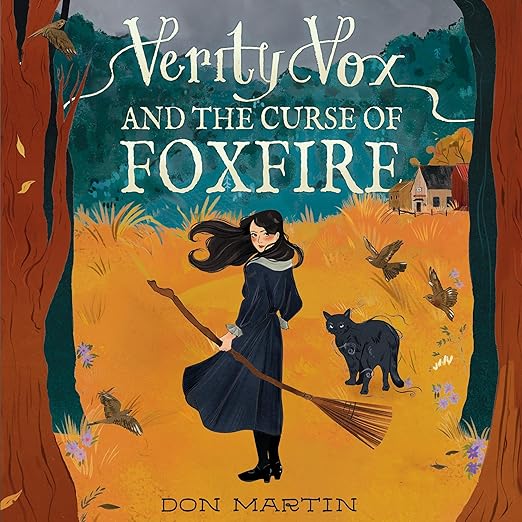
I was halfway through my morning commute when the opening rules of Foxfire stopped me mid-step on the platform: do not look in the trees, do not whistle in the woods at night, do not answer if you hear your name called, and remember, everything wants. I had been reading middle-grade and YA fantasy alongside adult literary fiction for years, and those four instructions told me immediately that Don Martin understood something specific about how folk horror works: the rules are not decoration. They are the world’s logic, and the stakes are exactly as high as what happens when they are broken.
I listened to the remaining eight hours over the next three days, finishing on a quiet Friday evening with that particular reluctance you feel when a fictional world has become more vivid than expected.
Our Take on Verity Vox and the Curse of Foxfire
Verity is a witch-in-training whose relationship to spells is confident bordering on overconfident, she has never met a problem magic could not solve, which is precisely the orientation a curse like Foxfire’s is designed to dismantle. The town is suffering in the specific way that curses work in folklore: not through dramatic violence but through slow, grinding diminishment. Crops will not grow. Treasured things fall apart. People go missing. The traveling magician who laid the curse is somewhere in the ancient Appalachian hills, and people desperate enough are still going to find him.
What separates this from generic YA fantasy is the setting’s depth. Multiple reviewers reached for the same Ghibli comparison, specifically Kiki’s Delivery Service, and it is accurate on two levels: the apprentice-learning-limits structure and the way the world around the protagonist has its own texture and weight independent of the plot. The town of Foxfire is not a backdrop. It is a community with specific relationships, specific histories, and specific ways of understanding the world that Verity has to learn to read before she can help. One reviewer described the Appalachian landscape as a surprisingly deep dive into the people who live there and a character of its own, which is exactly right.
Why Listen to Verity Vox as an Audiobook
Jennifer Hale’s narration is among the best YA performances I have heard in some time. She is best known as a video game voice actress, Commander Shepard in Mass Effect among dozens of other roles, and she brings that character-differentiation skill directly to the Foxfire cast. Verity sounds like a young witch who is confident and curious and occasionally wrong in ways she does not yet recognize. The Foxfire residents have their own voices, their own speech rhythms, their own relationship to the mountains. The magician, when he appears, sounds like something old and specific and patient.
The magic system is layered, Martin combines an apprenticeship model with song-based spell-casting, larger-on-the-inside spatial logic, and trickster bargain conventions, and Hale makes the different registers of magic audibly distinct. The shapeshifter familiar Jack be Nimble, singled out by reviewers as a particular delight, has a presence in Hale’s hands that the written text probably cannot quite replicate.
What to Watch For in Verity Vox and the Curse of Foxfire
The book’s pace in the first act is deliberate, Martin wants you to understand Foxfire before you understand the curse, which means the town-establishment work comes before the plot accelerates. Listeners who need immediate propulsion may find the opening slower than the compelling rule-set of the first pages promises. The magic system is also complex enough that following it precisely through audio requires attention; it rewards active listening rather than having the audiobook as background. At nine hours, this is a committed listen for a YA novel, though the time feels earned by the ending.
Who Should Listen to Verity Vox and the Curse of Foxfire
YA readers who want fantasy rooted in genuine folklore tradition rather than generic secondary-world magic will find this exactly in their territory. Listeners who responded to the Ghibli comparison, particularly Kiki’s Delivery Service and the non-human world of Spirited Away, will find the tonal match accurate. Adult readers of YA literary fantasy, particularly those who enjoy Appalachian settings and folk horror aesthetics, will find this accessible and substantive. Children younger than twelve may find some of the atmospheric eeriness and the weight of the curse’s human cost more intense than expected.
Frequently Asked Questions
Is Jennifer Hale’s narration accessible to listeners who do not know her video game work?
Completely. Her skill translates directly, the character differentiation, tonal range, and emotional precision that make her exceptional as a voice actress are exactly what make this an outstanding audiobook performance. No gaming context is needed or relevant.
How accurate is the Ghibli comparison that appears in several reviews?
Very accurate for the mood and structural DNA. The apprentice-learning-limits arc mirrors Kiki’s Delivery Service specifically, and the way Foxfire operates as a community with its own logic and weight is reminiscent of how Ghibli films treat their worlds, as places with texture independent of the protagonist’s journey through them.
Does the Appalachian setting function as local color or does it genuinely shape the story’s magic and themes?
The setting is load-bearing, not decorative. The specific beliefs, superstitions, and community structures of the Appalachian town are the foundation of the curse’s logic and Verity’s challenge. Several reviewers with personal familiarity with the region noted that Martin handles it with respect and depth rather than as aesthetic backdrop.
Is this a standalone novel or the beginning of a series?
It appears to be a standalone, though the world of Foxfire is rich enough that readers have expressed hope for more stories set there. One reviewer specifically mentioned hoping for a return to the Foxfire world, which suggests the ending resolves the central story without leaving obvious sequel hooks.