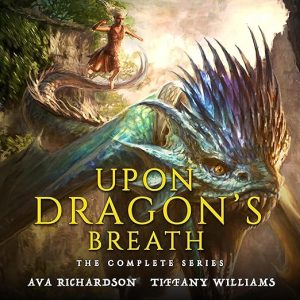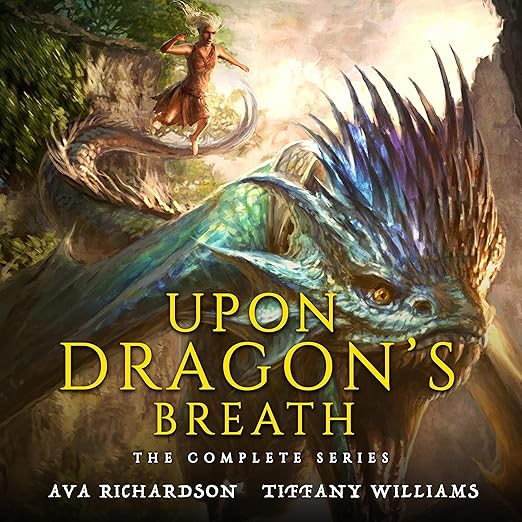
Saffron grows up in hiding, marked by a dragon affinity she can't explain to anyone who might report her to King Enric's men, and Upon Dragon's Breath Trilogy: The Complete Series opens from inside that fear before it ever gets to the rebellion. This audiobook bundles all three books of Ava Richardson's saga into one nearly 24-hour listen, following Saffron from exile into an uneasy alliance with Bower, the scholarly heir of a fallen noble house, as the two of them try to rebuild a broken bond between dragons and their Riders before Enric's magic finishes what it started.
How Upon Dragon's Breath Trilogy: The Complete Series Holds Up
This is comfort-food epic fantasy in the best sense: a wronged kingdom, a hidden magic bloodline, a prophecy, and two young leads who have to grow into power they didn't ask for. Richardson doesn't reinvent the dragon-rider template so much as execute it with real confidence across three full books' worth of material, and reviewer Colleen's response captures the target experience precisely: 'the characters were realistic, the world building very believable, the plot exciting.' That's not a description of anything experimental, it's a description of a trilogy that knows exactly what its readers came for and delivers it without irony.
Reviewer Kindle CustomerBrandora77 lays out the stakes clearly: King Enric has 'all but destroyed the former glory of Torvald,' hunting the dragons themselves nearly to extinction and banning even books that record their history. That detail, a kingdom criminalizing its own memory of dragons, gives the worldbuilding a sharper edge than a generic evil-king setup usually earns, since the central conflict isn't just about defeating Enric but about whether Torvald can even remember what it's fighting to restore.
Richardson is a genuinely prolific voice in YA dragon fantasy specifically, with multiple series built around a similar core appeal: exiled or hidden dragon-bonded protagonists reclaiming a broken magical order. That prolificacy shows up as a strength here rather than a weakness, this is a writer with real experience pacing a dragon-rider plot across a full trilogy arc, not someone attempting the structure for the first time. The synopsis's own closing line, promising a story that will keep listeners 'spellbound until the final tick,' swaps the more common 'final page' for something that reads as a small, almost musical flourish, fitting for a saga this committed to its own mythology.
Saffron's arc carries a genuine temptation the synopsis names outright: she can 'seize power for herself' rather than fight for shared freedom, which gives her a real corruption risk most YA chosen-one narratives sand down into a foregone conclusion. That open question, whether the girl raised in hiding chooses solidarity or supremacy once she actually has power, is a sharper thematic engine than the standard good-versus-evil dragon-rider setup usually offers, worth listening for how much genuine doubt Richardson lets Saffron sit with before the trilogy resolves it.
Why Upon Dragon's Breath Trilogy: The Complete Series Works as an Audiobook
The scale here is the real selling point: this is the complete trilogy in one audiobook, nearly 24 hours across all three books, which means no cliffhanger waits between volumes and no separate purchases to track down the ending. For a genre where readers often complain about being left hanging between installments, a single bundled listen removes that friction entirely, and the November 2024 expanded republication adds more material rather than just repackaging the original three books as-is.
Saffron and Bower's dynamic carries the emotional throughline across all three books: a hidden dragon-affinity exile paired with a scholarly noble heir is a classic opposites-drawn-together setup, but the synopsis is clear that their alliance stays 'fragile' even as the stakes rise, which suggests Richardson resists an easy, uncomplicated romance in favor of real friction between two people who don't agree on tactics. That tension, fight for shared freedom or seize power alone, gives Saffron a real character choice to make rather than a foregone conclusion, and it's the kind of internal conflict that benefits from a long, continuous listen rather than scattered reading sessions.
The found-alliance structure at the center of the trilogy gives the story two very different entry points into the same conflict: Saffron experiences Enric's tyranny as direct, personal danger, while Bower experiences it as inherited responsibility from a fallen house. That dual perspective lets Richardson explore both the visceral and the political costs of Enric's rule without either character feeling redundant, and it sets up the alliance's eventual fractures, doubts and division threatening their bond as battle looms, as a real structural payoff rather than a last-minute manufactured obstacle.
Weak Spots in Upon Dragon's Breath Trilogy: The Complete Series
Not every reader stays fully on board for all three books. Reviewer Doug liked 'book one and the 1st half of book 2' but found the main characters 'way too whiny by Book 3,' specifically calling out a repetitive emotional loop: insecurity, 'I'm not good enough,' swinging into defensiveness, 'how dare he or she question me,' every few pages. That's a real, specific craft complaint worth taking seriously for a trilogy this long, since 24 hours of listening asks a lot of patience if a listener's tolerance for that particular character rhythm runs low.
The 'complete series' framing is worth double-checking against whatever edition a listener already owns: since this bundles three previously separate books into one nearly 24-hour audiobook, anyone who already purchased the individual volumes will mostly be revisiting familiar material, expanded republication aside. New listeners get the opposite advantage, one continuous saga without a break, but should budget accordingly: this isn't a quick weekend fantasy, it's a genuine multi-day commitment even for a fast listener.
Tiffany Williams narrates without a confirmed prior track record in this specific catalog, worth naming honestly for a nearly 24-hour listen: a single narrator sustaining a large cast, Saffron, Bower, Enric, assorted trainees and nobles, across three full books is a real technical demand regardless of how it plays out here. Listeners who care deeply about vocal character differentiation across a long series should treat this as an open question rather than a confirmed strength, the same caution already worth applying to Doug's book-three fatigue complaint.
The Right Listener for Upon Dragon's Breath Trilogy: The Complete Series
YA fantasy readers who want dragons, rebellion, and a slow-building central partnership are the clear audience here, especially anyone who wants an entire trilogy's arc without waiting on sequels. Fans of Ava Richardson's other dragon-focused series will recognize her comfort with this exact territory, and listeners who specifically enjoy found-power, hidden-bloodline stories will find Saffron's arc familiar in the best way.
Readers who found Doug's complaint about repetitive teen angst a dealbreaker in other YA fantasy should go in with tempered expectations for book three specifically, since that's exactly where his patience wore thin. Anyone who already owns the trilogy as separate volumes should also confirm this bundle actually adds the promised new material before assuming it's simply the same three books repackaged.
A Few Questions About Upon Dragon's Breath Trilogy: The Complete Series
Does this audiobook include all three books in the trilogy?
Yes, it bundles all three books of Ava Richardson's saga into one continuous audiobook running nearly 24 hours, removing any need to purchase separate volumes.
How long is the complete trilogy audiobook?
The full bundle runs 23 hours and 56 minutes across all three books.