Quick Take
- Narration: Dyson self-narrates, and his oratorical voice, practiced, warm, authoritative, makes the material feel like an address to a room rather than a textbook being read aloud.
- Themes: Racial inequality, historical resistance, civic responsibility
- Mood: Urgent and clarifying, structured like an argument you cannot put down
- Verdict: One of the more compelling introductions to American racial history available in audio, Dyson narrating his own work gives it the weight of testimony.
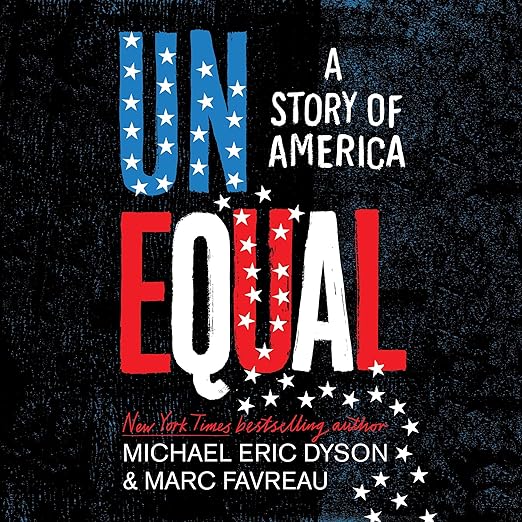
I came to Unequal sideways, I had been listening to a lot of dense historical nonfiction and wanted something that would cover similar territory without requiring a spreadsheet to follow the argument. A colleague recommended it specifically because Dyson narrates it himself, and that detail turned out to matter more than I expected. There is a difference between reading about Mary Church Terrell fighting Jim Crow segregation and hearing Michael Eric Dyson tell you that story in his own voice. The text becomes something closer to an oral tradition.
The book is framed as YA, Dyson’s debut in that category, co-written with Marc Favreau, but readers of any age come away from reviews noting that the label undersells it. Twenty chapters profile African American figures who refused the terms of racial inequality: from Terrell and Ida B. Wells in the early twentieth century through to the structures that maintain disadvantage today. The framing is deliberate: history as prologue. What happened is not background; it is the explanation for where we are.
Our Take on Unequal
What distinguishes Unequal from survey histories of American racism is the framework it offers alongside the narrative. Dyson and Favreau are not only telling you what happened, they are asking you to consider what agency looks like inside structural inequality. Each profile is chosen not just for historical significance but for what the person’s life demonstrates about resistance as a practice. The book closes with a question about what readers can do in their own lives, which lands differently at sixteen than at forty-five but is a worthwhile question at either age.
The self-narration is the production decision that elevates this above a competent adaptation. Dyson is one of the most practiced public intellectuals in American life, he has spent decades translating complex social thought for large audiences, and that experience is audible in how he handles the text. He does not read to you; he addresses you. The difference in register makes material that could feel like a civics lesson feel instead like an invitation into a conversation that matters.
Why Listen to Unequal
The reviews are uniformly strong, and the language reviewers reach for is consistent: essential, important, memorable, truth-telling. One reviewer catalogued all twenty chapter subjects by name, which is not what a reader does with a book they found forgettable. Another described learning history they had never encountered before despite being interested in the subject for years, that is the signal that Dyson and Favreau are doing archival work in accessible form rather than retreading the familiar.
At just under seven hours the audiobook fits in a long weekend or a week of commutes. The chapter structure makes it easy to listen in segments without losing the thread. Because each chapter centers on a specific historical figure, you can pause after one story and pick up cleanly with the next. That modular quality is a genuine advantage over long-form historical arguments that require sustained continuity across hundreds of pages.
What to Watch For in Unequal
The YA label may lead some adult readers to assume the book has been simplified for accessibility in ways that would diminish it. That assumption is wrong. The prose is clear and the argument is accessible, but neither Dyson nor Favreau has flattened the complexity of what they are describing. The twenty-chapter structure also means individual profiles are necessarily condensed, readers who want deep dives into specific figures like Ida B. Wells will find this a gateway rather than a destination.
This is not a neutral text. Dyson writes from a clear position about the reality of racial inequality and the urgency of addressing it. Readers who are not prepared to engage with that position as a starting point rather than a conclusion will find the framing uncomfortable. That is not a flaw, it is exactly what the book is doing. But it is worth knowing before you begin.
Who Should Listen to Unequal
This belongs in the libraries of high school students, college students, and adults who want a structured entry into American racial history. It is also a strong choice for parents or educators looking for something that takes young adults seriously while remaining genuinely readable. If you are already deeply versed in this history, Unequal may cover familiar ground, though Dyson’s narration alone is worth the time. If this is new territory, it is close to the best possible place to start.
Frequently Asked Questions
Is Unequal appropriate for actual young adult readers or is it effectively an adult book?
It genuinely works for the YA audience it targets, roughly ages 13 and up. Adult readers consistently report finding it substantive and not simplified. Both audiences are served well.
Does Michael Eric Dyson’s oratorical style translate well to the audiobook format?
Exceptionally well. Dyson is a practiced public speaker and the self-narration gives the book a presence that a third-party narrator would likely not replicate. It sounds like testimony rather than a read-aloud.
How does Unequal handle the historical figures it profiles, as heroes or as complex people?
The profiles are respectful but not hagiographic. The emphasis is on what each person’s choices and circumstances reveal about the structures they were resisting, rather than presenting them as uncomplicated icons.
Does the book cover recent events or stay with historical figures?
The book is grounded in history but explicitly frames it as prologue to the present. It connects historical patterns to contemporary inequality rather than treating the past as resolved.