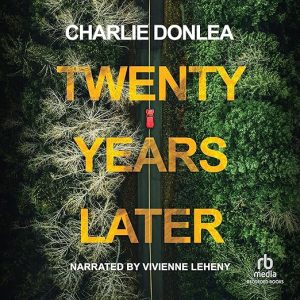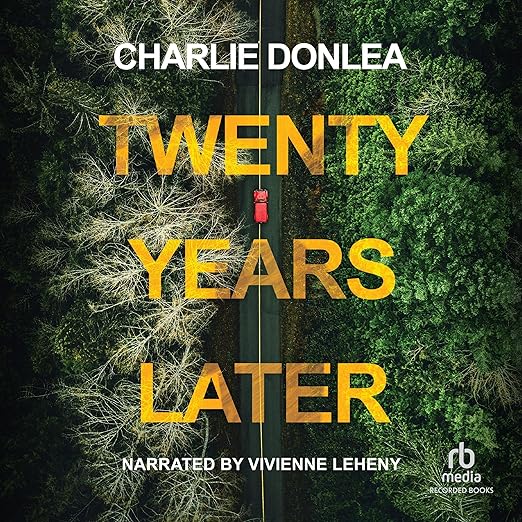
- Narrator: Vivienne Leheny handles the dual-timeline structure cleanly, giving Avery Mason a credible professional authority and shifting gears well when the personal stakes escalate.
- Subjects: Truth buried by tragedy, secrets with long half-lives, identity under pressure
- Tone: Tense and layered, with a pace that rewards patience
- Bottom line: A well-constructed thriller with a genuinely surprising final act; Charlie Donlea earns his reputation for twists that land rather than merely arrive.
I started Twenty Years Later on a Sunday afternoon intending to listen to an hour and then stop. I was halfway through by midnight. I am not sure exactly when the book stopped being a background listen and became the only thing in the room, but I know it happened somewhere around the midpoint, when a detail I had half-registered two hours earlier snapped into focus and I realized Donlea had been building toward something I had completely failed to see coming.
The premise is arresting: new DNA technology allows the New York medical examiner to make the first successful identification of a 9/11 victim in years. The victim, Victoria Ford, had been accused of murdering her married lover before she died in the North Tower, and her sister Emma has spent twenty years trying to clear her name. TV journalist Avery Mason takes the story, sees the ratings potential, and begins to pull on threads that have been quietly unraveling for two decades. What Avery does not know, and what the reader understands is coming, is that someone is pulling on her threads too.
Charlie Donlea is a writer who trusts his structure. This is not a thriller that announces its cleverness loudly or signals its twists with the kind of atmospheric heavy weather that less confident writers reach for. The plot mechanics are tight, the dual narrative strand, Avery's present-day investigation and the reconstruction of what actually happened to Victoria, is managed with real economy. Nothing is wasted. Details that seem incidental in the first act are doing work you will only understand in the third, and that kind of careful construction is rarer than it should be in the genre.
The 9/11 framing is handled with more sensitivity than I expected. Donlea does not use the tragedy as scenery. Victoria's final phone call from the North Tower, begging her sister to prove her innocence, is presented as something that has defined Emma Kind's life for twenty years, and the novel takes that weight seriously. The plot mechanics involving the DNA identification are grounded in real forensic science, the medical examiner has been making new identifications of 9/11 victims using advanced technology decades after the attacks, which is a fact that gives the novel's premise genuine gravity rather than mere plausibility.
Why Twenty Years Later Works as an Audiobook
Vivienne Leheny's narration is one of the better thriller performances I have heard in a while. Avery Mason is written as a professional television journalist with the particular combination of ambition and social intelligence that role requires, and Leheny captures that without making the character likable in an uncomplicated way. Avery has secrets of her own, and Leheny allows just enough edge into the performance to keep you uncertain about how much to trust her. That uncertainty is essential to the novel's design.
Multiple reviewers noted that the audiobook format worked especially well for this particular story, which makes sense. The dual-timeline structure, Victoria's story in 2001 against Avery's investigation in 2021, benefits from having a consistent voice anchor both timelines, and Leheny does that work well. The transition between time periods is clear without being mechanical. Listeners who find timeline-juggling challenging in print will find the audio format helpful here.
Weak Spots in Twenty Years Later
There is a mid-book section involving several layers of simultaneous investigation that requires some attention. Donlea introduces enough characters across enough institutional contexts, the medical examiner's office, the television network, the Catskills community around the original crime scene, that the architecture can feel briefly overloaded. One reviewer noted that there are quite a few characters to track, which is accurate. This is a novel that benefits from sustained listening sessions rather than fragmented twenty-minute chunks, because the connective tissue between plot threads needs to remain fresh in memory for the payoffs to register properly.
The ending generated consistent praise for being genuinely unexpected. I will not speak to specifics, but I will confirm that the twist is not the kind that retroactively cheapens what preceded it. Donlea plays fair. The pieces were there. You were simply looking at them wrong, which is the proper relationship between a thriller writer and their reader.
The Right Listener for Twenty Years Later
Readers who enjoy thrillers with genuine structural ambition and a real commitment to fair-play mystery mechanics will find this satisfying. It sits comfortably alongside Lisa Unger and Allen Eskens, writers who invest in psychological depth without sacrificing narrative momentum. The 9/11 context gives it a specific emotional gravity that distinguishes it from more generic conspiracy thrillers.
Skip it if you prefer thrillers that prioritize atmosphere over architecture, or if timeline-switching narratives frustrate you. This is a puzzle box of a novel, and it works best for listeners willing to stay attentive across nearly eleven hours of deliberate construction.