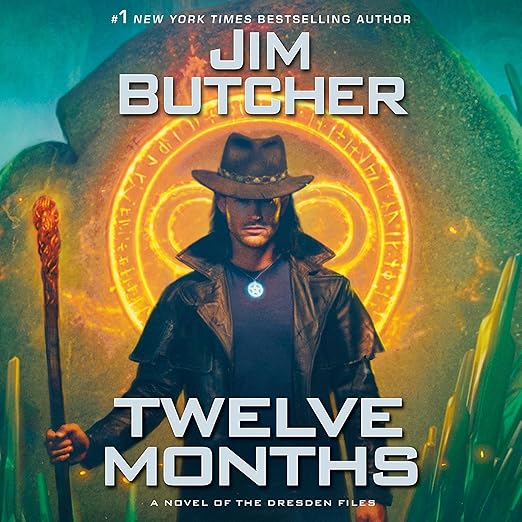
Quick Take
- Narration: James Marsters returns as Harry Dresden with the same lived-in authority he has brought to this series for two decades, his performance is the reason to listen rather than read.
- Themes: Grief and recovery, duty vs. self-preservation, the cost of heroism
- Mood: Reflective and emotionally heavy, with pulses of the series’ signature dry wit
- Verdict: A necessary but quieter entry in the Dresden Files that prioritizes character depth over set-piece action, essential for series followers, a poor starting point for newcomers.
I finished Twelve Months on a cold Thursday evening after starting it the day before. That pace tells you something: at nearly seventeen hours, this is one of the longer Dresden Files entries, and yet it moves with a different rhythm than the books that preceded it. I have been following Harry Dresden since Storm Front, and I came into this one knowing that Battle Ground had left the world of the series genuinely shattered, Chicago leveled, friends dead, Harry himself carrying the kind of grief that does not resolve in a single book. Jim Butcher does not let it resolve here either, and that decision is either the most interesting thing about Twelve Months or its central frustration, depending on where you are in your relationship with this series.
James Marsters is so completely Harry Dresden at this point that it is difficult to imagine anyone else in the role. His narration is not neutral voice acting, it is a performance with genuine emotional investment, and that investment is exactly what this book needs. The sections dealing with Harry’s internal processing of his losses from Battle Ground require a narrator who can carry vulnerability without making it feel like weakness, and Marsters does that consistently over nearly seventeen hours. It is an impressive performance even by his standards.
Our Take on Twelve Months
Butcher has described this book as a recovery novel, and that framing is accurate. The plot mechanics are present, ghouls hunting Chicago’s civilians, Harry’s brother Thomas dying, a politically charged betrothal to vampire Lara Raith that will have long consequences, but none of these feel like the book’s real subject. The real subject is what it costs Harry to keep functioning after profound loss, and how the people around him navigate their own versions of that cost in a city that now knows the supernatural is real.
One review describes the book as more reflective, meditative, and slower paced, and that is accurate without being a criticism. The Chicago that Harry moves through here is a city in the process of understanding what happened to it, which gives the book an unusual texture, urban fantasy that functions more like literary fiction in its interest in the aftermath of violence rather than the violence itself.
Why Listen to This Audiobook
The honest answer for series readers is that Marsters is the reason this book belongs in audio form specifically. His handling of Harry’s internal monologue has always been the performance heart of the Dresden Files, and in a book this focused on interior states, that is more true than ever. There are scenes in Twelve Months, conversations with Karrin, moments with Maggie, the scenes involving Thomas, where the emotional weight would land differently on a silent page. Marsters earns those scenes.
For listeners new to the series: do not start here. Multiple reviewers specifically recommend beginning with Storm Front. Twelve Months assumes complete familiarity with eighteen books of continuity, and the emotional payoffs require that investment. Listened to cold, this is a book about a wizard dealing with grief in a ruined city, listened to after seventeen prior books, it is something more resonant.
What to Watch For in This Audiobook
The book sets up what Butcher has indicated will be an apocalyptic trilogy to end the series, and one reviewer notes being able to see those tracks being laid even while reading. Some listeners will find that forward momentum satisfying, the sense of pieces being positioned. Others, who came in expecting the propulsive action of Changes or Peace Talks, will feel the slower pace as a letdown.
One review describes the book as a little vanilla relative to the last two entries, which is a fair criticism if you are measuring against Battle Ground specifically. That was one of the most action-dense books Butcher has written. A deliberate deceleration after that is artistically defensible, but it is a choice that some readers will not share.
Who Should Listen to This Audiobook
Twelve Months is for Dresden Files readers who have made it to at least Peace Talks and Battle Ground and want to see how Butcher handles the aftermath of those events. It rewards patience and emotional investment in Harry as a character rather than Harry as an action figure. Listeners who want a self-contained urban fantasy listen, or who are anywhere before book fifteen in the series, should wait and come back to this one after catching up.
Frequently Asked Questions
Does Twelve Months work as a standalone listen, or do I need to have read the previous Dresden Files books?
It does not work as a standalone. The emotional and narrative stakes depend entirely on the prior seventeen books, particularly Changes, Peace Talks, and Battle Ground. Butcher himself would recommend starting with Storm Front.
Is James Marsters’s performance in this book comparable to his earlier Dresden Files narrations?
Yes, and for this particular book his performance may be his best in the series. The reflective and emotionally heavier material gives him more range to work with than the action-heavy entries, and he handles it with the same authority he has built over nearly two decades with the character.
How much of the plot is setup for future books versus self-contained story?
Quite a bit is setup. The ghoul threat, the Thomas subplot, and especially the Lara Raith betrothal all read as groundwork for what Butcher has described as an apocalyptic trilogy. This is a bridge book that ends in a position rather than a resolution.
Is the slower pace of Twelve Months a deliberate artistic choice or a pacing problem?
Deliberately artistic, based on what Butcher has said publicly and what the structure of the book itself suggests. After the destruction of Battle Ground, a recovery novel that sits with grief rather than sprinting past it is a defensible creative decision. Whether it satisfies depends on what you want from this series.