Quick Take
- Narration: Damaras Obi gives Lynda Blackmon Lowery’s young voice an appropriate immediacy and emotional directness that serves the first-person memoir well.
- Themes: Youth activism, nonviolent resistance, the personal cost of civil courage
- Mood: Urgent and quietly heroic, with a clarity that makes the history feel immediate rather than historical
- Verdict: A vital, brief, and honestly moving account of the Selma-to-Montgomery march from the youngest participant, essential for young readers and adults alike.
I finished Turning 15 on the Road to Freedom in a single hour, it is a short book, by design, and then I sat with it for a while. Not because the ending left things unresolved, but because the beginning does something that is surprisingly rare in civil rights literature aimed at young readers: it opens by telling you, without drama or performance, that by the age of fifteen, Lynda Blackmon Lowery had been in jail nine times. The sentence is a fact, delivered plainly, and the book that follows holds to that same register. It does not tell you how to feel. It tells you what happened, and trusts you to arrive at the feeling yourself.
Damaras Obi’s narration captures that plainness without draining the story of emotion. The young narrator’s voice Obi constructs is not childlike or simplified, Lowery’s perspective is a fifteen-year-old’s in the sense that it is immediate and specific, not in the sense that it is naive. Obi preserves the firsthand quality of the account while giving it an authority that keeps the listener from treating it as a historical curiosity.
Our Take on Turning 15 on the Road to Freedom
The book’s brevity is not a concession to its young adult audience but a feature of the testimony itself. Lowery is not writing about the Civil Rights Movement in the abstract. She is writing about her experience of specific events, the Bloody Sunday protest, the march from Selma to Montgomery, the police violence that was used against nonviolent demonstrators, and the community of pastors, parents, teachers, and fellow young people who sustained the movement from inside. The scope is deliberately narrow, and that narrowness creates intensity rather than limitation.
What the book adds to the well-documented historical record is the texture of lived adolescence inside a movement. Lowery was not participating as an adult decision-maker or a professional organizer. She was a teenager who grew up in a specific community in Selma where resistance to segregation was part of the fabric of daily life, where the church was a political institution as much as a religious one, and where her nine jailings before age fifteen were not anomalous but part of a pattern of organized, strategic confrontation with an unjust system. That context, the close-knit community structure that made youth participation possible and supported it, is something that broader histories often flatten into iconic images and named leaders.
Why Listen to Turning 15 on the Road to Freedom
Because it gives Bloody Sunday a specific face and a specific voice. One reviewer in their sixties noted that they were too young to see these events on the news when they occurred and that Lowery’s account gave them a way into the history that more comprehensive histories had not quite managed. The personal register of memoir does something that analytical history cannot: it makes the individual’s physical experience of violence and fear and solidarity impossible to hold at arm’s length.
The book is also explicitly designed for young readers in a way that respects rather than simplifies its subject. The language is clear and direct, the content includes violence that is accurately described without being gratuitous, and the arc of Lowery’s story ends not with easy triumph but with a hard-won acknowledgment of what was achieved and what it cost. One reviewer noted that kids will relate to the characters, which is true, though it undersells how much adults without direct knowledge of this history will find themselves relating as well.
What to Watch For in Turning 15 on the Road to Freedom
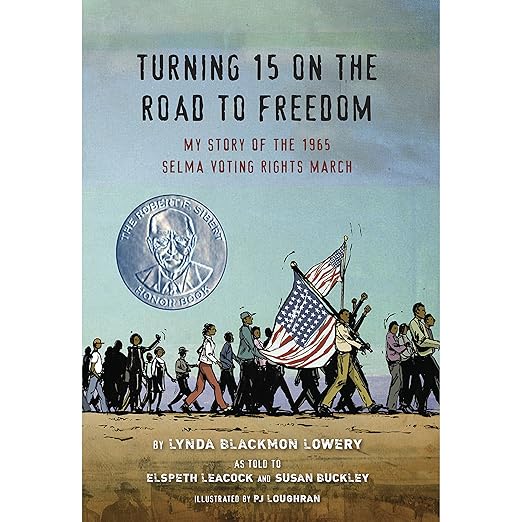
The book is an hour long. For listeners accustomed to longer audiobooks, this is worth knowing in advance rather than discovering mid-commute. At that length, it functions more as an extended spoken essay or a long short story than a conventional memoir. The illustrations from the print edition do not translate to audio, which means some of the visual texture that reviewers praised in the book format is absent here.
The scope is also deliberately personal rather than comprehensive. If you want a full historical account of the Selma-to-Montgomery marches, their political context, the legislative outcome, and the movement’s broader strategy, you will want to supplement this with additional reading. Lowery is not writing a history; she is bearing witness. Those are different and equally valuable things.
Who Should Listen to Turning 15 on the Road to Freedom
Young adult listeners encountering the Civil Rights Movement for the first time will find this an approachable and affecting entry point. Teachers looking for supplementary audio for history or civics classes will find it well-calibrated to classroom use. Adults who consider themselves familiar with this period of American history and who want to hear it from a perspective that the big names and big events have tended to occlude will find something genuinely new here. This is a book for anyone who wants to understand not just what the march was but what it felt like to be the youngest person in it.
Frequently Asked Questions
Is this audiobook appropriate for younger listeners, given the violence described in the memoir?
Yes. The book describes the violence of Bloody Sunday and police confrontations honestly but without graphic detail. It is designed for young adult readers and handles difficult content in a way that is accurate and emotionally appropriate rather than sanitized or gratuitous.
Does the audiobook include the illustrations from the print edition?
No. The illustrations that complement the printed version are not included in the audio format. The narration is complete and self-contained, but some of the visual documentary quality of the book format is absent.
How does Damaras Obi’s narration handle the emotional intensity of events like Bloody Sunday?
Obi matches Lowery’s own register, direct, factual, and deeply felt without being performative. The narration lets the events carry their own weight rather than amplifying them with interpretive emotion, which is the right approach for testimony of this kind.
At one hour, does this audiobook feel complete or abridged?
It is the full text of the memoir, which was written at this length deliberately. Lowery’s account is focused rather than truncated, she tells one specific story about a specific period in her life, and the brevity reflects that intentional scope rather than editorial cutting.