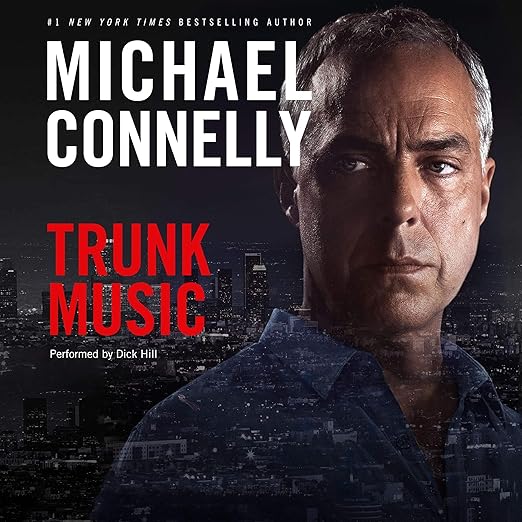
Quick Take
- Narration: Dick Hill is a reliable Bosch narrator, steady and controlled, with enough gravel in his delivery to suit Harry’s particular brand of dogged exhaustion
- Themes: Organized crime and LAPD corruption, the cost of obsession, the blurring of personal and professional entanglement
- Mood: Taut and procedural, with an unexpected romantic thread that complicates the investigation
- Verdict: A mid-series Connelly entry that deepens Harry’s personal mythology while delivering a genuinely complex investigation, best read in sequence but rewarding enough to justify starting here.
There is a particular pleasure in discovering a series you can trust. I was somewhere around book three of the Harry Bosch series when I understood that Michael Connelly is not the kind of crime writer who provides the satisfactions of puzzle and resolution and then moves on, Bosch is the kind of character who accumulates damage, who carries what has happened to him into every subsequent case, and whose investigations are partly about the case and partly about the man who cannot stop working them. Trunk Music, the fifth installment, is where that accumulated weight becomes most visible so far in the series.
At 12 hours and 41 minutes, narrated by Dick Hill for Brilliance Audio, this is a solidly mid-length Connelly, not his most expansive but comfortably full. Harry, recently returned from an involuntary leave of absence, catches a body in the trunk of a Rolls-Royce in the Hollywood Hills. The victim is a film producer. The wound pattern looks like organized crime, what the LAPD calls “trunk music,” a Mafia hit signature. What complicates the case almost immediately is that the LAPD’s organized crime unit seems conspicuously uninterested in helping.
Our Take on Trunk Music
The investigation moves from Los Angeles to Las Vegas, and with it the texture of the book shifts. Connelly is very good at Los Angeles, he has spent enough time with the city’s hierarchies and geographies that the LAPD procedural elements feel lived-in rather than researched. Las Vegas in his hands is something different: a city of strategic opacity, where money laundering for organized crime is so normalized it becomes wallpaper, and where the connections between gambling debts and Hollywood finance are almost too obvious to be suspicious. That deliberate obviousness is a trap Connelly sets with considerable skill.
The romantic subplot, a rekindled connection with an old girlfriend who turns out to be entangled in the investigation, is where the book does something that Connelly doesn’t always risk. Harry’s personal entanglement creates a genuine conflict between what he wants to believe and what the evidence is telling him, and that conflict is handled with more psychological precision than you might expect from a straight crime procedural. One reviewer described it as a book where Harry “has to start over” once he realizes the shape he thought the investigation had is wrong, and that reversal is one of the series’ better structural turns.
Why Listen to Trunk Music
Dick Hill’s narration is a good match for Harry Bosch. Hill finds the right register: controlled, slightly weary, with the dry competence of a detective who has been doing this long enough that nothing shocks him and everything still bothers him. The distinction between those two states, unshockable versus unbothered, is where Bosch lives, and Hill captures it without overplaying the tortured-cop archetype. His Los Angeles voice and his Las Vegas voice are subtly different, which is exactly right: Harry is at home in one city and navigating the other.
One reviewer compared Connelly’s Bosch to the Joe Friday archetype from Dragnet, which is a useful shorthand for a certain kind of detective, methodical, ethically rigid, doing the job when others have decided the job isn’t worth doing. But Bosch is considerably more complex than Friday, and Hill’s performance allows for that complexity without announcing it.
What to Watch For in Trunk Music
The investigation’s structure is more intricate than it initially appears. Connelly builds in an early solution that turns out to be wrong, and the pivot, the moment when Harry’s assumptions about the case collapse and he has to rebuild from scratch, is the book’s most satisfying structural moment. Watch for the organized crime unit’s specific form of obstruction; it is not the crude corruption of lesser crime fiction but something more insidious and institutionally comprehensible.
The rekindled romance deserves attention as a character development rather than just a plot complication. By book five, Connelly is clearly thinking about what sustained commitment does to Harry, whether someone this dedicated to the dead can sustain anything for the living. Trunk Music asks that question more directly than its predecessors.
Who Should Listen to Trunk Music
Series readers will find this one of the more rewarding mid-period Bosch entries, the investigation is strong, the personal stakes are higher than usual, and the Las Vegas detour gives the book a texture that the Los Angeles-centered entries sometimes lack. Starting here cold is possible; Connelly writes each book to function independently, and Hill’s narration holds the character together even for first-timers. But the weight of Harry’s history matters more in this book than in some others, and listeners who have followed from book one will get more from the romantic subplot.
Not recommended for readers who want clean, comfortable crime fiction, Connelly’s investigations leave residue, and Harry’s methods of getting to the truth are not always sanctioned. If you want tidy, look elsewhere. If you want real, this is as real as crime fiction gets.
Frequently Asked Questions
Does Trunk Music work as a standalone for someone new to the Harry Bosch series, or is prior reading required?
It functions as a standalone in the sense that Connelly provides enough context to follow the investigation without prior knowledge. But Harry’s leave of absence that precedes this book, his accumulated personal history, and the emotional texture of the romantic subplot all carry more weight for readers who have followed the series. New listeners will enjoy the investigation; series readers will get the fuller picture.
How does Dick Hill’s narration compare to other Harry Bosch narrators who have performed the series over the years?
Hill is one of the most established Bosch narrators and has a loyal following among series listeners. His delivery suits Harry’s particular character, controlled, procedurally precise, carrying the weight of experience without melodrama. Listeners who have followed the series with Hill will find the continuity reassuring; those encountering the character for the first time will find his portrayal convincing.
Is the Las Vegas section of the book as well-rendered as Connelly’s usual Los Angeles material?
Different rather than lesser. Connelly’s Los Angeles has the texture of deep familiarity; his Las Vegas feels more deliberately constructed as a place of calculated opacity, which is appropriate to the story the book is telling. The city’s function in the plot, as a location where money laundering and organized crime connections are practically institutional, comes through clearly in both the writing and Hill’s delivery.
Does the romantic subplot feel like a distraction from the investigation, or does it genuinely deepen the book?
It genuinely deepens it. The old girlfriend’s entanglement with the investigation creates a specific kind of problem for Harry, he has to hold open the possibility that someone he cares about may be implicated in ways that compromise both his judgment and his investigation. Connelly handles the tension between Harry’s personal feelings and his professional conclusions with real psychological precision, and it is one of the stronger personal threads in the early series.