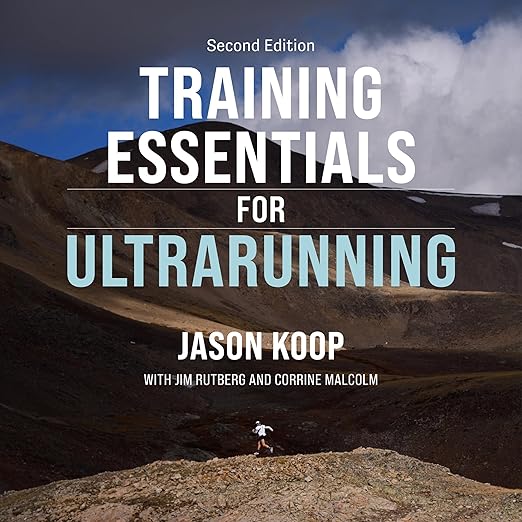
Quick Take
- Narration: Jason Koop narrating his own book is the right call. His dry humor and direct coaching voice translate well to audio, and the expert interviews scattered throughout give the production genuine documentary texture.
- Themes: Evidence-based ultramarathon training, the gap between conventional marathon preparation and ultra-specific demands, mental resilience as a trainable skill
- Mood: Authoritative and energizing, with the no-nonsense quality of a coach who respects your intelligence
- Verdict: The definitive audio resource for ultrarunners at any level, made even stronger by Koop’s self-narration and the inclusion of expert interviews not in the physical book.
I spent most of a week with Jason Koop’s Training Essentials for Ultrarunning on my headphones during evening walks, which felt apt. This is a book about moving through difficult terrain over long periods of time, and the audio format, seventeen hours narrated by the author himself with embedded expert interviews, suits the subject matter better than a desk reading would. By the end of the week I had not run a single ultramarathon and had no plans to, but I had a considerably more sophisticated understanding of how elite coaches think about endurance training than I started with.
Koop is the real thing: a professional coach with twenty years of working with both elite ultrarunners and everyday athletes. The second edition of this book, released in late 2021, adds substantial new material to an already authoritative first edition, including an expanded section on nutrition and what reviewers consistently describe as an excellent treatment of mental preparation. The audiobook version is not a simple recording of the print book. It contains interviews with figures like Stephen Seiler, Inigo Mujika, and Guillaume Millet, names that will be immediately recognizable to anyone who follows the science of endurance sports, that add a documentary layer unavailable in print.
Our Take on Koop’s Science-First Coaching Philosophy
What distinguishes Koop’s approach from the large and often overcrowded field of endurance sports coaching literature is his explicit commitment to evidence-based methodology and his freedom from sponsor influence. He says this directly in the book, and reviewers note it as a genuine differentiator. In a genre where advice often tracks closely to whatever brand is paying for the author’s race kit, Koop’s willingness to recommend or critique training approaches purely on scientific merit is meaningful.
His central innovation, at least for listeners coming to this material from a marathon training background, is the shift from mileage-based thinking to time-on-feet training. One reviewer described this shift as game-changing after discovering the first edition: the insight that ultrarunning performance is built through duration and vertical gain rather than pace and distance, and that training accordingly produces better results with less injury risk. Koop explains the science behind this approach with enough depth that listeners can understand not just what to do but why, which is the quality that turns a coaching book into a durable resource rather than a seasonal manual.
Why Listen to Expert Interviews Alongside the Main Text
The embedded interviews are, for me, the most distinctive feature of this audio edition. Koop has access to some of the most respected researchers in endurance science, and listening to him speak with Stephen Seiler about intensity distribution or with Dr. Emily Kraus about injury prevention produces something that a written summary of those perspectives cannot replicate. The conversations have an exploratory quality, moments where Koop pushes back or asks follow-up questions, that brings the underlying science to life in a way that footnotes cannot.
This makes the audiobook version genuinely more valuable than the print edition for many listeners, not just a convenience format. If you are already familiar with the first edition, the new material and the expert conversations provide substantial additional value. If this is your introduction to Koop’s work, the combination of his coaching voice and the expert interviews creates a layered, credible foundation for understanding ultra-specific training.
What to Watch For in the Nutrition and Mental Preparation Sections
The chapters on race-day nutrition and mental skills are the most practically immediate for listeners who are actively training or preparing for an event. Koop approaches nutrition with the same scientific riggor he brings to training load: he is skeptical of fads, interested in individual variation, and specific about what research actually supports versus what is conventional wisdom. The mental preparation section, which reviewers consistently flag as a strong addition to the second edition, draws on sports psychology in a way that is applied rather than abstract. Koop is not interested in motivation in the abstract. He is interested in concrete mental skills that hold up when you are twenty hours into a hundred-mile race.
One reviewer offered a constructive critique worth noting: the book discusses training principles at length without providing sample programs, which means that listeners cannot simply lift a plan from the audiobook and apply it directly. Koop acknowledges this; his philosophy requires individualization that a generic plan cannot capture. That is a real limitation for listeners who want a ready-made template, but it reflects his coaching principles honestly.
Who Should Listen to Training Essentials for Ultrarunning
This audiobook is for anyone seriously interested in ultramarathon training, from first-timers who want to understand the demands of the sport before committing to a race, to experienced ultrarunners looking to optimize training they have built more intuitively. The scientific approach means that listeners with some background in exercise physiology will get more from the technical sections, but Koop explains his methodology accessibly enough that dedicated beginners can follow the reasoning. Those expecting a motivational listen in the vein of popular endurance memoirs will find this more textbook than narrative, which is entirely intentional.
Frequently Asked Questions
Does the audiobook include the tables and figures from the physical book?
The synopsis notes that tables and figures are available as a free digital download accompanying the audiobook purchase. They are not embedded in the audio itself, so listeners who rely heavily on visual data will want to download that PDF.
Are the expert interviews with figures like Stephen Seiler and Inigo Mujika full conversations or brief clips?
The interviews are substantial enough to function as genuine documentary content rather than brief excerpts. Reviewers describe them as a meaningful addition to the audiobook experience, distinguishing this version from the print edition.
Is this audiobook useful for someone who has run road marathons but never an ultramarathon?
Yes. Koop explicitly addresses the transition from marathon to ultra training and identifies the key conceptual shifts involved, particularly around training by time rather than mileage. Experienced marathon runners will find the comparison points helpful.
How does this second edition differ meaningfully from the first edition of Training Essentials?
The second edition adds expanded sections on nutrition and race-day strategy, a more developed treatment of mental preparation, and the expert interview content embedded in the audiobook. Reviewers who owned the first edition describe the additions as substantive rather than cosmetic.