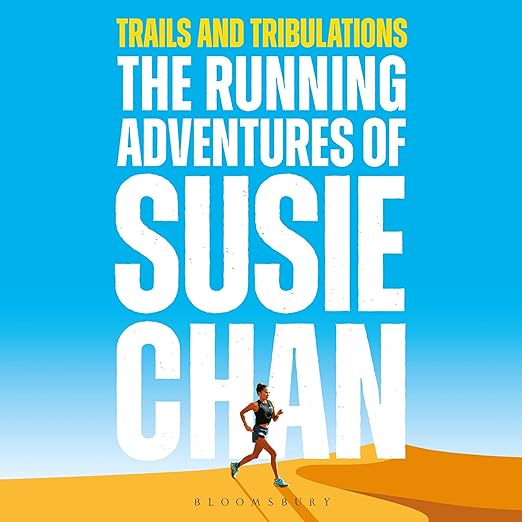
Quick Take
- Narration: Susie Chan narrating her own story is the obvious right call, and her down-to-earth humor and warmth land exactly as they should. You feel the wicked sense of humour that reviewers describe because Chan delivers it in her own voice rather than through a hired approximation.
- Themes: reinvention through physical endurance, survival and resilience, running as life practice
- Mood: Energizing, honest, and occasionally laugh-out-loud funny
- Verdict: One of the stronger running memoirs in recent years, and it works for non-runners too, which is a harder trick to pull off than it sounds.
I am not a runner. I want to be transparent about this because it is relevant to how I respond to running memoirs, and how surprised I am when one of them gets its hooks into me anyway. I picked up Trails and Tribulations on a Tuesday evening with mild expectations, and by Wednesday morning I had finished it. Susie Chan has that quality that the best memoirists share: she makes her particular world feel universal without flattening what makes it specific.
Chan did not run her first race until she was 35. By the time this book was written, she had completed the Marathon des Sables more times than any other British woman, set the 12-hour treadmill world record, and was among the first women to finish all six World Marathon Majors. She is also a Peloton instructor with a global following, which means some of her listeners are coming to this book already knowing her voice from their living rooms. She is, in other words, a figure with a substantial public profile, and the question this memoir has to answer is whether the person behind the profile is as interesting as the achievements. She is.
Our Take on Trails and Tribulations
What makes this memoir worth the attention of non-runners is that the running is never the actual subject. The running is the container. Inside it, Chan is working through the end of a dysfunctional marriage, the demands of solo parenthood, and a cancer diagnosis and treatment that she handles with the same matter-of-fact pragmatism she brings to running 250 kilometers across the Moroccan desert. Her mantra, you never regret a run, sounds like a motivational poster until she explains what it has actually carried her through, and then it sounds like something harder and more useful than that.
Why Listen to Trails and Tribulations
Chan narrating her own book is the right call, and the audio version is almost certainly the better format for this particular memoir. Her voice has the warmth and the humor that reviewers consistently describe on the page, but self-narration delivers them with none of the translation loss that comes from a professional narrator approximating someone else’s personality. One Peloton subscriber who had taken dozens of Chan’s classes reported that the memoir revealed dimensions of her that the classes never could, and finished it in two days. A running coach who was listening while already considering a new race distance signed up for their longest event ever before reaching the end. These are not responses you engineer; they are responses a specific kind of honest memoir produces.
What to Watch For in Trails and Tribulations
The geographic range of this memoir is part of its pleasure: the Moroccan desert, the Peruvian jungle, Death Valley, the South Downs, a running track in Tooting. Chan moves between these locations without letting the adventure-travelogue aspect overwhelm the personal thread. She is not writing a race diary; she is writing about what each of these places demanded of her and what they gave back. The cancer treatment sections are handled with her characteristic refusal to perform suffering for the reader’s sake, which makes them more affecting than a more dramatic treatment would have been.
Who Should Listen to Trails and Tribulations
Endurance runners and ultramarathon enthusiasts will find the race detail and the insider knowledge of events like the Marathon des Sables genuinely satisfying. But Chan has written something that extends beyond the running community, and multiple reviewers who are not runners report being moved and entertained in equal measure. At 8 hours and 26 minutes, the runtime fits comfortably into a long weekend. Those who want running technique or training advice rather than memoir should look elsewhere: this is a life story told through races, not a manual. For everyone willing to follow Chan across the terrains she describes, this delivers exactly the company it promises.
Frequently Asked Questions
Do you have to be a runner to enjoy Trails and Tribulations?
No. Multiple reviewers who identify as non-runners report finding the book inspirational and entertaining. Chan writes about running as a vehicle for living rather than as a technical pursuit, which makes it accessible regardless of whether you have ever laced up trainers.
Does Susie Chan discuss her cancer treatment in detail, and how does she handle it in the memoir?
She addresses it honestly but without dwelling. Chan’s approach to difficult material throughout the memoir is characterized by a refusal to dramatize for effect. The cancer treatment is part of the full picture of what she has navigated, handled with the same matter-of-fact resilience she brings to extreme race conditions.
Is this audiobook suitable for listeners who know Susie Chan from Peloton but have never read a running memoir?
Yes, and several Peloton subscribers in the reviews report that the memoir revealed dimensions of Chan that her classes never could. Coming in with familiarity from Peloton is a bonus rather than a prerequisite.
How does the Marathon des Sables and other race content fit into the memoir structure?
The races are structuring events rather than the sole focus. Chan uses specific races, including her multiple completions of the Marathon des Sables, as the settings in which she works through the larger life events: the marriage ending, the single parenthood, the cancer treatment. The race detail is rich enough for running fans but never so technical that non-runners lose the thread.