Quick Take
- Narration: Therese Plummer brings consistent energy across all eight parts, a crucial asset when four different authors share the writing duties.
- Themes: blown cover identities, FBI procedural tension, organized crime vengeance
- Mood: Fast and relentless, the kind of listen you reach for when you want noise and momentum
- Verdict: A serviceable binge for crime fiction fans who prioritize pace over depth, though the seams between authors show more than the box set format suggests.
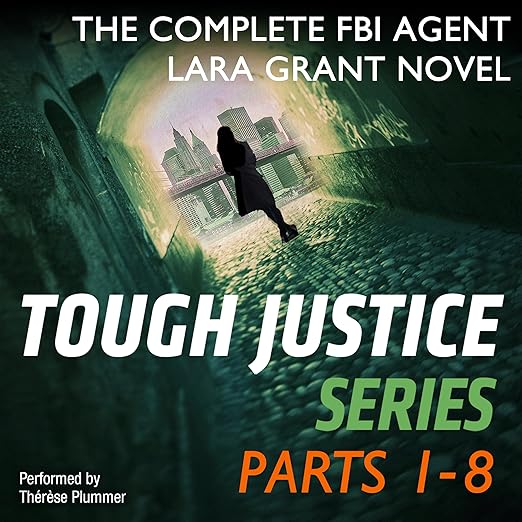
I came to the Tough Justice series on a week when I needed something purely propulsive. I had just finished a very slow, very literary historical novel, and I was craving the opposite: something that would drag me forward without asking me to hold a lot of complexity in my head. A 24-hour FBI crime serial spread across eight parts, built around a single protagonist whose cover gets catastrophically blown in the opening minutes, sounded exactly right. The answer, as it usually is with multi-author serialized fiction, is more complicated than that simple premise suggests. But for the context in which I was listening, tired evenings and one long Sunday of domestic chores, it served well enough.
The Cover-Blown Hook and What It Promises
The setup is efficient and genuinely grabby. Special Agent Lara Grant has spent years undercover inside the Moretti crime gang. A sniper attack exposes her face to the media, destroying her cover in a single moment of very bad luck. Then a body appears, branded with a Moretti tattoo, and Lara understands that someone is not just watching her but actively hunting her. That is a strong opening premise, and Part 1, written by Carla Cassidy, establishes it with the kind of blunt, kinetic prose that makes serial crime fiction work at its best.
The multi-author structure is both this box set’s defining feature and its central weakness. Cassidy, Tyler Anne Snell, Carol Ericson, and Gail Barrett each take turns with the narrative, and they maintain enough consistency in Lara’s voice that the whole holds together better than you might expect. But the transitions between authors are detectable. Each writer has a slightly different sense of how much interior reflection Lara gets, how hard the action hits, and how much secondary characters matter. One listener noted that Part 1 starts slowly before the series finds its feet, and that is accurate. The momentum is uneven across the eight installments, with some parts feeling tighter and more urgent than others.
Therese Plummer as the Unifying Thread
The decision to use a single narrator across all eight parts was the right one. Plummer has a warm but authoritative quality that suits FBI procedural fiction well, and she does the heavy lifting of making Lara feel like one continuous character even when four different authors are pulling her in slightly different directions. Her pacing quickens effectively in action sequences and relaxes in quieter exposition, which is a skill not every audiobook narrator deploys reliably. At over 24 hours, this is a substantial listen, and Plummer does not tire. That kind of stamina matters in a box set of this length. If the narration had wavered or grown repetitive in delivery style, the unevenness of the writing would have felt far more pronounced than it does.
What the Serial Format Gives and Takes Away
Serial fiction released in parts has a different rhythm than a conventional novel. Each installment has its own minor climax and cliffhanger, which keeps the binge quality high but creates a slightly mechanical feel over time. The antagonist, the Moretti gang’s reach into Lara’s new life, is a serviceable structural engine, but the gang itself never becomes as vivid as the best crime fiction antagonists do. Moretti is a name and a threat more than a character with real presence.
What works better is the texture of Lara’s situation: the paranoia of being watched, the loss of the false identity she had inhabited for years, the professional and personal stakes of exposure. These elements the authors handle consistently enough that Lara’s predicament feels real even when the plotting gets mechanical. The romance with Nick develops in ways that feel somewhat formulaic, but it does not overwhelm the procedural momentum, which is the right calibration for this kind of fiction.
At Audible’s free tier, the value here is obvious: 24-plus hours of consistently narrated content with a clear protagonist and a story arc that resolves fully by Part 8. For genre fans who want sustained entertainment without major investment, the proposition is strong.
The interplay between the four authors also reveals something interesting about collaborative serial fiction as a form. Each writer brings slightly different instincts to the material, and over 24 hours you begin to notice whose sections feel most confident with action, whose handle the interpersonal dynamics between Lara and her colleagues with more nuance, and whose tend to coast on formula. This is not a criticism so much as an observation: the box set format is inherently an aggregation of different creative sensibilities, and some inconsistency is the trade-off for the sustained runtime. Plummer’s narration is what makes the aggregate feel unified rather than stitched together from unrelated parts.
The FBI procedural texture is handled competently across all eight parts. The Crisis Management Unit setting allows for high-stakes scenarios without the logistical absurdities that sometimes undermine similar fiction, and the New York City backdrop is used for atmosphere without becoming the dominant concern of any individual installment. This is workmanlike genre fiction doing exactly what it sets out to do, neither more nor less, and there is a particular kind of satisfaction in that when you are in the right listening mood for it.
Who This Box Set Is For
This is a strong pick for listeners who want a sustained, high-volume binge of crime fiction with a clear protagonist and a contained story arc. Fans of FBI procedurals and Harlequin-style romantic suspense will find the genre beats reliably delivered. Those looking for the kind of psychological depth and moral complexity that defines the best crime fiction will find this thin. It is built for momentum, not meditation, and there is nothing wrong with that as long as you know it going in.
Frequently Asked Questions
Do all eight parts need to be listened to in order?
Yes. This is a continuous serial narrative, not an anthology. Lara Grant’s story builds across all eight installments, and listening out of order would undermine both the plot and the character arc.
How noticeable is the four-author structure across the eight parts?
Noticeable but not disruptive. The authors maintain enough consistency in Lara’s voice that the transitions are detectable rather than jarring. Therese Plummer’s single narration across all parts helps smooth the authorial handoffs considerably.
Is the romantic subplot between Lara and Nick central to the story?
It runs alongside the main procedural plot without overtaking it. This is primarily a crime thriller rather than a romantic suspense novel, though the romance is a consistent thread. Listeners who prefer their FBI fiction without romantic subplots may find it a mild distraction.
How does the pacing hold across 24 hours of content?
It is uneven. The series takes a few parts to find its full momentum, and some installments are tighter than others depending on which author is at the helm. Overall the pace is fast enough that the slow patches resolve quickly.