Quick Take
- Narration: Lamont Mapp reads with the tone of a patient, encouraging coach, he brings enough energy to make the content feel motivating rather than clinical, without tipping into the performative enthusiasm that makes some fitness audiobooks grating.
- Themes: Age-appropriate fitness, mindset and mobility, strength training after midlife
- Mood: Encouraging and evidence-forward, with a practical rather than aspirational register
- Verdict: A well-organized, research-grounded fitness overview for adults over forty who want to understand why the standard advice stopped working, Mapp’s narration makes the four hours feel genuinely coaching-like rather than instructional.
I turned forty-two last year, and I have spent a meaningful portion of the subsequent months becoming aware of things that didn’t used to require awareness. Recovery time. Morning stiffness. The specific sound my knees make on stairs that I’m fairly sure they didn’t make five years ago. I am not, to be clear, in any kind of crisis about this, but I am paying more attention to fitness information than I used to, and with more scrutiny, because the stakes feel different than they did when I was thirty-two and could ignore my body for weeks at a time without consequence.
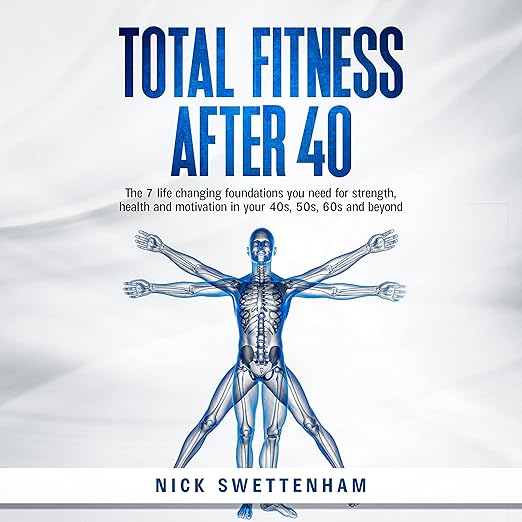
Nick Swettenham’s Total Fitness After 40 landed in my queue at exactly the right moment. It’s not a book about accepting decline, it’s a book about understanding what changes after forty and responding to those changes with specificity rather than with the generic advice designed for twenty-five-year-olds. That distinction matters more than it might sound.
Our Take on Total Fitness After 40
The book covers seven distinct areas of fitness, the synopsis doesn’t name all of them, but reviewers reference strength, mobility, cardio endurance, nutrition, mindset, goal-setting, and recovery as the main pillars. Swettenham’s decision to break fitness into these separate domains, rather than presenting a single unified program, is one of the book’s more intelligent structural choices. It reflects the reality that fitness after forty is less about finding the one right workout and more about understanding the system you’re working with and making targeted adjustments.
The research grounding is genuine. Swettenham cites the US National Cancer Institute’s findings on late-life physical activity benefits, references the evidence on strength training and aging (the claim that strength can increase by forty percent in twelve months with appropriate resistance training is backed by peer-reviewed literature, not manufacturer claims), and frames the nutrition section in terms of calculated needs rather than trend-driven restrictions. One reviewer with a clear reading background in fitness science called it “research-backed strategies that are easy to understand and implement,” which is the accurate summary.
Why Listen to Total Fitness After 40
Lamont Mapp is an excellent fit for this material. He reads like someone who has internalized the content rather than simply performing it, and his pacing gives Swettenham’s practical passages room to land without feeling rushed. The “trusted coach” quality that one reviewer identified is largely Mapp’s contribution, the same words read in a more clinical voice would produce a different experience. The companion PDF, available in the Audible library alongside the audio, is genuinely useful for the visual components: exercise form descriptions and structured workout plans work better with some form of visual reference than audio alone can provide.
The mindset and motivation sections, which could easily have been the weakest part of a fitness book, are handled with more sophistication than the genre usually manages. Swettenham frames negative self-talk not as a character flaw to be overcome but as a cognitive pattern to be understood and redirected. That’s a more useful framing than the motivational-poster approach most fitness books default to, and it’s the kind of insight that a 72-year-old reviewer (who called the content “realistic and achievable”) responded to specifically.
What to Watch For in Total Fitness After 40
The book is genuinely introductory, and listeners who already have a structured fitness practice and a working knowledge of periodization, progressive overload, and mobility training will find some sections familiar. The subtitle says the book works “even if you’ve never worked out a day in your life,” and that’s accurate, it’s calibrated for people who are new to structured fitness or returning to it after a significant gap. More experienced exercisers should approach it as a framework check rather than a program overhaul.
The nutrition section, while solid in principle, covers ground that is well-trodden elsewhere. Swettenham’s approach to caloric needs and macronutrient balance is evidence-based and sensible, but readers looking for detailed guidance on fueling strength training specifically, or on navigating the hormonal changes that affect body composition after forty, will need to supplement with more specialized sources.
Who Should Listen to Total Fitness After 40
This is an excellent starting point for adults in their forties, fifties, and beyond who want to understand the physiology of midlife fitness before they commit to a specific program. The broad scope means it won’t replace a strength training manual or a sport-specific conditioning guide, but it gives listeners the conceptual vocabulary to evaluate those resources more critically. Reviewers across a wide age range, one in their forties returning to exercise, one at seventy-two managing chronic conditions, found it applicable, which suggests the book’s principles are genuinely scalable. People already training seriously with a coach or following a structured program will find it less immediately useful.
Frequently Asked Questions
Does Total Fitness After 40 include actual workout programs, or is it primarily conceptual?
It includes workout plans and exercise guidance, particularly in the companion PDF that accompanies the audio in your Audible library. The audio itself covers the principles, framework, and reasoning; the PDF provides the visual reference for exercise form and program structure. The combination works better than audio alone for implementing the practical recommendations.
Is the book useful for people significantly older than forty, say, in their sixties or seventies?
Yes, based on reviewer feedback. A 72-year-old reviewer specifically found the content applicable and the goal-setting advice realistic. Swettenham’s framing around working within current physical capacity rather than recovering a previous baseline makes the content relevant beyond the forty-year-old starting point, the underlying principles about mobility, strength, and recovery apply across the later decades.
How does Swettenham handle the nutrition section, does he push a specific diet approach?
He takes a balanced, non-dogmatic approach. The focus is on building a balanced meal plan, understanding caloric needs, and avoiding the fad-diet thinking that tends to complicate fitness for people in midlife. He doesn’t advocate for a specific diet framework (keto, paleo, etc.), the guidance is grounded in general nutritional science rather than a branded system.
Is Lamont Mapp’s narration well-suited to following along during actual workouts?
The book is better listened to as a planning and learning resource rather than during workouts themselves, it’s conceptual and explanatory rather than a guided workout format. Mapp’s pacing is designed for comprehension rather than real-time physical performance. For workout audio, you’d want to implement the principles first and then listen to something else while training.