Quick Take
- Narration: Chris Abell handles the New Zealand caddie’s perspective with respect for Williams’s voice, steady, unpretentious, and appropriate for memoir.
- Themes: Partnership and its limits, the psychology of winning, loyalty tested by ego
- Mood: Nostalgic and occasionally wistful, with flashes of real bitterness kept carefully in check
- Verdict: A window into one of sport’s most dominant partnerships that reveals more about the nature of proximity to greatness than it does about Tiger Woods himself.
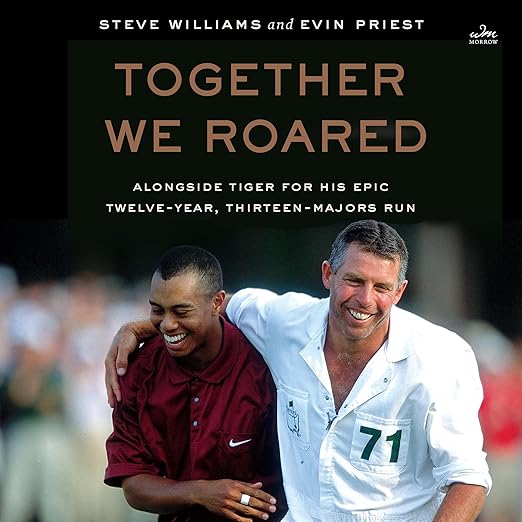
I listened to Together We Roared over two evenings, which felt like the right pace for a book about patience. Steve Williams spent twelve years walking eighteen holes at a time beside the greatest golfer of his generation, reading greens, carrying bags, and making calls under conditions that would crack most people. Patience is his professional medium. The book reflects that, it is not a tell-all, it is not a settlement of scores, though it has been described as explosive in certain quarters. What it actually is, is a carefully considered account of what it means to stand in someone else’s reflected light for a decade and then be switched off.
The partnership between Williams and Tiger Woods produced thirteen major championships between 1999 and 2008. The Tiger Slam of 2000 and 2001, that extraordinary 2005 Masters chip on the 16th hole, the 2008 US Open won on a broken leg, Williams was present for all of it, and his memory for the specific textures of those moments is the book’s greatest asset. He is not writing history from a distance. He is reconstructing what he heard and felt and decided in the seconds before Tiger swung, and those passages carry a specificity that no outside account could replicate.
Our Take on Together We Roared
The subtitle positions this as a definitive account, and Golf Digest called it exactly that. It is also, necessarily, a partial account. Williams is not neutral about his own contribution, and at least one reviewer noted that the portrait of the caddie is perhaps a little too flawless, never a bad read, never a wrong call. That critique is fair. Williams acknowledges Tiger’s personal transgressions exist without dwelling on them, which is the graceful choice but leaves certain questions about the nature of their dynamic unexplored. The book is generous where it could be vindictive, which is admirable, but readers expecting genuine psychological excavation of what went wrong will find the surface deliberately maintained.
What the book does excavate is the friendship off the course, and those passages are the most unexpected. Tiger caddying for Williams on his wedding day. Tiger giving a best man speech. The intimacy of a partnership built across thousands of hours in each other’s company, in locker rooms and hotel corridors and practice ranges before dawn. Williams had access that no journalist or biographer has, and the personal photographs and ephemera he shares, described in the print version and referenced in audio, give the memoir a texture that pure sports recollection rarely achieves.
Why Listen to Together We Roared
Chris Abell narrates with a quality that suits Williams’s unpretentious, plain-speaking voice. The nine-hour runtime is substantial, but the material sustains it. Abell does not impose emotion where Williams has chosen restraint, which is the right instinct. The book’s controlled register, admiring but not hagiographic, honest about the abrupt ending but not bitter in its telling, requires a narrator who can hold that tension without forcing resolution, and Abell does that effectively.
The golf content is technically rich enough to reward knowledgeable listeners without excluding those who come primarily for the personal story. Williams explains his role in shot selection and course management with enough precision that the partnership becomes comprehensible even to listeners who have never played a round. That explanatory generosity is one of the book’s quiet virtues.
What to Watch For in Together We Roared
The twelve-year silence between Williams and Woods after their split is treated with more restraint than many readers will expect. Williams explains the parting and its aftermath, but he does not press hard on it. The later reconnection is mentioned, but the emotional weight of two men who built something historic together and then spent over a decade not speaking is not fully reckoned with. That gap is either wisdom or avoidance depending on your perspective.
Listeners coming from following the Amazon Prime series based on the Reacher novels should note, this is an entirely different sporting universe. Together We Roared lives in the world of fairways and majors, and its pleasures are specific to that world. It rewards patience with precision, which is, after all, exactly what caddying requires.
Who Should Listen to Together We Roared
Essential for golf fans who followed the Woods-Williams years and want an insider perspective that has not been previously available. Valuable for memoir readers interested in how proximity to extreme success shapes a person’s identity. Less suited to listeners who want unfiltered disclosure or psychological depth about Tiger’s personal failures. Williams has chosen his register, and it is consistent, reflective, respectful, and occasionally more guarded than the subject demands.
Frequently Asked Questions
Does Together We Roared reveal new information about Tiger Woods’s personal scandals?
Williams addresses Tiger’s indiscretions briefly and makes clear he found them abhorrent, but he does not dwell on them or provide new details. The book focuses on the professional partnership and the friendship, not the tabloid narrative.
Do you need to be a golfer to enjoy this book?
Not necessarily. The personal narrative about the caddie-golfer relationship, the friendship, and the abrupt ending of a twelve-year partnership works for general memoir readers. The technical golf content is explained accessibly, though hardcore golf listeners will get the most from those sections.
How does Chris Abell’s narration compare to having Williams read it himself?
Abell brings a clean, steady delivery that respects the material. He does not attempt to replicate a New Zealand accent, reading instead in a neutral register that keeps the focus on Williams’s words rather than the performance. For memoir listeners accustomed to author narration, the distance is noticeable but not distracting.
Is the account of the 2008 US Open win on a broken leg covered in detail?
Yes, and it is one of the book’s most compelling sections. Williams was present for every hole of that tournament and describes the physical and psychological cost of Woods completing the championship under those conditions with firsthand specificity.