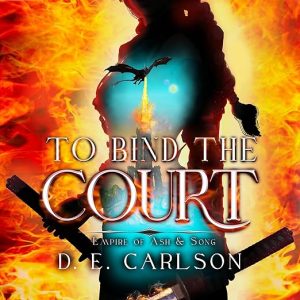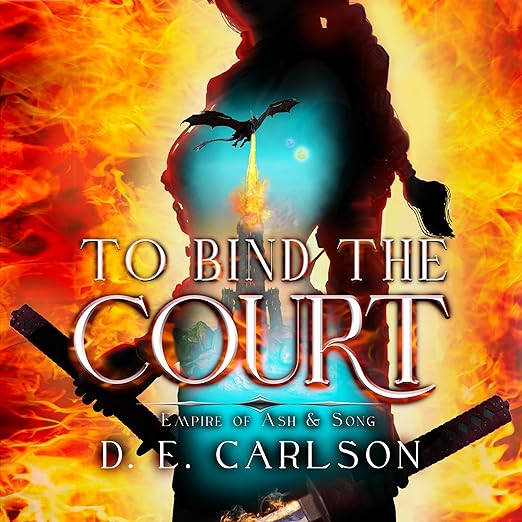
Empire of Ash and Song reached its second volume on the page long before anyone could hear it. This audiobook arrived in November 2025, and four of the five reader responses on the listing were already posted by then, the earliest back in mid-2024. What that tells a buyer is useful: the audio is a catch-up release for a series a devoted readership had been tearing through in print for eighteen months, and the enthusiasm you see attached to it was earned before a microphone was ever involved.
D. E. Carlson's premise carries a tagline that reviewer Bright003 liked enough to quote back verbatim: "When you play the games of emperors,you'll pay an emperor's ransom." Iris is destined to break the Fire Empire's hold on the world, and the last hope for doing it sits inside the Fire City, which is also where the person hunting her lives. Prince Besaun, betrayed by the girl he loves, languishes in what the description calls "a prison of his own making" while his mother keeps that same girl tortured and captive to guarantee his cooperation.
Structure is the achievement here, and Nathan Davis puts a finger on it: the author "does an excellent job weaving together the various points of view and giving all of them emotional arcs worth caring about". That is harder than it sounds when one viewpoint belongs to a girl running toward the empire that wants her dead and another belongs to a prince being blackmailed with her suffering. The two strands are built to squeeze each other, and the central question the description poses, whether Besaun can doom an empire to save one girl, only works if both sides of it hurt.
Devotional material is not incidental here and the marketing makes no attempt to hide it. Readers are pointed toward Narnia on precisely that basis, and Madison Welch confirms the effect from the inside, writing "I also really appreciated the Christian themes" and naming "The battle between temptations and right and wrong" as the element that landed. Alongside that sits a romance the publisher describes as clean and sweet. Listeners who want their fantasy morally ambiguous should know this book has a settled position on right and wrong and is not shy about it.
The Best Parts of To Bind the Court
Momentum is the most consistent praise in the pool. heymrslewis reports a series "that has many plot twists and constantly pulls you in", and had been reading it "all winter nonstop". Madison Welch says the series "has stollen sleep from me the past few days", and sounds entirely cheerful about the theft. Nathan Davis offers the version I find most persuasive, that "The story carries you and you just want to keep reading", which the review calls "the highest compliment a story can be paid". Twelve hours and nineteen minutes goes quickly on that kind of pull.
Something unusual about the narration credit deserves a straight explanation. Where most listings name an individual reader, this one names Starlit Audiobooks, which is a production house rather than a person. Practically, that removes the normal way a buyer calibrates expectations, since you cannot go and sample the reader's other work before committing. What the book demands is clear enough regardless: two viewpoint characters in very different circumstances, one on the run and one imprisoned, must stay instantly distinguishable, and the faith material has to be delivered without sliding into sermon. Neither task is exotic, but both are the sort of thing an individual reader's earlier work would let you check in advance.
Endings are the other draw. juan palacio finishes with "Wow, what a great ending" and notes that "The message is sooo clear at the end too", while Nathan Davis calls the book "a worthy sequel". Second volumes in fantasy series frequently exist to move furniture around, and this one apparently resolves enough to satisfy while leaving juan palacio impatient for a third. That is a difficult balance and worth crediting, because a middle book that closes nothing is the most common way a series loses people.
Before You Commit to To Bind the Court
Watch for a lull in the middle, which is the clearest flag anyone raises here, and it comes from an enthusiast rather than a critic. juan palacio describes the shape precisely: the book "had me hooked then it slowed and then boom, Couldn't put it down again". Madison Welch touches the same stretch from another angle, noting that "It takes awhile to get answers to details" before concluding the author delivered them gracefully. Expect a slower passage in the middle of the listen and know from two separate readers that it recovers.
Start with book one. Nathan Davis is explicit about it, advising readers to "pick up the first book in the series and continue with this book, a worthy sequel", and the setup confirms that advice. Besaun's betrayal, his relationship with Iris and his mother's leverage over him are all inherited from the previous volume rather than established here. Beginning at book two would mean absorbing an emotional history secondhand.
Ambivalence from one reader is worth respecting too. Bright003, at four stars, admits to unresolved questions, writing that "I just have lots of questions, but when I sit back and try to think of how to ask those questions, I realize I just don't really care that much". That is affection winning over scrutiny, which is a fair description of how this kind of fantasy usually works, and a warning for listeners who need their worldbuilding airtight.
Should You Listen to To Bind the Court?
Teen and adult listeners who want epic fantasy with a moral compass and no explicit content are the core audience, and the 4.7 average across 191 ratings suggests they are being well served. The publisher's own comparison points, a Narnia-style faith current and the clean romance of Caraval, are accurate signposts. Nathan Davis recommends it for adventure and fantasy readers of any age, and a shared family listen would work here in a way it would not for most court-intrigue fantasy. I would put it in front of a fourteen-year-old and an adult in the same car without hesitating.
Avoid it if you want grit, ambiguity, or a romance with heat, since the book is built to sidestep all three by design. Pass as well if a slow patch frustrates you enough to abandon a listen, because two readers independently flagged one here. And anyone unwilling to start with volume one should choose a different series, because this sequel assumes you already care about a betrayal it does not restage.
At a Glance
- Read by: A studio name stands where a performer's usually does, which removes the usual way of sampling a reader's other work before committing twelve hours.
- At its heart: prophecy against empire, faith and temptation, blackmail and captivity, clean YA romance
- Vibe: Propulsive and morally certain, with a devotional streak
- Short version: A satisfying second volume for readers who want epic fantasy without grit, provided you started at book one.
Common Questions
How prominent are the Christian themes?
Prominent and deliberate. Narnia is the publisher's own point of comparison on exactly that basis, and Madison Welch singles out the Christian material and the pull between temptation and doing right. It shapes the moral framework rather than decorating it, which will delight some listeners and deter others entirely.
Does the audiobook pacing hold across the full twelve hours?
Not evenly. juan palacio describes being hooked, then hitting a slowdown, then being unable to put it down again. Madison Welch notes it takes a while for answers to arrive. Two readers independently flagging the same middle stretch is a reliable signal, and both say the book recovers strongly.
Who actually narrates this audiobook?
A studio name appears where a performer normally would, so the audiobook is credited to Starlit Audiobooks rather than a person you can research. What the material asks for is clear enough: a fugitive and a prisoner whose chapters never blur together, and religious passages delivered without sliding into a sermon.