Quick Take
- Narration: Shaun Grindell delivers the stage-by-stage structure with propulsive energy, making a known outcome feel genuinely suspenseful.
- Themes: Athletic rivalry, the role of chance in competition, margin and consequence
- Mood: Tense and immersive, like watching a race you already know ends in a photograph finish
- Verdict: A definitive account of cycling’s most dramatic race, with fresh testimony that justifies revisiting even for those who lived through it.
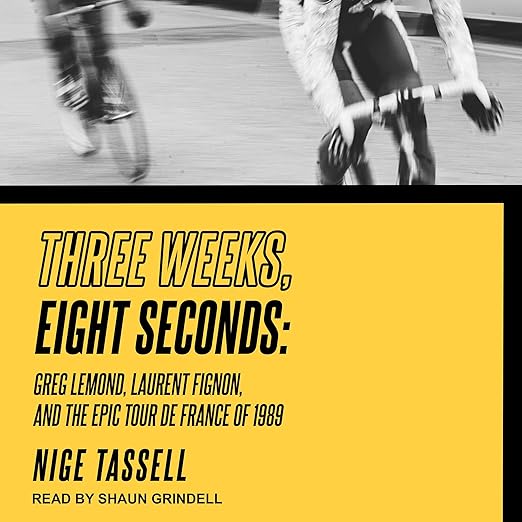
I was twelve years old when Greg LeMond won the 1989 Tour de France by eight seconds. I did not watch it live, but the story came to me in fragments over the years, the kind of sporting legend that arrives with so much mythology already attached that you assume you know it. What Nige Tassell’s book made clear to me, several hours into a long motorway drive, is that I had the skeleton of the story but almost none of its flesh. The stage-by-stage reconstruction of that three-week race is something else. Knowing the outcome does not neutralize the tension. If anything it deepens it, because you keep asking yourself: here, on this stage, on this mountain, how did LeMond not give it away? How did Fignon not seal it?
The premise for the drama is simple and almost absurd in its elegance. Over more than 2,000 miles, across three weeks and 21 stages, two rivals swapped the yellow jersey back and forth while never pulling more than 53 seconds apart. The entire race came down to a final time trial on the Champs-Elysees, with Fignon starting in the lead and LeMond in pursuit. Eight seconds separated them at the finish. In the hundred-plus-year history of the Tour de France, no race has ever been decided by a smaller margin. Tassell makes the case, convincingly, that it remains the greatest race in cycling history. He does not need to oversell it; the facts do that themselves.
Our Take on Three Weeks, Eight Seconds
What elevates this book beyond a straightforward race recap is the fresh first-hand testimony that Tassell gathered from participants and witnesses. The reviewer who noted the book provides details and backstory beyond the known outcome is pointing at the book’s most valuable contribution. You get LeMond’s aerodynamic helmet choice, the internal Fignon camp deliberations, the role of injury and recovery, the team dynamics that shaped tactical decisions stage by stage. These are not details assembled from archive footage; they are accounts from people who were there, collected by someone who spent real time pursuing them.
Shaun Grindell’s narration suits the material particularly well. He brings the kind of measured British delivery that works for sports history, neither too flat nor too theatrical, and he handles the French names and place names with enough fluency that the geography of the race feels real. The stage-by-stage structure that Tassell uses, working through each of the 21 stages before the time trial climax, could easily become monotonous in lesser hands. Grindell keeps the pace moving.
Why Listen to Three Weeks, Eight Seconds
For cycling listeners specifically, this is essential. But Tassell writes with enough narrative breadth that the book works for anyone drawn to sports history, to stories about how competition operates at the extreme margins of human performance, or to the specific drama of watching a lead evaporate in real time. The dynamic between LeMond and Fignon is also a character study: two riders with genuinely opposed temperaments and approaches, both at or near their peaks, pushed to the limit over three weeks.
The book also benefits from its timing relative to Fignon’s death in 2010. Tassell handles the aftermath of that eight-second loss, and what it meant to Fignon for the rest of his career and life, with genuine sensitivity. The story does not belong entirely to the winner.
What to Watch For in Three Weeks, Eight Seconds
The stage-by-stage structure is the book’s main risk for some listeners. Going through each of twenty-one stages before reaching the climax requires investment, and a few of the middle stages offer less dramatic material than the mountain finishes and time trials that bracket them. Listeners who prefer narrative summaries over procedural detail may find their attention flagging in the book’s middle third. Those willing to commit to the complete journey, as one reviewer put it, will feel like they were there. That gap in experience between the two types of listener is genuine and worth acknowledging.
One reviewer’s note about a family connection to LeMond should be taken in context. That endorsement is warm but not disinterested. The broader pattern of critical praise, from cycling fans and general sports readers alike, reflects a book that earns its reputation on the quality of its reporting and Tassell’s storytelling rather than on the subject’s built-in drama alone.
Who Should Listen to Three Weeks, Eight Seconds
Cycling enthusiasts will find this the most complete account of the 1989 Tour available in audio form. Sports history readers who are drawn to stories about athletic competition operating at thin margins, about the role of equipment, chance, and psychology in determining outcomes, will find substantial material here. Those who remember the race from watching it live may find the fresh testimony revelatory. Listeners who need propulsive narrative pacing throughout, rather than the methodical stage-by-stage reconstruction that Tassell uses, should know what they are signing up for before they start.
Frequently Asked Questions
Does knowing the outcome of the 1989 Tour de France diminish the tension of listening to Three Weeks, Eight Seconds?
Reviewers who knew the result going in consistently report that Tassell’s stage-by-stage reconstruction generates genuine suspense regardless. The detail and fresh testimony reframe a known ending into an open question at multiple points along the way.
How much cycling knowledge do you need to follow the book?
Very little baseline knowledge is required. Tassell provides context for the race’s mechanics, the significance of the yellow jersey, and the personal histories of both LeMond and Fignon. The book is written accessibly enough for sports readers who are not cycling specialists.
What is the fresh testimony that Tassell gathered, and how does it differ from existing accounts?
Tassell interviewed participants and witnesses directly, gathering first-hand accounts of tactical decisions, equipment choices, team dynamics, and personal experiences that were not in the existing record. This distinguishes the book from accounts assembled purely from archival material and journalism of the period.
Is the stage-by-stage structure of the book likely to feel repetitive?
For some listeners, yes. The book works through all 21 stages before the time trial climax, and the middle stages offer variable dramatic intensity. Listeners committed to the complete procedural reconstruction will feel immersed; those who prefer narrative summary may find the middle third slower going.