Quick Take
- Narration: Joan Baker manages an extraordinary range of voices across 500-plus interview subjects, holding the oral history format together across nearly 28 hours without the listener losing their bearings.
- Themes: Media empire building, the gap between on-screen performance and behind-the-scenes culture, the economics of cable sports television
- Mood: Compulsive and occasionally uncomfortable, with the oral history format delivering candor that a conventional narrative would soften
- Verdict: A thorough and often riveting institutional history that rewards listeners willing to commit to its considerable length, particularly those with memories of ESPN in its 1990s prime.
Twenty-seven hours and fifty-six minutes is a serious commitment. I want to be upfront about that because this audiobook either fits your life or it does not, and the decision should be made in full knowledge of the scale. I came to Those Guys Have All the Fun during a period when I had a lot of driving to do, and it turned several long highway stretches into something I was actually looking forward to. That is not a small thing to say about a book that covers institutional media history.
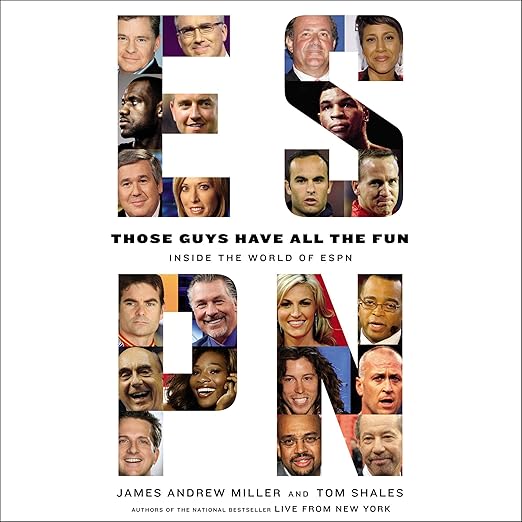
James Miller and Tom Shales assembled this ESPN oral history from over five hundred interviews, and the result is one of the more complete institutional portraits I have encountered in audio. The book begins with 1979 and ESPN’s origin as an improbable idea to televise local Connecticut sporting events, and it carries through to the network’s position as arguably the most successful cable operation in American television history. What distinguishes it from a conventional corporate history is the format. This is almost entirely presented in the voices of the people who were there, with minimal narrative connective tissue from the authors.
Five Hundred Voices and the Oral History Gamble
The oral history format is both the book’s greatest strength and its principal risk. Its strength is candor. When people speak in their own voices, unmediated by a narrator who might soften edges or resolve contradictions, you get a kind of access that third-person narrative rarely achieves. The men and women who built ESPN say things here about each other, about the network’s culture, and about the decisions that shaped its rise that they probably would not say if a journalist were paraphrasing them.
The risk is that five hundred voices across nearly twenty-eight hours can create navigation problems for the listener. Who is speaking? What time period are we in? The audiobook handles this better than you might expect, partly because Joan Baker’s narration of the transitions is clear, and partly because the voices have distinct enough personalities that the more significant figures become recognizable across their multiple appearances. But there are stretches, particularly when the book covers the transition from one decade to another, where keeping track of who is contending with whom requires active attention. This is not a book for distracted listening.
The Scandals and the Substance
Much of the publicity around this book at the time of publication focused on the more salacious elements: the behind-the-scenes battles, the rivalries, the conduct that would generate very different responses today. Those elements are present and frank. But reviewers who focused exclusively on the gossip missed what is actually the more durable part of the book, which is its account of how ESPN made the decisions that shaped modern sports media. The business strategy, the talent acquisitions, the programming gambles, and the editorial culture that made the network both dominant and controversial are all covered with the kind of detail that only oral history from participants can deliver.
One reviewer specifically noted that the book’s most impressive quality is not the salacious material but the account of how ESPN lasted and innovated for so long. That rings true. The institutional history of how a regional cable idea became a global media phenomenon is genuinely interesting, and it does not require the scandals to hold up. The scandals are there, they are honest, and they complicate the triumphalist narrative that ESPN’s own publicity would prefer. That complication is valuable.
Joan Baker and the Technical Challenge of Twenty-Eight Hours
Narrating an oral history of this scope requires a particular skill. Baker is not performing a single narrator’s perspective. She is essentially serving as a kind of anchor across hundreds of individual voices, most of which she does not attempt to voice-match but instead delivers with a professional clarity that keeps the listener oriented. Her work here is closer to skilled journalism reading than to performance narration, and that is exactly the right choice. Any attempt to perform five hundred distinct voices would have been both impossible and distracting.
At nearly twenty-eight hours, the production is also an endurance test for any audio listener. The book rewards the commitment. By the time you reach the sections covering ESPN’s 1990s expansion, which hit many listeners in their own sports-watching memories, the accumulated portrait of the network feels genuinely earned. The people who made it what it is have been introduced carefully enough that their later decisions carry real weight. This is the advantage of a long oral history done well: it creates the conditions for consequence. By hour fifteen, you know enough about the key figures that their choices actually matter to you in a way they could not have in hour two.
Who Should Make This Commitment and Who Should Pass
This audiobook is built for a specific listener. If you watched ESPN with any regularity during the 1980s and 1990s, or if you are professionally interested in the business of media, this is essential listening. The access is unprecedented, the candor is genuine, and the portrait that emerges of how sports television became the cultural force it is rewards the time invested. The book has earned its reputation as a comprehensive and honest institutional history.
If you are a casual sports fan who wants a light entertainment listen, the length and the density of the oral history format will likely work against you. This is not a book you can tune in and out of without losing context. And if you are primarily interested in the most famous on-screen personalities, you should know that figures like Dan Patrick appear far less than their cultural prominence might suggest. The book’s center of gravity is the producers, executives, and decision-makers rather than the on-air talent, which turns out to be exactly the right choice for an institutional history but may not be what every prospective listener is expecting.
Frequently Asked Questions
Do I need to be a sports fan to enjoy Those Guys Have All the Fun?
A sports background helps, but the more essential quality is interest in media and institutional history. The book is primarily about how ESPN was built, how it made decisions, and what its internal culture was like rather than about the sports it covered. Several non-sports-fan reviewers found the business and media dimensions compelling on their own terms.
How does Joan Baker handle the challenge of narrating more than 500 interview subjects?
Baker does not attempt to voice-match each speaker, which is the right call for material of this scope. She delivers the text with clear, professional authority that keeps the listener oriented across transitions. Her approach is closer to skilled documentary narration than to character performance.
Is the oral history format of Those Guys Have All the Fun easy to follow in audio?
Mostly yes, though it requires attentive listening particularly during transitional passages between time periods. The most prominent figures become recognizable across their multiple appearances, and the production handles transitions clearly. It is not a book suited to distracted listening.
Does the audiobook focus more on on-air personalities like Dan Patrick or on the behind-the-scenes figures?
The book’s center of gravity is definitively the producers, executives, and business figures rather than on-air talent. Dan Patrick, for instance, appears relatively little despite being one of ESPN’s most recognizable faces. This is a deliberate choice that makes the institutional history stronger but may disappoint listeners who came primarily for on-air personalities.