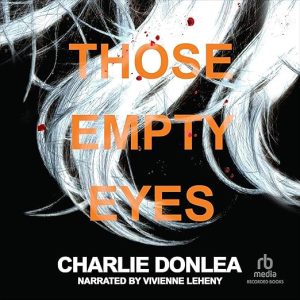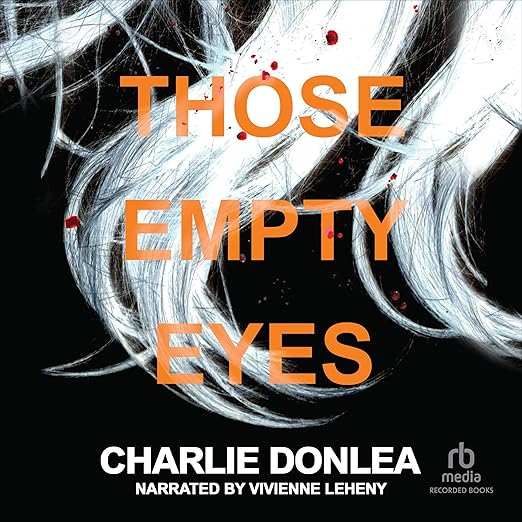
- Read by: Vivienne Leheny handles Alex's dual identity with composure, keeping the emotional layers readable without over-signaling the reveals.
- At its heart: Media vilification of crime suspects, identity reconstruction, campus sexual assault cover-ups
- Vibe: Tightly wound and propulsive
- Short version: A well-constructed thriller that earns its final twist through patient setup rather than cheap misdirection.
I started Those Empty Eyes on a Sunday afternoon while folding laundry, which I mention because within twenty minutes the laundry was still sitting in the basket and I was on the couch with my phone screen on full brightness trying to keep up. Charlie Donlea has a particular facility for hooking you before you've consciously decided to commit, and this novel uses that skill efficiently from the opening pages.
The premise is multi-layered. Alex Armstrong is a legal investigator who has spent ten years rebuilding a life under an assumed identity, hiding from the true crime community that still obsesses over her. As a teenager, she was nicknamed Empty Eyes by the media after emerging in handcuffs from her family home the night they were massacred. She was accused, fought to clear her name, won a defamation lawsuit, and then disappeared. Now she works to secure justice for others, including a man suspected in the disappearance of a student journalist named Laura McAllister, who was on the verge of exposing a rape cover-up on her university campus. The investigation into Laura's fate gradually connects to Alex's own unsolved family murders in ways that neither Alex nor the reader anticipates.
Donlea's structural strength is in how he layers the two investigations. The campus story involving Laura McAllister is not simply a B-plot that feeds information to the main narrative; it develops its own momentum and forces Alex into positions where her legal investigator identity and her personal history press against each other in uncomfortable ways. The result is a thriller that uses its protagonist's dual life as actual dramatic machinery rather than just backstory flavor. When reviewers describe expert pacing and sharp twists, the campus investigation thread is a significant part of why that assessment holds.
The media vilification angle gives the novel a contemporary edge. Alex's nickname, Empty Eyes, and the decade of harassment she has endured from true crime communities reflects a cultural reality that has only intensified since cases like the ones Donlea appears to be drawing from. One reviewer referenced the general cultural climate of podcasts and online speculation around real crimes, and that atmosphere bleeds into how Alex navigates her present. She has become fluent in the language of suspects and accusation in a way that is both her greatest professional asset and her deepest wound.
What Makes Those Empty Eyes Worth Hearing
Vivienne Leheny is a strong choice for this material. Alex is a woman who has spent ten years performing calm while processing something traumatic in the background of every interaction, and Leheny conveys that quality without ever making it feel theatrical. The control in her delivery mirrors Alex's own control. When that composure fractures in key scenes, the shift registers clearly without requiring obvious vocal dramatics. The ten-hour-and-twenty-eight-minute runtime passes with the kind of momentum that makes you feel the book was shorter than it was, which is precisely what a well-paced thriller narration should accomplish.
The double-narrative structure, alternating between Alex's present investigation and the flashback record of her original trial and defamation case, is handled cleanly in the audio format. Leheny differentiates the temporal layers with enough tonal variation to keep orientation easy without resorting to character voices that would feel out of place in a first-person thriller.
Things to Know Before Starting Those Empty Eyes
Several reviewers noted that the central twist was partially anticipated. One reader specifically said she could see it coming from early in the book but enjoyed the journey regardless. That assessment seems fair: the twist is not a bolt from nowhere but rather the logical completion of a pattern Donlea plants carefully. Whether that reads as satisfying craftsmanship or insufficient misdirection depends on your relationship with thriller conventions. Readers who want to be completely blindsided may feel the setup is too legible.
The university cover-up plot is well-executed but not subtle. Donlea's sympathies are clear, and the guilty parties are drawn with enough specificity to be recognizable types. That clarity serves the thriller machinery even if it sacrifices some moral ambiguity that might have given the novel additional texture.
Who Charlie Donlea Is Writing For
Ideal for fans of character-driven suspense who want a protagonist with genuine history and stakes, not just a competent detective archetype. Those who enjoy legal procedural elements alongside their mysteries will find the investigator framing satisfying. If you prefer thrillers where the twist is completely unpredictable, manage your expectations; Donlea's reveals reward careful readers who will have picked up on clues. Skip if you want a purely dark or literary approach to the crime genre.
Before You Listen
Does the ending of Those Empty Eyes require outside reading to make sense?
One reviewer mentioned needing to research the ending online to fully interpret the twist. The conclusion is intentionally layered, but Donlea provides enough internal context that most attentive listeners will follow it. The ambiguity may require a re-listen of the final section rather than external research.
Is this the first book by Charlie Donlea, or does it connect to his other novels?
Those Empty Eyes is a standalone novel. Donlea has a broader catalog including The Girl Who Was Taken and The Suicide House, and fans of those books will recognize his structural approach, but no prior reading is required.
How prominent is the campus sexual assault storyline, and is it handled sensitively?
The Laura McAllister investigation, which centers on a campus rape cover-up, is a significant part of the plot. Donlea does not depict assault graphically but deals directly with institutional failure and the targeting of victims. Listeners who find this subject matter difficult should know it is substantive, not background noise.
Is Vivienne Leheny's narration a good fit for Alex's character, given that Alex is hiding her identity throughout?
Yes. Leheny plays Alex's surface calm against her inner tension without overplaying either layer. The character's controlled exterior reads clearly in the narration, which makes the moments of genuine fracture hit harder than they would under a more emotionally transparent performance.