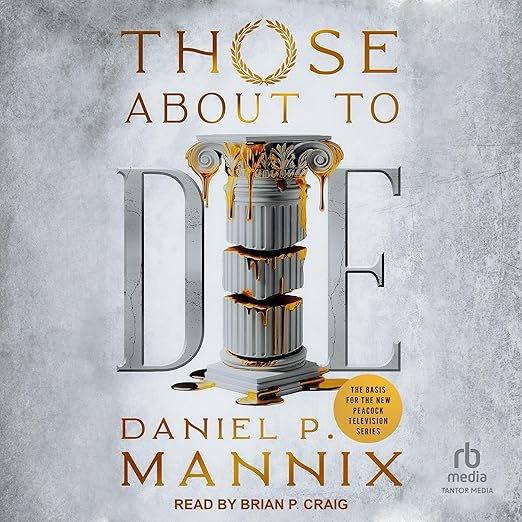
Quick Take
- Narration: Brian P. Craig delivers Mannix’s vivid prose with steady authority, his measured tone keeps the graphic content from tipping into sensationalism.
- Themes: Spectacle and political control, the evolution of violence as entertainment, gladiatorial fame and freedom
- Mood: Visceral and historically immersive
- Verdict: A 1950s classic of popular history that still holds up as a propulsive account of Rome’s games, with the caveat that scholarship has moved on since Mannix wrote it.
I was partway through a documentary on the Colosseum when a recommendation for Those About To Die appeared in my queue. I switched to the audiobook on impulse and did not stop until the chapter covering the sea battles in flooded arenas. The idea that Roman engineers actually flooded the Colosseum to stage naval reenactments is one of those historical facts that refuses to become mundane no matter how many times you encounter it.
Daniel P. Mannix wrote this book in the 1950s, when popular history had a different relationship with narrative than it does today. Those About To Die sits in the tradition of books that blend factual history with vividly rendered scenes, a style that fell out of academic fashion but never stopped producing readable books. One reviewer described it accurately as combining nonfiction historical fact with historical fiction short stories. That hybridity is the book’s main strength and, for some readers, its main limitation.
Our Take on Those About To Die
Mannix traces the games from their origin in 238 BC as county-fair-style entertainment, trick riding, acrobats, trained animals, chariot racing, through the pivotal moment when Marcus and Decimus Brutus staged slave fights at their father’s funeral, and then through the full escalation into gladiatorial spectacles that defined imperial Rome. The arc is well constructed: you feel the momentum of each escalation, the way each innovation in violence raised the bar for the next promoter trying to keep crowds satisfied.
The chapter on Circus Maximus and the Colosseum as architectural achievements is particularly strong. Mannix has genuine enthusiasm for the engineering as well as the history, and he conveys the scale of these structures in ways that make the abstract concrete. Successful gladiators who won fame, fortune, and freedom are rendered as recognizable human beings rather than abstractions.
Why Listen to Those About To Die
Brian P. Craig’s narration suits the material. He reads with composed, slightly grave authority that keeps graphic descriptions of arena violence from feeling exploitative, while still conveying the visceral reality of what Mannix is describing. At just over seven hours, the runtime is compact for a book that covers nearly seven centuries of Roman spectacle.
The prose is genuinely pleasurable in the way 1950s popular nonfiction often is, fluent, confident, written for readers who want to be educated and entertained simultaneously. One reviewer who has read the book multiple times calls that style something you do not see much anymore. There is a directness to Mannix’s writing that more hedged contemporary popular history sometimes lacks.
What to Watch For in Those About To Die
The book was first published in the 1950s, and the scholarship shows its age in places. Two reviewers note historical inaccuracies and moments where Mannix uses modern terminology that feels anachronistic. He also blends documented fact with reconstructed scenes in ways he does not always clearly distinguish, which can mislead readers who take everything at face value.
Listeners who have read more recent academic work on Roman spectacle will notice where Mannix oversimplifies or where the archaeological record has since complicated his account. Those About To Die works best as an introduction and an entertainment, not as a definitive source. Mature themes are present throughout, as flagged in the product notes.
Who Should Listen to Those About To Die
This is the right audiobook for listeners who loved Ridley Scott’s Gladiator and want the historical reality underneath the film’s spectacle, but who are not ready for dense academic monographs on Roman entertainment culture. It suits commute listening well, each chapter functions almost as a standalone episode in a longer story. Listeners who already have strong backgrounds in Roman history may find the accuracy gaps frustrating; those new to the subject will likely find it exactly as gripping as its long reputation suggests. The book’s survival across seven decades of changing scholarly fashions says something about how well Mannix understood the material he was working with, even where later research has refined or corrected his account.
Frequently Asked Questions
Is Those About To Die historically accurate, or does it take liberties?
It takes considerable liberties. Mannix blends documented history with reconstructed scenes and occasionally uses anachronistic framing. Two reviewers note specific inaccuracies. The book works best as narrative popular history rather than as a scholarly source, broadly accurate in outline, but not reliable on details.
Does Brian P. Craig’s narration handle the graphic violence well?
Yes. Craig’s delivery is measured and authoritative without being clinical. He does not dramatize the violent content in ways that feel gratuitous, and his steady pace through the more disturbing material keeps the listener focused on the historical dimension.
How does Those About To Die compare to more recent books on Roman gladiatorial culture?
It is older and less precise than contemporary scholarship, but it has a readability that academic works on the subject often lack. Think of it as a gateway text, if it captures your interest, follow it with Donald Kyle’s Sport and Spectacle in the Ancient World for a more rigorous treatment.
Does the book cover the political function of the games, or only the spectacle?
Both, though the political dimension gets less attention than the spectacle. Mannix understands that the games served as a mechanism of social control and crowd management, and he gestures toward that reading, but his primary interest is in the pageantry, the personalities, and the evolution of the entertainment itself.