Quick Take
- Narration: Kathleen Early handles the ensemble cast with practiced ease, a reliably strong pairing for Slaughter’s alternating perspectives.
- Themes: Family secrets, domestic violence, closed-room mystery
- Mood: Tense and immersive, with a gothic mountain atmosphere
- Verdict: One of the stronger Will Trent entries for newcomers to the series and a locked-room showcase that rewards patient readers through a sprawling middle section.
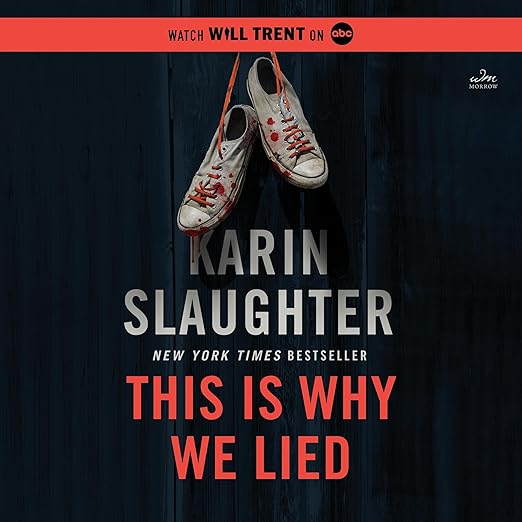
I came to This Is Why We Lied in the middle of a flight delay, which turned out to be the ideal setting. Karin Slaughter’s twelfth Will Trent novel is the kind of audiobook that makes airports disappear. By the time boarding was called I had logged four hours and was genuinely reluctant to pause it, which tells you most of what you need to know about her structural instincts even if it tells you nothing about whether the ending earns all that investment.
The premise is clever and confidently executed. GBI investigator Will Trent and medical examiner Sara Linton arrive at McAlpine Lodge for their honeymoon, an off-the-grid mountain property accessible by a single road. When Mercy McAlpine, the lodge manager, is murdered and a storm washes out that road, Will and Sara find themselves conducting an investigation they were supposed to be on vacation from, surrounded by eight guests and a dysfunctional family with enough secrets to fill the seventeen hours of runtime.
Our Take on This Is Why We Lied
Slaughter has always been more interested in the architecture of violence than in its spectacle, and this book continues that pattern. The McAlpine family, fractured, manipulative, and deeply scarred by decades of abuse and silence, is drawn with the psychological specificity that distinguishes Slaughter’s best work. Mercy herself, seen primarily through others’ accounts and brief flashback sequences, becomes one of the more haunting figures in the series: a woman ground down by her family’s cruelty who found no way out until someone took the choice from her entirely.
The Agatha Christie-adjacent structure, with its closed community and rotating suspects, is one reviewer’s comparison and it is apt. Slaughter is doing locked-room work here with contemporary Southern Gothic dressing, and the combination largely succeeds. The clue architecture is fair, the solution is achievable in retrospect without feeling telegraphed in advance, which is genuinely difficult to pull off at this length.
Why Listen to This Is Why We Lied
Kathleen Early has been narrating this series long enough that her performance of Will and Sara feels like lived familiarity rather than interpretation. She handles the ensemble, eight guests plus the McAlpine family members, with a precision that makes the large cast navigable over seventeen hours. The mountain setting, with its storm and isolation, comes through in the pacing of her delivery during the more claustrophobic passages.
For listeners new to the Will Trent series, this functions as a reasonable entry point. The honeymoon framing provides natural in-story context for who Will and Sara are and what they mean to each other, and Slaughter is careful to seed enough backstory that the emotional beats land even without prior knowledge of the eleven preceding books. That said, those who have followed the series will find particular satisfaction in seeing the relationship at a threshold moment.
What to Watch For in This Is Why We Lied
The middle section runs long. Slaughter uses the investigation’s progress through the guest list as an opportunity to build out each character’s concealed history, and some of those histories are more compelling than others. One reviewer notes that the book becomes too descriptive and lengthy in places before rushing through the ending, and that structural imbalance is real. The final revelations arrive at a pace that can feel compressed after hours of careful unspooling.
The ending also draws some criticism for not satisfying the emotional need to see the guilty parties suffer commensurately with their crimes. Slaughter has never been a writer who provides easy catharsis, and readers expecting conventional genre resolution may find the finale anticlimactic. Those who appreciate her tendency to leave darkness partially unresolved will find it more true to life.
Who Should Listen to This Is Why We Lied
Strong recommendation for fans of psychological crime fiction with Southern settings and morally complex victims. Readers who enjoy the Christie locked-room format in a contemporary key will find the premise delivers. Skip it if you need a tidy, cathartic resolution or find ensemble casts of over ten characters difficult to track across long audiobooks.
Frequently Asked Questions
Is This Is Why We Lied a good entry point for listeners new to the Will Trent series?
Yes, reasonably so. The honeymoon premise gives Slaughter a natural reason to reintroduce Will and Sara, and the mountain setting creates enough narrative self-containment that prior knowledge of the series is helpful but not required.
How does the locked-room structure work given that the lodge has eight guests plus the McAlpine family?
Slaughter manages the ensemble by giving each guest a concealed history that becomes relevant to the investigation. It is complex but navigable, especially with Kathleen Early’s differentiated narration helping distinguish the voices.
Does Kathleen Early’s narration work well for the multiple McAlpine family members, who are described as an unfamiliar ensemble?
Yes. Early handles large casts with practiced economy, she finds distinguishing vocal markers for major characters without overcrowding minor ones. The family dynamics remain clear throughout the seventeen-hour runtime.
The synopsis mentions the Will Trent TV series, do I need to watch the show to appreciate the audiobook?
No. The television adaptation takes significant liberties with the source material. The books stand completely on their own, and several longtime readers note that book Will and show Will are quite different characters.