Quick Take
- Narration: Sophie Amoss handles the ensemble of four distinct teenagers with energy and tonal range, matching Cottingham’s horror-comedy register without pushing either too far.
- Themes: Marginalization and belonging, the ethics of survival, how communities turn on those who are different even when different is just a dietary requirement
- Mood: Darkly funny and blood-soaked, festival heat, synthetic flesh, and genuine sapphic heart
- Verdict: A clever, entertaining YA horror that uses cannibalism as social metaphor more thoughtfully than you would expect, not especially frightening, but a lot of fun.
I was halfway through my evening run when This Delicious Death made me stop on a sidewalk and laugh out loud at something that, described to anyone else, would sound completely unacceptable. A ghoul ate a band member at a music festival. The other ghouls are panicking. The synthetic flesh supply is running low. Somehow Kayla Cottingham has made this feel charming. That is a significant technical achievement, and it is the thing I want to spend most of this review on.
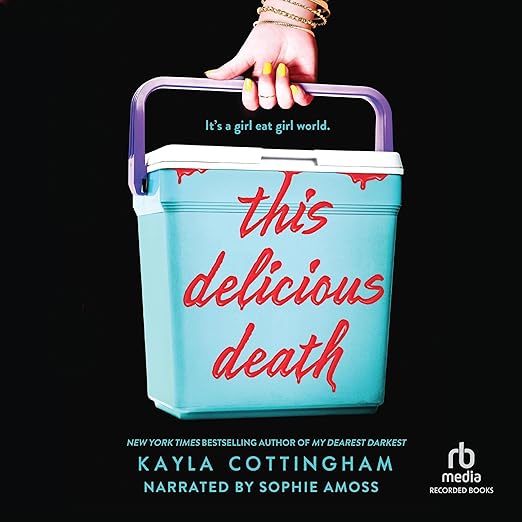
The book’s setup requires brief explanation for the uninitiated. Two years before the events of the novel, a percentage of the population underwent a transformation called the Hollowing, which left them able to survive only on human flesh. Scientists developed Synflesh, a synthetic alternative, which allowed hollowed people to function in society without ongoing atrocity. Zoey, Celeste, Valeria, and Jasmine are four hollow girls in Southern California, heading to a desert music festival for a last hurrah before graduation. They have a cooler full of vodka, seltzer, and Synflesh. Then Val goes feral on the first night and kills a band member, and everything deteriorates from there in ways that are both predictable and consistently entertaining.
The Hollowing as Social Metaphor
Cottingham is working in an established genre tradition of using literal monstrousness to explore marginalization, and she is doing it at the YA level where the allegory needs to be accessible enough to land without being so blunt it collapses. The comparison to Jennifer’s Body that multiple reviewers make is apt, both works are interested in how female monstrousness gets policed, and both use the horror genre to create space for female rage and queer desire that would be harder to stage in a realistic register. The Hollowing functions as a condition that marks its subjects as fundamentally other, that requires constant management to maintain social acceptance, and that becomes the target of organized elimination when it becomes inconvenient to the majority. The festival setting, Coachella energy, boho desert aesthetic, influencer culture on display, provides exactly the right social environment for that dynamic to play out.
A reviewer described it as ‘part horror, part social commentary, and part sapphic coming-of-age story with a side of synthetic flesh,’ which captures the layering accurately. The horror elements are present and occasionally visceral, this is not a bloodless horror-adjacent read, but Cottingham keeps the tone light enough that the gore functions more as punctuation than as atmosphere. The social commentary is sharp without being laborious, and the sapphic storyline is central rather than supplementary.
The Ensemble and the Problem of Differentiation
One of the most consistent notes in reader responses to This Delicious Death is that the four protagonists can be difficult to distinguish in the early chapters. Cottingham is working with an ensemble of teenage girls who share similar backgrounds, similar problems, and similar speech patterns, and while she differentiates them through personality and arc over the course of the novel, the opening sections ask listeners to track four similar voices before those distinctions become fully established. Sophie Amoss’s narration helps here, she gives each character a slightly different vocal quality, but the early going does require some active listening.
The character development across the four protagonists is uneven. Zoey, whose perspective is most central, and Valeria, whose going-feral crisis initiates the central plot, receive the most nuanced treatment. Celeste and Jasmine are present and functional but do not achieve quite the same depth. This is a common ensemble problem in YA horror and does not particularly damage the novel’s entertainment value, but listeners who prefer ensemble casts where every member carries equal narrative weight may notice the imbalance.
Sophie Amoss and the Horror-Comedy Tonal Balance
Horror-comedy is one of the most demanding tonal registers to sustain in audio format because the difference between a line that lands as darkly funny and the same line landing as simply inappropriate is almost entirely a matter of delivery. Sophie Amoss navigates this consistently well across the eight-and-a-half-hour runtime. Her timing in the comedic sections is quick without feeling pushed, and her handling of the more genuinely frightening sequences, the moments when the horror is real rather than campy, carries sufficient weight to make the tonal shifts feel earned rather than arbitrary.
The festival setting is evoked effectively in audio, which requires more than it might seem: Cottingham builds specific sensory detail around the heat, the crowd, the stages and vendor areas, and Amoss translates that detail into something that feels spatially coherent. The desert environment is a specific character in the novel, and the narration honors that.
For Readers of YA Queer Horror and Those Approaching the Genre
This Delicious Death works best for listeners who come to it with genre expectations calibrated appropriately. This is not a deeply frightening book, reviewers hoping for sustained dread will be disappointed. It is an entertaining, occasionally clever, consistently fun YA horror novel with sapphic heart and a protagonist group whose diversity of race, sexual orientation, and gender is handled with the matter-of-fact normalcy that represents the best of contemporary YA. For listeners who find Jennifer’s Body and Blood Fest the natural comparison points, Cottingham has delivered something in that vein. For those coming to it as a straight horror experience, the comedy and the relatively clean emotional register will likely feel too light. Knowing what you are getting is most of the battle here, and what you are getting is very much worth the eight and a half hours if the genre profile fits.
Frequently Asked Questions
How graphic is the violence in This Delicious Death, is it appropriate for younger YA readers?
The violence is present and occasionally explicit, this is, after all, a book about people who eat other people, but Cottingham keeps the tone campy enough that the gore functions more as horror-comedy punctuation than as sustained disturbing content. It is probably best suited to older teens and adults comfortable with horror-adjacent material rather than the younger end of the YA age range.
Is the sapphic romance central to the story or a secondary element?
It is genuinely central. The romantic storyline, including a transgender love interest, is integrated throughout rather than treated as a subplot. Reviewers who came for the queer horror angle consistently flagged this as one of the book’s strongest qualities.
The festival setting is compared to Coachella, does Cottingham use that setting meaningfully or is it mostly aesthetic?
It is both aesthetic and functional. The festival environment provides the specific social context the thriller requires: crowds where disappearances can be obscured, a surveillance culture that creates both visibility and vulnerability, and the particular social dynamics of an event designed for performance and consumption. The setting earns its place.
How does Sophie Amoss handle the challenge of voicing four similar teenage protagonists across eight-plus hours?
She gives each character a slightly different vocal texture and cadence that becomes more distinguishable as the novel progresses. The early chapters, where the characters are still establishing their distinct personalities, require some active listening, but by the midpoint the ensemble is clearly differentiated in the narration.