Quick Take
- Narration: Kim Churchill handles the first-person female protagonist with confidence; the voice suits the mix of defiance and underlying fear that defines the character at this stage of the series.
- Themes: Dystopian survival under vampire rule, the dismantling of indoctrinated belief, love triangle under impossible circumstances
- Mood: Urgent and at times breathless, with a slow-burn middle that pays off in a chaotic final act
- Verdict: A strong second entry in the Kingdom of Blood and Ash series that raises the stakes and expands the world, though listeners new to the series should start with the first book.
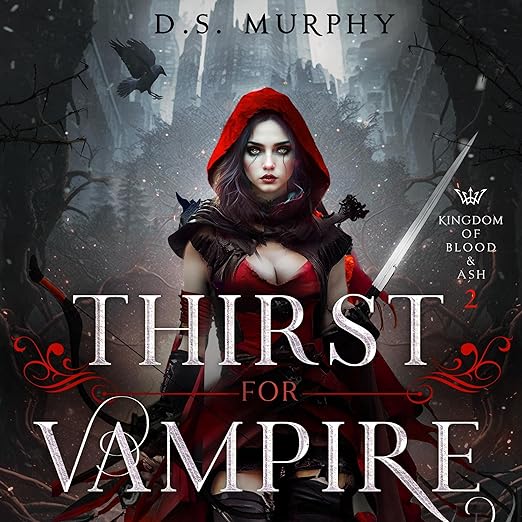
I picked up Thirst for Vampire mid-afternoon on a Friday, meaning to listen to an hour or so before dinner. I finished it that evening. That is not always a compliment in YA; sometimes the momentum comes from the prose being too thin to slow down. In this case it came from D.S. Murphy structuring her reveals well enough that the question of what happens next genuinely drove me forward through the parts of the book that were slower.
This is Book 2 in the Kingdom of Blood and Ash series, and it picks up directly from the events of the first volume. The protagonist, having barely survived her trials and been identified as a renitent, a rare human who can resist the vampire king’s compulsion, is now public enemy number one and hiding with rebels in the dystopian wasteland. The world is built with the genre’s characteristic bleakness: poisonous ash, dangerous beasts, ancient antidotes stolen by grandfathers from vampire fiancés. Murphy is not writing minimally.
Our Take on Thirst for Vampire
The central achievement of this book is what multiple reviewers describe as the protagonist’s recognition that everything she learned growing up is a lie. Murphy is working in a tradition that stretches from classic dystopia through contemporary YA, and the defamiliarization of an entire life’s worth of beliefs is the engine that powers the genre when it works. Here it works. The compound she grew up in, with its promise of elite status and eventual claiming, turns out to have been built on fabrications layered so deep that dismantling them requires the entire arc of the series, not just one book’s revelation.
The love triangle is present, as a reviewer noted somewhat dryly with a laughing emoji referencing the absence of Damien in this volume. Murphy is aware of what her readers want, and she plays the tension between the protagonist’s deepening connection with her worst enemy and her existing entanglement with the vampire fiancé with more structural self-awareness than many series at this level manage. One reviewer described the ending as not quite a cliffhanger but an open ending, which is accurate; Murphy resolves enough to give the reader satisfaction without closing off the larger arc.
Why Listen to Thirst for Vampire
Kim Churchill’s narration is the right choice for this material. The protagonist is established in the first book as someone whose defiance and fear are running simultaneously, and Churchill maintains that balance without tipping too far into either. The voice work is particularly effective during the action sequences, which Murphy writes with a kinetic quality that benefits from audio pacing. Churchill handles the emotional beats with similar care, avoiding the over-performance that YA narration can sometimes fall into when the material is intense.
The world-building in this entry also rewards listeners who have been following the series. Murphy expands the scope of the dystopian architecture significantly, providing context for the vampire king’s century-old lie that makes the first book’s revelations more meaningful retroactively. At thirteen hours, this is a full listen, and it earns the runtime through consistent narrative development rather than filler.
What to Watch For in Thirst for Vampire
The beginning of this book, as at least one reviewer noted, is slow. Murphy is reestablishing the world and the character’s situation after the events of Book 1, and listeners who are coming straight from the first book will feel the difference in momentum from where that one ended to where this one begins. The payoff is real, but the opening chapters require patience that the first book’s setup did not demand.
The final act is also very dense. Murphy compresses a significant amount of plot, revelation, and emotional resolution into the last portion of the book, and the effect is that some elements feel rushed where the middle was leisurely. It is a pacing imbalance the series has, and listeners should adjust expectations accordingly: the experience is uneven but the high points are worth the slow patches.
Who Should Listen to Thirst for Vampire
Series readers who have finished the first Kingdom of Blood and Ash book are the obvious audience, and the book rewards their investment. New listeners should not start here: the world-building, character relationships, and backstory are too established to be absorbed without prior context. For those who enjoyed the first entry and wanted more world-expansion and a broader canvas for the protagonist’s development, this delivers both. Listeners who found Book 1 had too much romance and not enough action will find this entry better balanced; those who came specifically for Damien will find his reduced role a genuine disappointment.
Frequently Asked Questions
Can I start with Thirst for Vampire without having read the first book?
Not recommended. The second book in the Kingdom of Blood and Ash series begins where the first ends and assumes full familiarity with the world, the character relationships, and the events of the protagonist’s trials. New listeners should start with Book 1.
How prominent is the romance in this second book compared to the first?
The love triangle remains present but shifts in emphasis; Damien, the vampire fiancé who featured heavily in the first book, has reduced page time here, which some reviewers noted as a disappointment. The protagonist’s relationship with her worst enemy develops more significantly in this volume.
Is Kim Churchill’s narration consistent with the first audiobook in the series?
Yes, Kim Churchill narrates throughout the series, providing continuity of voice across volumes. Listeners familiar with her work in Book 1 will find the transition to Book 2 seamless.
Does the book end on a cliffhanger, or is there enough resolution to feel complete?
Reviewers describe it as an open ending rather than a true cliffhanger; enough is resolved to provide satisfaction, but the larger arc of the series is clearly unfinished. Those who prefer contained stories should know there is a third book, but the ending of Book 2 is not calculated to leave listeners stranded.