Quick Take
- Narration: Dion Graham is an Audie Award-winning narrator, and his handling of this material is a model of how to deliver disturbing historical content with gravity and clarity. He also appears in bonus audio for a conversation with Bartoletti.
- Themes: The origins of domestic terrorism, Reconstruction-era racial violence, the anatomy of a hate group
- Mood: Sobering, historically rigorous, and deliberately unsettling
- Verdict: One of the strongest introductions to KKK history written for young adults, strengthened considerably by Dion Graham’s narration and the inclusion of primary source material.
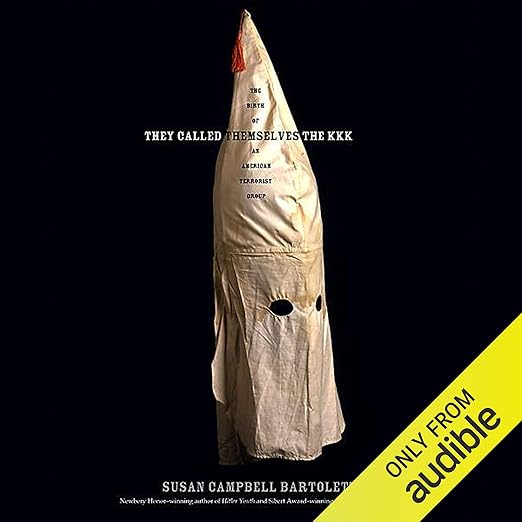
I had a week of heavy reading and put off finishing They Called Themselves the KKK because I knew what I was getting into. Not because Susan Campbell Bartoletti’s book is gratuitous, but because it is thorough. This is a YALSA Nonfiction Finalist from 2011 that has held up in a way that genuine historical scholarship tends to. It does not sensationalize, and it does not soften. It presents the origins and early expansion of the Ku Klux Klan in the post-Civil War South with the careful, sourced attention of a writer who understands that she is writing history, not cautionary tale.
The origin story is both chilling and banal, which is the point. Six restless young men raided linens at a friend’s mansion in Pulaski, Tennessee, pulled pillowcases over their heads, and rode through town for spectacle. They called themselves the Ku Klux Klan. From that absurd beginning grew an organization that terrorized Black communities, targeted Republican politicians and allies, and functioned as a system of racial control during Reconstruction that the book places within its full historical context. The chilling words Boys, let us get up a club have rarely carried this much freight.
Our Take on They Called Themselves the KKK
Bartoletti’s great strength here is her sourcing. She weaves together oral histories, congressional documents, and personal diaries in a way that makes abstract historical violence feel documentably real. Reviewers consistently praise the thoroughly-researched quality of the work. This is not a simplified overview. It is a Young Adult history that treats its readers as people capable of handling complexity, which is the only responsible way to write about this subject.
The historical framing matters as much as the facts. Bartoletti places the Klan’s rise within the context of Reconstruction and the specific political and economic resentments that allowed it to grow from a handful of young men in Tennessee into what they called an Invisible Empire. One reviewer notes that the book corrects the Lost Cause framing many students received in school, presenting Reconstruction not as Northern oppression but as a period in which Black political and economic progress was systematically and violently dismantled. That corrective function is one of the book’s most important contributions.
Why Listen to They Called Themselves the KKK
Dion Graham is one of the finest narrators working in audiobook production, and this material calls for exactly the qualities he brings: gravity, precision, and the ability to deliver genuinely disturbing content without retreating from it or overemphasizing it for effect. The bonus audio, a conversation between Graham and Bartoletti, adds a layer of context that deepens the listening experience and is worth staying for. At four hours and twenty-six minutes, this is efficiently sized for classroom or independent listening.
One reviewer purchased this book specifically because it appeared on book ban lists, wanting their children to grow up as well-educated human beings who know about history and the social dilemmas that continue to permeate society today. That motivation speaks to something real about why this book matters and why the discomfort it provokes is not a reason to avoid it.
What to Watch For in They Called Themselves the KKK
A few reviewers note that the book focuses primarily on the Klan’s first wave during Reconstruction and covers the twentieth century resurgence relatively briefly in the epilogue. Listeners hoping for a comprehensive history of the Klan through the mid-twentieth century civil rights era will find this scope intentionally narrow. The depth within that first wave, however, is substantial.
One critic noted the absence of full citations and questions about the academic rigor of some claims, which is worth acknowledging. This is a Young Adult history, not a scholarly monograph, and its footnote apparatus reflects that. It is thoroughly researched in the sense of drawing from primary sources, but it is not designed for academic citation chains.
Who Should Listen to They Called Themselves the KKK
Essential listening for high school history classes covering Reconstruction and post-Civil War America, for any young person who received a whitewashed version of this history in school, and for adults who want to revisit and correct gaps in their own historical education. Those seeking a comprehensive twentieth century history of the Klan should supplement with additional sources. But as an entry point to understanding how domestic terrorism is built and how it functions, this is among the most accessible and honest books in the young adult nonfiction canon.
Frequently Asked Questions
What is the historical scope of this book? Does it cover the Klan’s full history through the twentieth century?
The book focuses primarily on the Klan’s founding in Pulaski, Tennessee and its growth during Reconstruction. The epilogue briefly addresses the twentieth century resurgence and ongoing activity, but the core narrative stops short of a comprehensive twentieth century history. Reviewers note this is the book’s main scope limitation.
Is Dion Graham’s narration appropriate for the disturbing content this book contains?
Graham handles the material with exactly the gravity it requires. He delivers accounts of racial terror and violence with clarity and weight, neither sensationalizing nor retreating from the content. His narration has received specific praise for how it serves difficult historical material. The bonus conversation between Graham and Bartoletti is also included in the audiobook.
How does this book address the Lost Cause mythology many students learned in school?
Directly and substantively. Bartoletti explicitly situates the Klan’s origins within the political and economic realities of Reconstruction, countering the narrative that Reconstruction was Northern oppression and that the Klan emerged as a defensive response. The book frames the Klan’s rise as a terror campaign against Black political and economic progress, sourced from primary documents including congressional testimony.
Why has this book appeared on book ban lists, and is the content appropriate for the young adult audience it targets?
The book contains accounts of racial terror, murder, and systematic violence that some communities have sought to restrict. It is age-appropriate in the sense that it handles this content without gratuitous detail, in the same manner serious young adult history has always handled difficult subjects. The argument for keeping it available is precisely that understanding this history is necessary for informed citizenship.