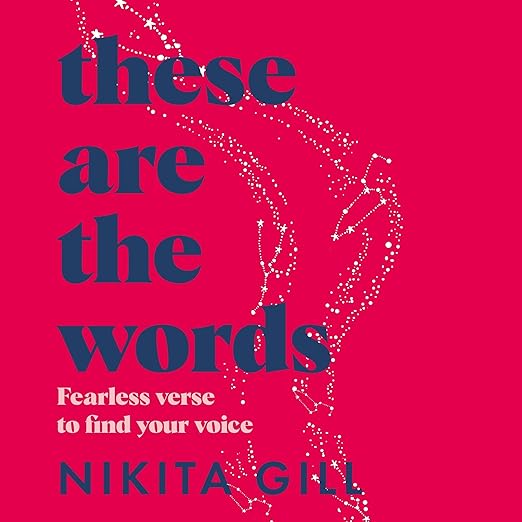
Quick Take
- Narration: Nikita Gill reads her own poetry, and the difference between this and a stranger performing her work would be considerable, her voice carries the cadence she intended.
- Themes: Self-reclamation, the seasons of emotional life, feminist agency
- Mood: Achingly warm and fierce in turns
- Verdict: A short but genuinely affecting listen for anyone in the middle of heartbreak, anger, or the slow work of becoming yourself.
I came to Nikita Gill’s work the way a lot of people do, through a single poem shared somewhere online, the kind that stops you mid-scroll. These Are the Words arrived as her YA debut in 2022, and listening to her read it herself at just over two hours is a different experience than encountering her words on a page or screen. The intimacy is greater. The pauses carry more weight. I listened to it on a Sunday afternoon when I had no particular agenda, which turned out to be exactly the right conditions for it.
Poetry audiobooks live or die by the voice that reads them, and Macmillan Children’s Books made the right call in having Gill narrate her own collection. This is poetry written from a specific emotional geography, and the author’s performance makes that geography legible in a way that a hired narrator, however skilled, could not reliably achieve. When Gill reads lines like those excerpted in the synopsis, the trees do not apologize to the wind that uproots them, you feel the conviction behind the construction. These are not lines she assembled for effect. They are lines she needed to write, and hearing her deliver them makes that clear.
Our Take on These Are the Words
The collection is organized around the seasons of the soul, which is less a structural gimmick than a genuine organizing principle. Each section has its own emotional weather: the grief of first breakup, the relief of found community, the particular anger of being told to forgive what you have not finished surviving. Gill writes with what one reviewer called an instantly recognizable voice, and that is accurate. There is a compression in her lines, a refusal to let sentiment sprawl, that distinguishes her from the more diffuse end of contemporary social media poetry.
The seasonal astrological poetry mentioned in the synopsis sits alongside more directly personal pieces, and together they give the collection a breadth that a purely memoir-driven approach might not achieve. This is poetry that wants to be useful as much as beautiful, and it largely succeeds at both impulses simultaneously.
Why Listen to These Are the Words
A reviewer described buying this for a struggling young woman who found it excellent. Another noted that despite the YA designation, the work is worth sharing with adults, particularly those who respond to poetry that speaks directly rather than obliquely. At two hours and fifteen minutes, this is a collection you can listen to in a single sitting or in small pieces, returning to individual poems the way you would bookmark a page in a physical copy. Gill’s pacing as a narrator is unhurried, giving space for each piece to settle before the next begins, a rhythmic generosity that enhances the experience considerably.
What to Watch For in These Are the Words
Listeners expecting traditional narrative arc will not find it here, this is a poetry collection, not a memoir with connecting prose. The pieces are short and self-contained, which means the listening experience is more cumulative than progressive. Some entries are stronger than others, as in any collection. The two-hour runtime may feel brief to listeners accustomed to longer audiobooks, but the format is appropriate to the material: poetry is not best absorbed in bulk, and Gill’s pacing makes the brevity feel intentional rather than insufficient.
Who Should Listen to These Are the Words
This is particularly well-suited for teens and young adults in the middle of a significant emotional transition, a breakup, a falling out with family, a period of uncertainty about who they are. It is also a strong choice for adults who respond to contemporary poetry with feminist and healing-oriented themes. Those who find Rupi Kaur’s work too spare or too familiar may find Gill’s voice more satisfying, her lines are slightly more dense and her use of imagery more grounded in the natural world. Anyone who has gifted Wild Embers or Great Stars will know exactly who to share this one with.
Frequently Asked Questions
Does Nikita Gill’s narration of her own poetry affect the listening experience significantly compared to a professional audiobook narrator?
Considerably. Gill’s cadence, pacing, and emotional emphasis are baked into the poems at the composition stage. Hearing her read them makes the intended rhythm audible in ways that even a skilled narrator would have to approximate. This is one of the stronger arguments for author narration in poetry specifically.
Is These Are the Words appropriate for a 14 or 15-year-old, or is it pitched at older young adults?
The publisher has positioned it as YA, and the content, first heartbreak, family, identity, anger, is appropriate for readers from around 14 upward. The emotional themes are universal rather than age-restricted, and multiple reviewers noted sharing it with adults.
How does this collection compare to Nikita Gill’s earlier poetry books like Great Stars and Wild Embers?
Those earlier collections were written for an adult audience. These Are the Words is Gill’s first YA-specific poetry collection, meaning the voice is slightly more direct and the themes are organized around experiences that feel particularly urgent in adolescence. Existing fans of her work will recognize the style but find the framing more explicitly addressed to younger readers.
At just over two hours, is the runtime sufficient for the price point compared to prose audiobooks?
Poetry runs short. Two hours of Gill reading her own work is substantially richer per minute than two hours of a prose narrative. The brevity reflects the form, not the depth of the collection.