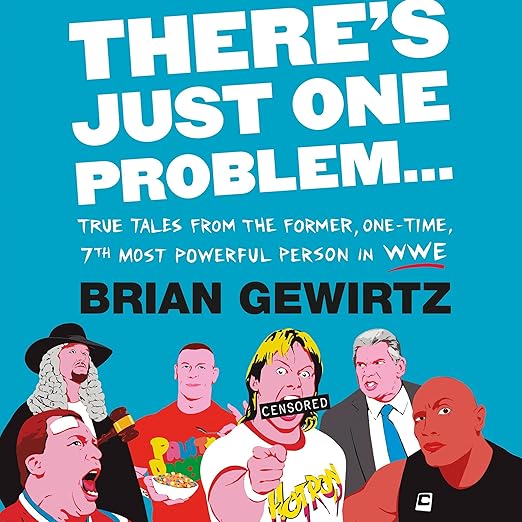
I am not a wrestling fan. I want to be upfront about that because There's Just One Problem is one of those books that non-fans occasionally try to write off before opening, assuming that the institutional knowledge required to appreciate it is too specialized. They are wrong. Brian Gewirtz's memoir of fifteen years as WWE's head writer is, at its core, a book about what it is like to be a creative person dropped into an institution run by an unpredictable alpha personality who also happens to be brilliant at what he does. If you have ever worked in television, entertainment, or any creative environment with a powerful and difficult boss, significant parts of this book will feel like they are describing something you lived.
The origin story is legitimately strange. In 1999, after working on a special together for MTV, Dwayne Johnson turned to twenty-six-year-old television writer Brian Gewirtz and asked if he had ever considered writing for WWE. Gewirtz said yes, thinking it would be a brief detour. It lasted fifteen years and took him from the edge of the industry to the position of, by his own reckoning, the seventh most powerful person in all of professional wrestling. That arc, from complete outsider to ultimate insider in a world that actively did not want him, is the book's backbone and its most compelling argument that stranger things have happened in the entertainment industry.
The Review
The book's most compelling relationship is not the one between Gewirtz and The Rock, though that relationship is warmer and more nuanced than celebrity proximity stories usually produce. It is the relationship between Gewirtz and Vince McMahon, WWE's Chairman, whom Gewirtz describes with the kind of specific, carefully observed detail that can only come from years of close proximity to a genuinely unusual person. McMahon is brash, unpredictable, capable of creative brilliance and institutional stubbornness in the same meeting, and loyal in ways that Gewirtz finds both sustaining and complicated.
One reviewer accurately describes Gewirtz's self-deprecating, sardonic internal dialogue as one of the book's primary pleasures. He is not particularly interested in making himself the hero of his own story. The moments where his instincts were wrong, where his scripts failed, where the locker room made clear that he was not welcome, are described with the same analytical attention he brings to the things that worked. That even-handedness is unusual in behind-the-scenes entertainment memoirs, which tend to either settle scores or sanitize. Gewirtz appears to be doing neither, which makes the book considerably more trustworthy as a document.
Why Listen to There's Just One Problem...
For wrestling fans, the value of the book is in its specificity. Gewirtz was present for the Attitude Era, the Ruthless Aggression Era, the PG Era, and the Reality Era, covering the full arc of WWE's creative evolution across a remarkable fifteen-year window. His accounts of working with Stone Cold Steve Austin, John Cena, Stephanie McMahon, Paul Heyman, Chris Jericho, and Shawn Michaels are not gossip but working accounts of the creative process, the negotiations between what was written and what the talent would actually do, the gap between the theoretical script and the performed moment. These sections are the most operationally interesting for wrestling fans, but they function as entertainment regardless of your familiarity with the product.
The Rowdy Roddy Piper anecdote, where Piper advises Gewirtz that when you are full of fear the only way through is to become fearless, is one of several moments in the book that transcend the wrestling context entirely. This is advice about creative courage, about what it costs to do work in an environment that is actively hostile to your presence, and it lands with real weight in a book that is otherwise consciously comic in its self-presentation.
The Caveats
Comedy is the hardest thing to narrate. The timing that makes a self-deprecating observation land in prose depends entirely on rhythm and pace in audio, and a narrator who cannot feel the comedy will flatten it completely. Baglia is well matched to Gewirtz's voice, reading with the sardonic lightness the material needs without pushing the jokes. Reviewers consistently describe the book as funny enough to read aloud, and Baglia's performance validates that assessment. At just under nine and a half hours, the pace sustains well through the anecdotes without losing energy in the more reflective sections.
One quality Baglia brings that is easy to undervalue is his comfort with the material's genuine affection for its subject. Gewirtz is not a disenchanted former employee writing a takedown. He liked the work, he liked many of the people, and he is nostalgic in an honest rather than a dewy way. Baglia captures that register without sentimentalizing it, which is the correct interpretation and the harder one to pull off.
Who Brian Gewirtz Is Writing For
For wrestling fans, this is straightforward: it is the behind-the-scenes account of an era and a creative apparatus that has been discussed and speculated about for decades, told by someone with unmatched access. For non-fans, the wrestling context is a vehicle for a very good story about creative work, institutional loyalty, and the specific experience of an introvert who found himself, against all probability, at the center of one of the biggest entertainment enterprises in the world. The jokes land regardless of what you know about the product. The management lessons are real. And the portrait of Dwayne Johnson as a friend and collaborator is one of the more humanizing accounts of a celebrity I have encountered in the behind-the-scenes memoir genre.
In Brief
- Narrator: Greg Baglia matches Gewirtz's self-deprecating, sardonic register and handles the comedic timing well, keeping a behind-the-scenes memoir consistently entertaining across nine hours.
- Subjects: The outsider making it inside a closed industry, creative work under absurd institutional pressure, the friendship between an introvert and a global celebrity
- Tone: Hilarious and unexpectedly candid, with genuine affection for the subject
- Bottom line: The definitive insider account of WWE's Attitude Era and beyond, written by the person closest to the creative center of it, and funny enough to read even if you have never watched a minute of wrestling.
Common Questions
Does Greg Baglia's narration capture Gewirtz's sardonic, self-deprecating voice, or does the comedy get flattened in audio?
Baglia is well matched to the material. He handles the comedic timing with enough lightness to let the jokes land without over-performing them, which is the correct approach for memoir comedy. Reviewers who describe the book as laugh-out-loud funny are largely referring to the audio experience.
Does the book cover the full arc of Gewirtz's time in WWE, including both his rise and his departure?
Yes. The book follows Gewirtz from his entry in 1999 through the major creative eras of WWE, covering the Attitude Era through the Reality Era and addressing how his relationship with the organization evolved over fifteen years. The ending is handled with the same candor as the rest.