Quick Take
- Narration: Andy Andrews reading his own work adds genuine warmth and authority : self-narrated inspirational fiction tends to work, and this is no exception.
- Themes: Resilience through adversity, wisdom as a gift across generations, purpose and second chances
- Mood: Uplifting, earnest, and briskly paced at under four hours
- Verdict: A compact and sincerely felt inspirational story best suited to young listeners at genuine crossroads, with enough emotional intelligence to work for adults reading alongside them.
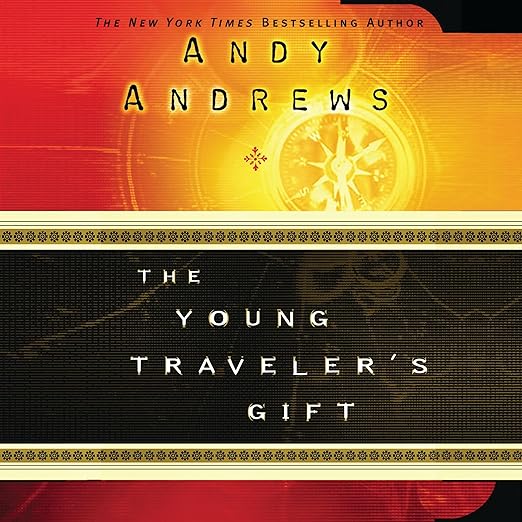
I have a complicated relationship with inspirational fiction aimed at teenagers. The genre often talks at its audience rather than with them, packing lessons into narrative packaging that the reader can feel from the first page. The Young Traveler’s Gift, Andy Andrews’s YA adaptation of his adult novel The Traveler’s Gift, is better than that framing suggests, partly because Andrews reads his own work and you can hear the genuine investment in it, and partly because the character of Michael Holder is drawn with more specificity than the genre usually allows.
Michael is a high school senior who hits what the synopsis honestly calls rock bottom. Caught in the wrong place at the wrong time, he loses his track scholarship, faces suspension, disappoints his parents, and arrives at a moment of genuine despair. The divine intervention that follows sends him on a journey through historical figures, each of whom offers one of the Seven Decisions for Success that the adult Traveler’s Gift built its reputation on. Rewritten for a teen and tween audience, the framework is the same but the emotional register is calibrated for younger readers who may be encountering these ideas for the first time.
Our Take on The Young Traveler’s Gift
Andrews narrating his own work is a significant asset. At three hours and fifty-six minutes, this is short enough to finish in a single sitting, and his voice carries the confidence of someone who has given these ideas not just intellectual but personal weight. The reading feels like a mentor telling a story rather than an author performing one, which is precisely the right quality for material aimed at young people facing actual difficulty.
What strikes me about the reviews for this book is how consistently readers mention using it as a gift rather than discovering it themselves. Multiple reviewers bought it for grandchildren, nieces, nephews, teenagers they know who are struggling. That pattern tells you something about how the book functions: it is designed to be handed to someone at a particular moment in their life, which gives it a fundamentally different purpose than fiction meant to be discovered independently.
Why Listen to The Young Traveler’s Gift
The audio format is particularly well-suited to this kind of inspirational fiction because the experience of being read to by an author who genuinely means what they are saying is qualitatively different from reading the same words yourself. Andrews has been delivering these ideas in talks, books, and interviews for decades, and that accumulated clarity comes through in how he paces his own sentences. He knows where the emphasis should land, and he places it there without telegraphing it.
For young listeners especially, audio removes the resistance that can come with being handed a book and told it will help them. Listening on headphones in a private moment creates the conditions for a story like this to actually land rather than feel like assigned meaning-making.
What to Watch For in The Young Traveler’s Gift
The Seven Decisions framework is explicitly foregrounded, which means the book does carry a didactic quality that some readers will find more or less natural depending on their tolerance for structured inspirational content. The meetings with historical figures serve primarily as vehicles for delivering each decision rather than as fully dramatized historical encounters, and readers looking for richly imagined historical fiction will find the apparatus thin. This is not a criticism of what the book is trying to do, but a clarification of what it does not aim to be.
The faith dimension is present but lighter than in much of the Christian inspirational space. The divine intervention is real within the story’s logic, but the book does not lean heavily on explicit theology. This makes it somewhat more accessible to readers outside a Christian framework than the synopsis might suggest.
Who Should Listen to The Young Traveler’s Gift
This is an excellent choice for teenagers at genuine crossroads : college decisions, disappointments, moments of genuine self-doubt about whether effort is worth it. It works equally well as a gift from a trusted adult as a self-discovery. Adults who have read the original Traveler’s Gift and want a version to share with a young person in their life will find this adaptation does the job with care. Skip it if you are looking for morally complex YA fiction, or if didactic narrative frameworks are something you resist in general. For the audience it is designed for, it earns its reputation.
Frequently Asked Questions
Do I need to have listened to The Traveler’s Gift before picking up The Young Traveler’s Gift?
No. The Young Traveler’s Gift is a self-contained retelling designed specifically for a younger audience, with a different protagonist and simplified framework. The synopsis notes that Michael Holder’s journey actually precedes David Ponder’s in narrative chronology, but you do not need any prior knowledge of the series to follow or appreciate this book.
Is this audiobook appropriate for younger teens, or is it aimed at older high schoolers?
Andrews writes it for ‘teens and tweens,’ and the material supports that range. Michael’s situation, a scholarship lost and a reputation damaged in senior year, will resonate most with high schoolers, but the Seven Decisions framework is pitched in language accessible to younger readers. Parents of twelve to fourteen year olds should find it appropriate and useful.
How explicitly Christian is the content, given it is published by Tommy Nelson?
The divine intervention framing is present and real within the story’s logic, and the book is published by an imprint known for faith-based content. However, the Seven Decisions themselves are framed as universal principles rather than explicitly theological doctrine. The faith element is present but not the dominant register, making it more accessible than other titles in the Tommy Nelson catalog.
At under four hours, is this audiobook substantial enough to justify the time investment?
For the audience it targets, yes. The brevity is actually a feature. A teenager in a difficult moment does not need a ten-hour commitment : they need something that can be finished in an afternoon and absorbed quickly. The short runtime also makes it a natural candidate for re-listening, which several reviewers mention doing.