Quick Take
- Narration: Eleanor Tomlinson delivers a composed, English-accented performance that suits the domestic thriller tone well; her pacing during the tension-heavy third act is particularly effective.
- Themes: sisterly bonds under pressure, domestic secrets, identity and mistaken targeting
- Mood: Taut and quietly unsettling, with a slow build that accelerates sharply
- Verdict: A clean, competent psychological thriller that earns its twist; best suited to readers who can tolerate a measured first half before the story breaks open.
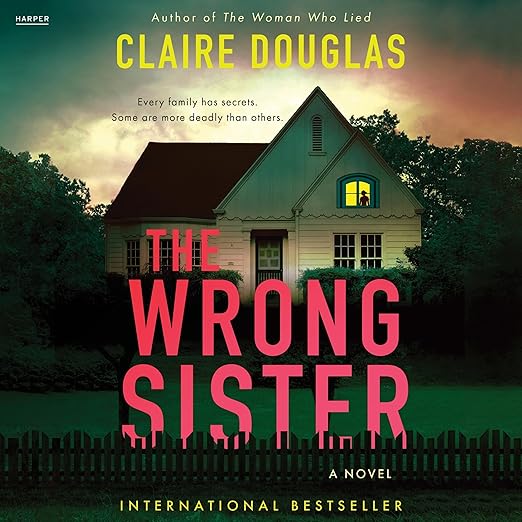
I started this one on a Thursday evening with no intention of finishing it that night. By the time the note arrived, the one addressed to Tasha that reads it was supposed to be you, I had passed midnight without noticing. That kind of hold is exactly what Claire Douglas is known for, and The Wrong Sister delivers it in familiar but well-executed form.
Douglas has built a substantial career on domestic thrillers with near-identical women at their center, from The Sisters to Local Girl Missing, and this entry in her catalogue follows a reliable template while finding enough specific texture to stand apart. Two sisters, Tasha and Alice, who look alike but have built entirely different lives. A home invasion while Tasha is away. A husband dead. A sister in intensive care. And a note that reframes everything that came before.
Our Take on The Wrong Sister
The novel’s central mechanics are efficient. Douglas sets up the central misdirection early, with enough clarity that attentive listeners may sense its shape before the reveal, while still managing to pay it off satisfyingly. One reviewer, BC, noted that as an avid mystery fan who typically figures everything out before the end, this one was a genuine surprise. That is the real benchmark for this genre, and by that measure, Douglas succeeds.
Eleanor Tomlinson narrates with a calm authority that suits the material. The story is told in close third-person, following Tasha, and Tomlinson keeps the emotional register believable throughout the long middle section where the investigation stalls and Tasha has to hold her own life together. The pacing does drag slightly in hours three and four, which is the price of the slow-burn structure, but Tomlinson’s measured delivery stops it from becoming frustrating.
Why Listen to The Wrong Sister
Douglas has been publishing domestic thrillers for over a decade, and what is consistent across her catalogue is a structural discipline that keeps the reader off-balance without feeling cheated. The Wrong Sister applies that discipline reliably. If you are a Claire Douglas reader, this is a natural continuation. The Bristol setting is specific and grounded. The sibling dynamic between Tasha and Alice is drawn with enough psychological plausibility that the story never feels schematic. And unlike some domestic thrillers that withhold information arbitrarily, Douglas plays relatively fair with her clues; the dramatic irony arrives from the situation itself rather than from narrative sleight of hand.
For new readers to Douglas, this is an accessible entry point. The Wrong Sister is self-contained and does not require knowledge of her earlier work. Several reviewers flagged it as a book that sent them looking for more of her catalogue, which suggests it functions well as an introduction.
What to Watch For in The Wrong Sister
The novel’s tension depends on a particular assumption that Tasha holds about who the real target was, and Douglas is careful to make that assumption feel natural rather than contrived. Pay attention to the early chapters that establish Tasha and Aaron’s home life in Bristol; details introduced quietly there carry more weight later than they initially appear to.
The third act accelerates noticeably, which is both a strength and a structural seam. A handful of reviewers noted small logical gaps in how certain plot details resolve, though none found them fatal to the overall experience. This is the kind of thriller where emotional momentum matters more than procedural precision, and on that level it holds together well.
Who Should Listen to The Wrong Sister
Domestic thriller readers who have enjoyed Douglas’s previous work will be comfortable here. Listeners who want complex psychology or subversive genre experimentation will find this conventional by design. At just under nine hours, it moves quickly enough to reward those who want a focused listen over a weekend. Tomlinson’s narration makes it particularly well-suited to commute or evening listening, where the atmosphere can build without interruption. The Bristol setting and the close family dynamics give the story enough specificity to feel grounded rather than generic, which is the quality that separates Douglas’s better work from the crowded field she operates in.
Frequently Asked Questions
Does The Wrong Sister work as a standalone, or should I read other Claire Douglas books first?
It is fully standalone. The Wrong Sister has no continuing characters from Douglas’s other novels and requires no prior knowledge of her work. It functions as a complete, self-contained thriller.
How graphic is the violence in The Wrong Sister?
The violence is present but not gratuitous. A man is killed and a woman seriously injured in a home invasion, but Douglas focuses on aftermath and psychological consequence rather than graphic description. The tone is closer to psychological suspense than crime procedural.
Is the twist in The Wrong Sister genuinely surprising or telegraphed early?
Opinions vary, but most listeners report the main twist landing with real impact. The setup is fair enough that careful attention may surface hints, but the story is structured to keep the critical information convincingly obscured until Douglas chooses to reveal it.
How does Eleanor Tomlinson handle the dual-sister dynamic in the narration?
Tomlinson narrates primarily from Tasha’s perspective and does not differentiate the sisters through distinct vocal characters, as the story stays in close third-person. Her performance is consistent and emotionally controlled, which suits the sustained dread that Douglas builds across the novel.