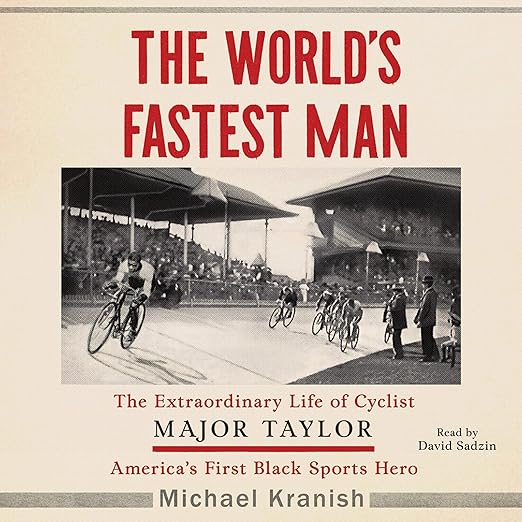
Quick Take
- Narration: David Sadzin delivers Kranish’s investigative journalism prose with clean authority, the narration serves the story without calling attention to itself, which is exactly right for this material.
- Themes: Racial injustice in the Gilded Age, athletic excellence against structural opposition, the forgotten history of Black American sports pioneers
- Mood: Inspiring and at times genuinely heartbreaking, meticulously researched
- Verdict: An essential recovery of a near-forgotten figure, Major Taylor’s story illuminates an entire era of American history through the unlikely lens of competitive cycling.
I knew almost nothing about Major Taylor before picking up The World’s Fastest Man. I knew cycling had a complicated racial history, I knew the 1890s cycling craze was real, and I knew the name vaguely as someone who had been written about in the context of Black athletic pioneers. What I did not know, what almost no one outside a narrow circle of sports historians knows, is how complete and remarkable the story is: the world championship, the European tours, Paris receiving him as a celebrity while American venues refused to let him race, the white mentor who staked his own reputation on a Black teenager nobody thought should be competing. I listened to the first three hours of this on a Saturday morning and did not stop for anything.
Michael Kranish is an investigative journalist, and that background shapes this book in entirely productive ways. He conducted a rare interview with Taylor’s daughter and uncovered details about Taylor’s life that had not previously appeared in print. The result is a biography that feels genuinely new rather than a repackaging of existing knowledge, the archival work is visible in the texture of the storytelling, in the specificity of the social and political contexts Kranish reconstructs around Taylor’s career. David Sadzin’s narration handles that journalistic prose with the same no-fuss clarity that characterizes good sports reporting: he stays out of the way and lets the material do its work.
Our Take on The World’s Fastest Man
Publishers Weekly called it a sharp-eyed account of a nearly forgotten African-American sports legend, and The Washington Post noted that Taylor preceded Joe Louis, Jesse Owens, Serena Williams, and Tiger Woods in the lineage of Black athletes who had to fight for the right to compete on equal terms. That lineage framing is not incidental, it is the book’s argument. Taylor’s story matters not only on its own terms but because it keeps getting forgotten, and Kranish’s research is partly an act of historical recovery. The Jim Crow context is rendered with enough depth that readers who come primarily for the sporting story will leave with a richer understanding of what American society looked like at the turn of the twentieth century. Twelve years before boxer Jack Johnson, fifty years before Jackie Robinson, the historical specificity of that framing matters enormously.
Why Listen to The World’s Fastest Man
Because the story is genuinely extraordinary and because Kranish tells it with a journalist’s respect for evidence and an essayist’s feel for scene. The cycling content is vivid, the track racing of the 1890s, the technology of the bicycle as transportation revolution, the physical reality of the events Taylor dominated, and the racial politics of the era are drawn with specificity rather than broad strokes. One reviewer noted that the book opened their eyes to a sport they never knew existed and to the race problem in those days in ways they had not appreciated. That combination of revelation in two directions at once is what elevates this above competent sports biography into something more lasting.
What to Watch For in The World’s Fastest Man
A few reviewers noted that the book’s ending carries genuine sadness, Taylor’s later years were not kind, and Kranish does not soften that reality. The Washington Post review that describes it as both inspiring and heartbreaking is accurate. Listeners hoping for a clean triumphant resolution should be prepared for something more complicated. The cycling-specific material may also require patience from readers with no prior interest in the sport, though Kranish provides enough context that prior knowledge is not a requirement for following the story.
Who Should Listen to The World’s Fastest Man
Readers of American sports history, particularly anyone interested in the pre-integration era of Black athletic achievement, will find this indispensable. Fans of narrative nonfiction that uses sport as a lens for broader social history, think David Maraniss or Jonathan Eig, will be entirely at home here. Cycling enthusiasts will find both the historical context and the racing detail rewarding, and may be surprised by how much they did not already know.
Frequently Asked Questions
Do I need any interest in cycling to enjoy The World’s Fastest Man?
No. Multiple reviewers describe themselves as non-cyclists who found the book compelling primarily as American history and as a story about race, ambition, and structural opposition. The cycling provides the context rather than being the point.
What makes Kranish’s account different from earlier biographies of Major Taylor?
Kranish conducted a rare interview with Taylor’s daughter and uncovered previously unpublished details about his life. The book’s investigative foundation gives it specificity that distinguishes it from earlier, less-researched treatments of the subject.
How does the book handle Taylor’s later years and decline?
Honestly and without false consolation. Taylor’s post-career years were marked by financial difficulty and declining health, and Kranish does not minimize that. Several reviewers describe the ending as heartbreaking alongside the inspiration of the championship years.
Is David Sadzin’s narration a good fit for Kranish’s journalistic prose?
Yes. Sadzin’s clean, authoritative delivery suits investigative nonfiction well, he reads for clarity and pace rather than theatrical effect, which is the correct approach for this material.