At a Glance
- Narration: Samantha Desz brings clarity and measured enthusiasm to a complex subject - her pacing makes the cryptology accessible without condescending.
- Themes: Gender discrimination, cryptology and code-breaking, WWII intelligence history
- Mood: Quietly gripping and inspiring, with an undercurrent of justified anger
- Verdict: One of the stronger STEM-focused YA biographies in recent years, and entirely worthwhile for adult listeners who didn't know Elizebeth Smith Friedman's name before opening this.
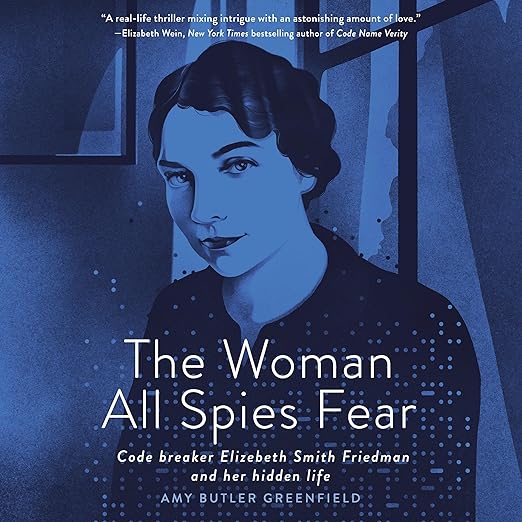
I was introduced to Elizebeth Smith Friedman through a roundabout route - a footnote in a broader book about WWII intelligence that mentioned her name and then moved on, as if her contributions were self-explanatory. They were not. She had been erased from her own story so thoroughly by the NSA and J. Edgar Hoover's FBI that most accounts of wartime cryptology simply don't include her. Amy Butler Greenfield's biography, aimed at young adult readers but discovered by a great many adults who have written surprised reviews, is a corrective act wrapped in a genuinely compelling narrative. I listened to it over two evenings and found myself genuinely angry on Elizebeth's behalf by the end.
The biography opens with one of the stranger origin stories in American cryptology: Elizebeth came to code-breaking through Shakespeare. Hired by an eccentric millionaire named George Fabyan to prove that Francis Bacon had encoded secret messages in Shakespeare's plays, she learned enough about patterns and ciphers in that single unusual job to become one of the foremost cryptanalysts in the country. The Shakespeare angle is both factually true and a structurally smart opening - it grounds the story in literary curiosity before the wartime stakes arrive, and it establishes Elizebeth as someone whose intelligence was broadly applicable rather than narrowly technical.
First, the Big Picture
Greenfield handles the relationship between Elizebeth and her husband William with appropriate care. William Friedman was himself a legendary figure in American cryptology, and their partnership is one of the sustained marvels of the biography: two people who were equals in the most demanding technical sense working in a society that afforded only one of them formal institutional recognition. One reviewer noted that the book follows William early before shifting focus to Elizebeth approximately halfway through, which is an honest structural choice - their careers were intertwined, and excluding his work would distort the picture. But Elizebeth's own achievements, particularly her Coast Guard work against Prohibition-era smugglers and her WWII decoding of Nazi spy communications in South America, are extraordinary enough to carry the narrative on their own terms.
The institutional theft Greenfield documents is quietly furious material. Kathryn's review describes how Hoover and the NSA claimed credit for Elizebeth's work in the public record - a pattern familiar enough in the history of women in intelligence and STEM that it no longer surprises, but that doesn't make it any less infuriating to encounter in specific detail. Greenfield presents the evidence clearly without editorializing excessively, which is the right call: the facts are damning enough without rhetorical amplification.
What Makes The Woman All Spies Fear Worth Hearing
Samantha Desz's narration is well-matched to the material. She has a quality of clear-eyed engagement that suits a biography aimed at young adult readers without feeling juvenile for older listeners. The cryptology sections, which could easily become dense or alienating in audio format, are delivered with pacing that makes the patterns legible - she doesn't rush through the technical material or treat it as an obstacle to get past. At seven hours, the runtime is appropriately compact for the scope of the biography.
Multiple adult readers have noted in reviews that they did not initially realize this was categorized as young adult and found it fully engaging anyway. The writing style is accessible but not simplified - Greenfield makes choices that respect her audience's intelligence, including the inclusion of cipher exercises (available as a PDF download with the audiobook) that invite readers to try solving historical codes themselves. The audio format cannot replicate the visual element of those exercises, but their existence signals something about the book's ambitions.
A Few Reservations
The YA categorization does mean that some topics are treated at a level of depth that specialist adult readers may find insufficient. The cryptological methodology, the specific mechanics of how Elizebeth solved particular cipher systems, and the intelligence tradecraft of the era are all present but not exhaustively explored. Greenfield prioritizes the human story and the historical injustice over technical deep dives, which is the right call for the intended readership but may leave history or cryptology specialists wanting more granular detail.
The book's timeline is also ambitious - spanning WWI, the Prohibition era, and WWII in seven hours means each period gets real but not expansive coverage. Listeners who want to go deeper should follow this with Jason Fagone's The Woman Who Smashed Codes, a full adult biography of Elizebeth that covers much of the same ground with considerably more room.
Should You Listen to The Woman All Spies Fear?
This audiobook works for young adult listeners discovering WWII and intelligence history, for adult readers who prefer accessible narrative nonfiction over densely researched specialist texts, and for anyone who appreciated Hidden Figures or Liar Temptress Soldier Spy and wants another story of a woman whose contributions were systematically minimized by the institutions she served. It is also simply a good listen about a remarkable person. Those who want maximum technical and historical depth on Elizebeth Friedman should treat this as an introduction and move to Fagone's longer work for the full picture.
Good to Know
How much does the audiobook cover of William Friedman's work versus Elizebeth's?
William is present primarily in the first half, as his career was intertwined with Elizebeth's early development. The second half of the biography focuses primarily on Elizebeth's independent achievements, particularly her WWII work with the Coast Guard and against Nazi spy networks in South America.
Does Samantha Desz's narration handle the cryptology sections clearly enough for listeners with no background in the subject?
Yes. Desz paces the technical material carefully and makes it accessible without condescension. The audiobook format does mean the PDF cipher exercises included with the text are not directly usable, but the core cryptological concepts come through clearly in audio.
Is this the most comprehensive biography of Elizebeth Smith Friedman available in audiobook format?
No - Jason Fagone's The Woman Who Smashed Codes covers Elizebeth's story in considerably more depth for adult readers. Greenfield's book is an excellent introduction and stands on its own as a narrative, but Fagone's work goes deeper into both the technical and personal dimensions.