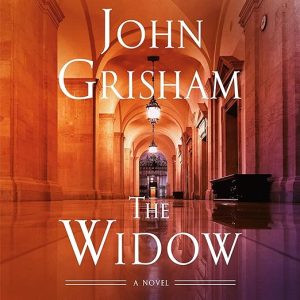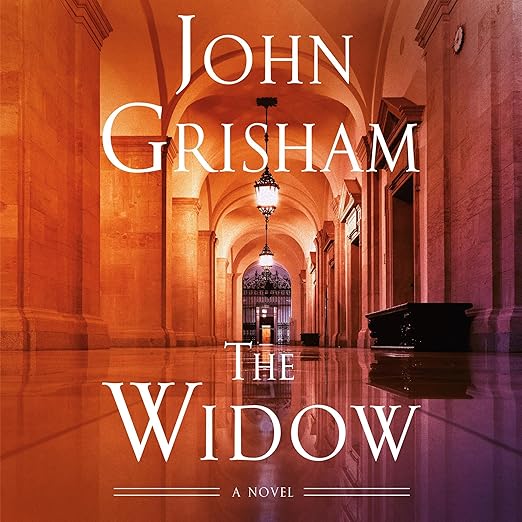
I started The Widow on a long Wednesday commute and found myself mildly annoyed by the time I reached my destination, which is not the reaction I was hoping for but which, I think, is a fairly honest one. John Grisham is a writer I have followed for years, and the announcement that this was his first-ever whodunit felt like the kind of pivot that could go very well or very badly. The reality is somewhere in between, and worth understanding before you commit to fourteen hours.
Simon Latch is a small-town Virginia lawyer, quietly failing at his marriage and his practice, when Eleanor Barnett walks into his office. She is an elderly widow, apparently wealthy, in need of a new will. Simon hooks his richest client in years and then starts to realize her story has holes. When she is hospitalized after a car accident and a murder charge arrives at his door, Simon is suddenly fighting for his freedom rather than his billing rate. The premise is genuinely strong, a classic misdirection setup with more layers than the description suggests.
Guilt Moves Backward Into the Setup Instead
Grisham's legal thrillers have always derived their tension from the machinery of the courtroom, from motions and discovery and the performance of argument. The Widow is structured differently. The whodunit format pushes the question of guilt and innocence backward, into the investigation and the setup, rather than forward into the verdict. Grisham adapts to this shift with more success than the mixed reader response might suggest. The first act, establishing Simon's world and Eleanor's arrival, is tight and well-constructed.
Where the book earns its more divided reception is the middle section, which one reviewer accurately described as methodical to the point of frustration. The details accumulate slowly, and some of the character dynamics, particularly between Simon and his wife, feel underwritten. Another reviewer noted that the final chapter wraps loose ends hastily after a long setup, which is a structural problem Grisham has navigated better in his courtroom books, where the trial provides natural forward momentum. The whodunit form requires a different kind of discipline, and he is not fully there yet.
Beck's Steady, Unshowy Voice Fits Simon Exactly
Michael Beck's narration is steady and unshowy, which suits a book that works through accumulation rather than dramatic peaks. He captures Simon's particular kind of small-town lawyer anxiety, the combination of ambition, pragmatism, and ethical compromise, without making the character either too sympathetic or too obviously flawed. Beck's rural Virginia register feels authentic throughout.
For Grisham's established readership, there is genuine pleasure in watching him attempt something structurally new. The whodunit format strips away the courtroom scaffolding that has supported his work for decades and asks him to construct suspense through a different architecture. That experiment does not fully succeed, but it is interesting to watch an accomplished genre writer operate outside his comfort zone. One reviewer who teachers writing noted the pacing issues as evidence of what happens when authors are given page counts to meet rather than stories to finish, which is the most pointed critique in the reviews, and probably the most accurate.
Patience Pays Off in a Fast, Amazing Ending
The slow build is a deliberate choice, not an accident, and the payoff in the final section is faster and more propulsive than the middle sections suggest it will be. One reviewer who almost abandoned the book described the ending as "fast and amazing" and said it justified the earlier patience. That experience appears to be common enough to trust.
Listeners who go in knowing this is Grisham's first whodunit will calibrate their expectations appropriately. This is not his best work, but it is a recognizable Grisham experience transported into a new structural form. The legal underpinnings remain, the rural Southern setting is vividly rendered, and the final revelations around Eleanor Barnett are genuinely satisfying.
Grisham Loyalists Get Enough to Justify Fourteen Hours
Grisham loyalists who enjoy his procedural instincts and rural legal settings will find enough here to reward the fourteen-hour commitment. Listeners who come to him specifically for courtroom drama should know that the trial is not the centerpiece this time; the mystery structure puts the investigation front and center. Pure whodunit fans who are new to Grisham may want to start with a more polished entry before working back to this one. Patience with slow-building stories is a genuine prerequisite here.
In Brief
- Read by: Michael Beck handles Simon Latch's rural Virginia legal world with a steady, grounded delivery that suits the procedural pacing of Grisham's whodunit format.
- At its heart: Greed and its consequences, the machinery of wrongful conviction, small-town secrets
- Vibe: Slow-building and methodical, with a final act that shifts into a higher gear
- Short version: Grisham trades his courtroom formula for a classic whodunit structure, and while the middle stretches thin, the setup and conclusion make it worth the time for loyal readers.
Questions Listeners Ask
How different is The Widow from Grisham's usual courtroom thriller format?
Significantly. Grisham frames this as his first whodunit, and the structure reflects that shift: the mystery and investigation drive the narrative rather than courtroom argument. The trial is present but not the book's engine, which changes the pacing considerably compared to his earlier work.
Is the middle section of the book as slow as some reviewers describe?
Several reviewers did flag the middle as methodical and slower than expected for a Grisham novel. The consensus seems to be that the details planted there matter for the finale, but listeners who need constant forward momentum may find the middle section a test of patience.
Does Michael Beck's narration add to the rural Virginia atmosphere?
Yes. Beck's delivery is grounded and unhurried in a way that fits both the setting and Simon Latch's character. The performance does not push the drama beyond what the text supports, which is the right call for this kind of procedural material.
Does The Widow work as a standalone, or does it connect to Grisham's other books?
Fully standalone. Simon Latch and Eleanor Barnett are original characters with no connections to Grisham's recurring lawyers like Mitch McDeere or Jake Brigance. Listeners can come to this one with no prior Grisham reading.