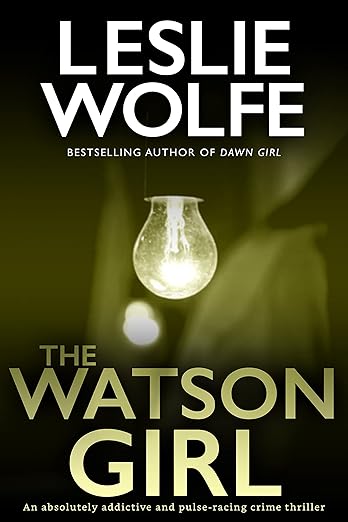
Quick Take
- Narration: Leslie Wolfe narrates her own work, which gives the prose a lived-in authority, though the production occasionally leans more functional than theatrical.
- Themes: Repressed memory, serial killer procedural, witness survival
- Mood: Tense and propulsive with a clinical edge
- Verdict: A sharp police procedural that earns its intensity through character rather than shock alone, best suited for readers who enjoy a relentless female protagonist.
I was somewhere around the second hour of The Watson Girl when I realized I had completely missed my subway stop. That is not a thing I say lightly. I was standing on a platform in the wrong neighborhood, earbuds still in, genuinely unsettled by what FBI Special Agent Tess Winnett had just walked into. That kind of involuntary absorption is what separates a well-constructed thriller from a competent one, and Leslie Wolfe, whatever her rough edges, knows how to build that pull.
The setup here is more elegant than the synopsis lets on. For fifteen years, Laura Watson has believed the man who slaughtered her family is sitting on death row. She survived as a child because she was hidden in a bathroom laundry hamper, and she has spent her adult life not remembering that night fully, which turns out to be a very dangerous kind of not-knowing. When regression therapy begins to crack that seal, the real killer, still free, begins to move. The dramatic irony is well-managed: we understand the danger before Laura does, and that gap generates genuine dread rather than mere suspense.
Our Take on The Watson Girl
Wolfe writes with the confidence of someone who has done her research on FBI procedure and criminal psychology, and it shows. Tess Winnett is sharp, short-fused, and formidably competent. She is also a character who has clearly been through something herself, though the novel does not overplay that backstory in ways that would bog down the pace. The killer perspective chapters, which Wolfe weaves in throughout, are genuinely unsettling. One reviewer compared the author to someone who thinks like a psychopath, which is a compliment of a strange and specific kind, and not entirely wrong. Those sections have a cool, methodical menace that elevates the whole.
Why Listen to The Watson Girl
The audiobook experience here is unusual because Wolfe reads her own novel. That can go badly in either direction, and the result here is somewhere in between: authoritative and committed, though not always polished in the way a trained narrator might be. What it does deliver is a sense of genuine ownership over the material. The pacing of her narration matches the pacing of her prose: quick, direct, and occasionally blunt. For listeners who find the author-narrator dynamic compelling, this is a real asset. For those who prefer a fully produced performance, the straightforwardness may feel a little flat in quieter scenes.
What to Watch For in The Watson Girl
The book has a known weakness, and one reviewer names it plainly: predictability. The plot mechanics, once you are a few hours in, do not offer many surprises in terms of who the killer is or roughly how the climax will resolve. Wolfe’s suspense lives not in the revelation but in the escalating danger around Laura Watson and the race-against-time structure that tightens around her. If you need genuine misdirection to stay engaged, this may frustrate you. But if you are more interested in the texture of a procedural, the quality of the protagonist’s reasoning, and a villain with a chillingly coherent internal logic, the predictability is less of a problem than it sounds.
Who Should Listen to The Watson Girl
Listeners who enjoy authors like David Baldacci or James Patterson at their most procedural will feel at home here. This is not literary crime fiction in the mode of Tana French; it is closer to a well-built airport thriller with more psychological care than the packaging suggests. Skip it if you need a twisty, revelation-heavy plot. Come to it if you want a female protagonist who does not soften herself for the reader, a villain with genuine menace, and a central mystery about memory and survival that gives the story real emotional stakes.
One piece of context that is easy to miss if you come to The Watson Girl cold: the series title character, Tess Winnett, is described in the synopsis as having recovered from injuries sustained in the line of duty. That backstory is present but not foregrounded in this installment, and it is one of the threads that carry meaningfully into subsequent books. For readers who finish this and want more, the Tess Winnett series continues with several additional entries, each building on the procedural world Wolfe has established here.
Frequently Asked Questions
Is The Watson Girl the first book in the Tess Winnett series?
It is the second book in the Tess Winnett series, following Dawn Girl. However, it reads as a standalone and most listeners report no difficulty jumping in here without the first book.
Does Leslie Wolfe narrating her own audiobook affect the listening experience?
It is worth knowing before you start. Wolfe is a committed narrator but not a trained one, so the performance lacks some of the expressiveness a professional voice actor would bring. The upside is a strong sense of authenticity and pacing that matches the text.
How graphic is the violence in The Watson Girl?
There are scenes involving murder and threat that are described with directness rather than gratuitous detail. It sits comfortably within mainstream crime thriller territory, closer to James Patterson than Thomas Harris in terms of graphic content.
Does the book resolve completely or does it end on a cliffhanger?
The central case resolves within this book. There are character threads that carry forward into the series, but The Watson Girl does not leave you without an ending.