In Brief
- Narrator: Feodor Chin brings a quiet gravity to the material that suits Bruce Lee's philosophical register, avoiding both martial pomposity and new-age softness.
- Subjects: Eastern philosophy applied to daily life, Yin-Yang as practical framework, adaptability as the highest form of strength
- Tone: Contemplative and grounded, with flashes of real philosophical depth
- Bottom line: A genuine access point to Bruce Lee's private philosophical writings, assembled with care by John Little, and best approached as personal wisdom literature rather than martial arts instruction.
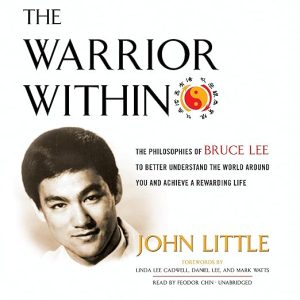
I finished The Warrior Within on a quiet Sunday evening, sitting outside with a glass of water and nothing particular to do. That context turned out to matter. This is not a book you can rush, and I tried twice before settling into the right pace for it. On the third attempt, somewhere around Bruce Lee's extended meditation on the nature of water and adaptability, something clicked. The book rewards a specific kind of receptive attention that our usual listening habits work against.
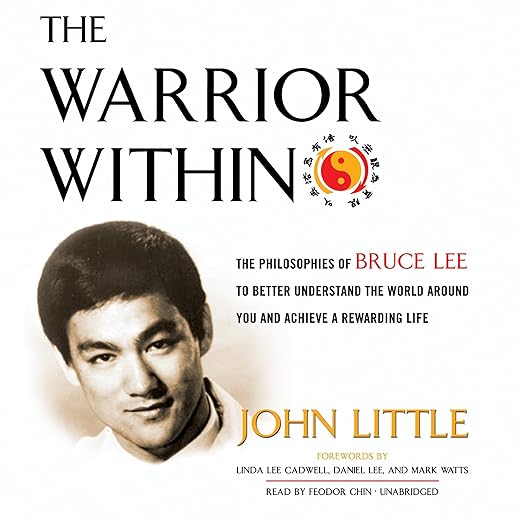
John Little spent years in the Bruce Lee estate archives, granted access to philosophical writings that had never been published or widely shared. The Warrior Within is his attempt to distill those writings into a coherent framework, drawing on Lee's personal journals, notes, and unpublished manuscripts to map out the philosophy that shaped his life and work. For anyone who encountered Bruce Lee primarily through his films or through Jeet Kune Do, this book is a genuine revelation about the depth and seriousness of his intellectual life.
How The Warrior Within Holds Up
The Bruce Lee most people know is a physical phenomenon, a martial artist whose speed and precision seemed to violate normal human limits. What the estate archives reveal, and what Little draws out carefully, is a man who read voraciously across Eastern and Western philosophy, who annotated his books with real engagement, and who was trying to synthesize a complete worldview rather than simply a fighting system. The Warrior Within is where that synthesis lives most fully.
Lee drew on Taoism, Buddhism, Jiddu Krishnamurti, and Nietzsche in nearly equal measure. His conception of Yin and Yang was not decorative symbolism but a working framework for how to navigate contradiction in practice. The sections on non-attachment, on the difference between technique and principle, and on how to remain flexible in the face of circumstances that resist control, these read like genuine philosophical argument rather than motivational aphorism. The book's value is in demonstrating that Lee's mind was as extraordinary as his body, and that his philosophy was lived rather than performed.
Why The Warrior Within Works as an Audiobook
John Little made curatorial decisions in assembling this material, and those decisions are not always transparent. Some passages feel directly drawn from Lee's own voice, spare and precise. Others have the quality of Little's own synthesis, the connective tissue between Lee's fragments. This is not a critique so much as a disclosure, and readers who want to parse exactly what came from Lee versus what came from his editor will need to treat this as a curated portrait rather than a primary text. The experience of reading it, however, feels consistently rooted in a specific intelligence.
That said, Little has done this kind of work with the estate for decades, and his commitment to faithfulness is evident. A reviewer with seven decades of martial arts experience across Judo, Jujitsu, Krav Maga, and multiple other disciplines noted that the book captures something true about Lee that he had not found elsewhere, even after reading most of what Lee published in his lifetime. That kind of testimony from someone with the background to evaluate it carries significant weight.
Weak Spots in The Warrior Within
Feodor Chin is an excellent choice for this material. His voice carries a calm authority that does not press against the philosophical content, and he understands that Lee's ideas need space between them rather than forward momentum. The seven-hour-seven-minute runtime moves at a meditative pace, which some listeners will love and others will find slow. A reviewer noted that the book benefits from some prior exposure to Eastern philosophical concepts, and Chin's measured delivery accommodates that need without becoming plodding.
The production from Blackstone Audio is clean, and the chapter structure makes this suitable for listening in shorter sessions, returning to individual ideas between sittings rather than consuming it all at once. I found that approach worked better than marathon listening for this particular text. Some sections benefit from being heard, set aside, and returned to with whatever life has offered in the interval.
A final observation worth making: The Warrior Within holds a particular place in Bruce Lee's posthumous legacy because it is one of the few works that shows the full scope of his reading. He did not just study martial arts. He studied philosophy, psychology, science, and literature with the same intensity, and the synthesis he was working toward before his death in 1973 was more ambitious than most people realize. John Little has done significant work in making this accessible, and the audiobook format gives the material a different texture than reading the print version. Feodor Chin's delivery makes the ideas feel lived-in rather than historical, which is the right quality for a book that is fundamentally about how to apply ancient wisdom to the specific pressures of a specific life. That the life in question belonged to someone who died over fifty years ago does not diminish the applicability. If anything, it deepens it.
The Right Listener for The Warrior Within
Listeners who come to Bruce Lee with genuine curiosity about the intellectual framework beneath the martial arts will find The Warrior Within deeply rewarding. It is also worthwhile for anyone exploring practical Eastern philosophy, particularly Taoist and Buddhist concepts applied to daily life rather than formal religious practice. Listeners expecting a training manual, combat philosophy, or sports psychology will be surprised by the introspective depth on offer here. This is a book about how to live, not how to fight, and it is worth reading on those terms alone regardless of any connection to Lee's film work or Jeet Kune Do.