Quick Take
- Narration: Zach McLarty delivers a composed, authoritative performance that serves the documentary clarity Freedman’s prose demands.
- Themes: The causes and consequences of WWI, the illusion of a conclusive peace, the seeds of future conflict
- Mood: Clear-eyed and somber, never dull
- Verdict: The best introductory WWI audiobook for young listeners that I know of, Freedman treats the complexity with respect and the audience with intelligence.
World War I is the orphaned war in American popular memory. We know Hiroshima and Anne Frank and D-Day; we are less certain about Franz Ferdinand and the Somme and what any of it actually means for the century that followed. I remember feeling genuinely embarrassed, years into a literature degree, that I had a shakier grasp of WWI than of WWII, and Freedman’s book, had it existed in a widely available audio format then, would have fixed that gap in under four hours.
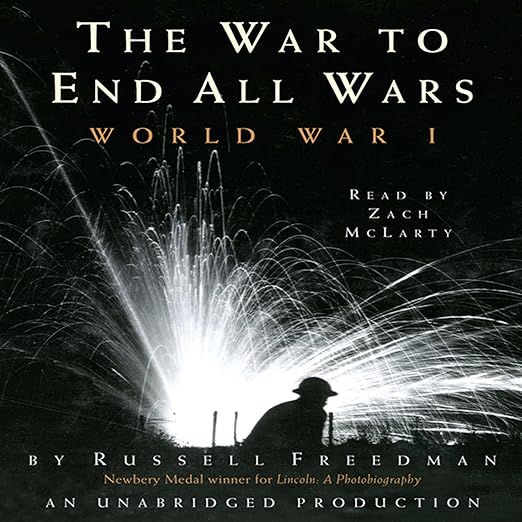
Russell Freedman won the Newbery Medal and spent a career demonstrating that nonfiction for young readers does not have to be condescending to be accessible. The War to End All Wars, narrated by Zach McLarty for Listening Library in 2010, is a clear example of what that approach looks like in practice. At three and a half hours, it covers the causes, conduct, and consequences of World War I with enough specificity to be useful and enough clarity to be understood by a 12-year-old who has never encountered the subject before.
Our Take on The War to End All Wars
Freedman’s argument, embedded in the structure of the book, is that WWI and WWII are not separate events but a single catastrophe interrupted by a twenty-year armistice. He traces how the peace terms imposed at Versailles, the humiliation of Germany, the redrawing of borders with little regard for populations, made a second war nearly inevitable. A reviewer who lived through WWII personally found the book a precise articulation of something he had experienced. That is not a trivial endorsement for a book nominally aimed at middle grade readers.
The coverage of the tangled alliances that pulled nations into a conflict none of them fully intended is handled with particular care. Freedman does not simplify the diplomatic collapse of July 1914 into a villain narrative. He shows it as a system failure, which is both more accurate and more instructive for young listeners trying to understand how large-scale catastrophes happen.
Why Listen to The War to End All Wars
McLarty’s narration is deliberately unshowy, he is serving a nonfiction text rather than performing it, and that restraint is the right choice. Freedman’s prose is precise and well-organized, and McLarty follows its structure without embellishment. Reviewers flagged this as the best resource they found for homeschooling a 15-year-old through WWI history, and that practical recommendation holds. It is factual without being dry, detailed without being overwhelming, and structured in a way that supports retention rather than just comprehension.
The original print book includes photographs that add context, those are not available in audio format, but McLarty’s descriptions of terrain and events are clear enough to compensate. For classroom or homeschool use, pairing this with a few archival images would enrich the experience without making it a research project.
What to Watch For in The War to End All Wars
This is introductory nonfiction, not a deep military history. Listeners who already have a solid grounding in WWI will find it too broad for their purposes. The book covers a large chronological and geographic span in three and a half hours, which means some events receive only summary treatment. For anyone coming in without prior knowledge, that breadth is a feature. For those who want detailed tactical history or primary source engagement, this is not the right text.
Who Should Listen to The War to End All Wars
It is also a reliable antidote to the amnesia that allows WWI to be treated as a prelude to something more important. Freedman makes a compelling case that understanding the first war is inseparable from understanding the second, and, arguably, from understanding how large-scale political failures happen at all.
Ideal for middle and high school students studying WWI, or for homeschool curricula covering early twentieth-century history. Equally valuable for adult listeners who want a clear, concise framework for a war they never learned properly the first time. Those who found David Macaulay’s nonfiction work or Freedman’s own Lincoln: A Photobiography compelling will recognize the same combination of accessibility and rigor that has defined Freedman’s career across decades of writing for young readers.
Frequently Asked Questions
Does The War to End All Wars cover the political and social causes of WWI or focus mainly on the battles?
Both, with meaningful emphasis on the political and diplomatic causes. Freedman opens with the assassination of Franz Ferdinand and the alliance system that turned a regional crisis into a continental war before moving into the military conduct and human cost of the conflict.
Is the 2010 audio release still considered accurate, or has historical scholarship moved on in ways that affect the account?
The core historical narrative Freedman presents is well-established and not meaningfully contradicted by subsequent scholarship at the introductory level. For a YA account of WWI, the 2010 recording remains accurate and reliable for classroom or personal use.
Reviewers describe this as appropriate for 13-year-olds, how does Freedman handle the violence and mass casualties of trench warfare?
Freedman describes the scale and conditions of trench warfare honestly, including the mass casualty figures, without graphic imagery. The approach is sobering rather than sensationalistic, consistent with Freedman’s other nonfiction for young readers.
How does Zach McLarty handle the many European names and place names throughout the text?
McLarty is careful with pronunciation throughout, handling names like Archduke Franz Ferdinand and geographic locations like Passchendaele without awkwardness. His delivery is authoritative enough to carry the historical weight of the material steadily.