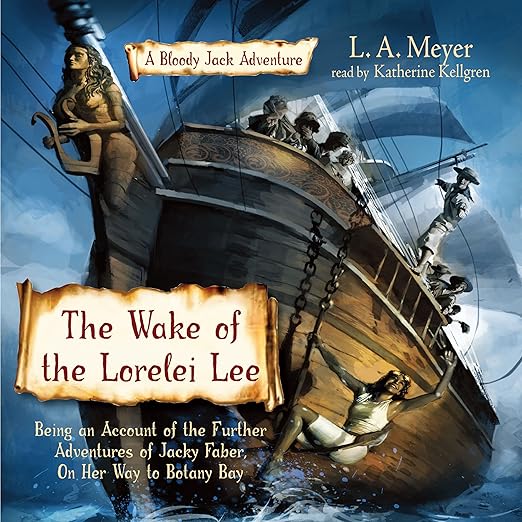
Quick Take
- Narration: Katherine Kellgren’s performance is a tour de force of character voice work, widely considered one of the finest narrations in the YA audiobook genre.
- Themes: Female resilience and survival, colonial justice and its hypocrisies, found community among women
- Mood: Rousing and irreverent, with dark undertones that earn the lightness around them
- Verdict: The eighth Bloody Jack adventure delivers exactly what the series promises, and Katherine Kellgren’s narration makes it an argument for why some books belong in audio above all other formats.
I came to the Bloody Jack series late, long after most of its readers had already lived through several Jacky Faber adventures in sequence. A friend with impeccable taste in audiobooks handed me the first one with the specific instruction that I listen to it rather than read it, and within fifteen minutes I understood why. Katherine Kellgren is not just narrating these books. She is inhabiting them. By the time I reached The Wake of the Lorelei Lee, the eighth installment, I had developed the slightly irrational feeling that I was checking in on someone I actually knew.
This entry drops Jacky at a particularly cruel narrative juncture. Having used her Spanish-diving profits to purchase the Lorelei Lee and establish herself as a legitimate ship owner, she arrives in London expecting absolution for her past run-ins with the Crown. What she gets instead is arrest, a life sentence, and the confiscation of her own ship, which is then used to transport her and over two hundred female convicts to the Australian penal colonies. L. A. Meyer does not handle his protagonist gently, and the series is better for it. The peril is real, even if Jacky's survival is never seriously in doubt.
Our Take on Jacky’s Darkest Departure
What Meyer does especially well in this volume is use the historical reality of convict transportation to Australia to ground what might otherwise be picaresque entertainment. The conditions on the Lorelei Lee, the demographics of the female convicts, the systematic brutality of colonial legal systems toward women and the poor: these are not invented backdrop. Meyer notes in the afterword that several details reviewers flagged as improbably dramatic are, in fact, historically documented, which adds weight to scenes that could have read as mere adventure flourishes.
Jacky's response to her situation is characteristically inventive. She rallies her fellow convicts toward improving their conditions through a combination of charm, theatricality, and the particular strategic intelligence that has kept her alive through seven previous volumes. The solidarity that emerges among the women is the emotional center of the book, and it has a warmth that the action sequences support rather than interrupt.
Why Listen to The Wake of the Lorelei Lee
The answer is Katherine Kellgren, and that is not reductive. She won an Audie Award for the first Bloody Jack audiobook, and her performance across the series maintains an extraordinary standard. She voices Jacky's Yorkshire-inflected first-person narration with complete conviction, shifts into period-appropriate registers for secondary characters, and handles the songs that Jacky performs throughout as actual musical performances. The fourteen-plus hours of this volume never drag, not because Meyer is writing at a breakneck pace, but because Kellgren finds variation and energy in every chapter.
One reviewer described the series as "mostly incredibly unbelievable" but found themselves wanting more anyway, which is precisely the magic Jacky Faber works on readers. She is implausible by design, a character built to survive and triumph in ways that would be absurd if they were not delivered with such commitment. Kellgren makes that commitment total, and it is infectious.
What to Watch For in This Volume
This is the eighth book in a series, and new listeners who begin here will be missing context. The series is built cumulatively, with recurring characters whose histories become relevant at key moments. Jacky's relationships with Jaimy and Amy carry particular weight here, and those weights are earned through earlier installments. The pacing in the Australian sections is somewhat different from the nautical adventures that dominate earlier books. Some readers have preferred the ocean-set chapters, and there is a gear change in the book's second half. Meyer is clearly interested in the colonial setting as a historical space, not just as adventure backdrop, and that interest occasionally pulls against the momentum of Jacky's personal story.
Who Should Listen to The Wake of the Lorelei Lee
Series readers will not need convincing. For listeners new to the Bloody Jack Adventures, this is not the entry point: start with the first volume and let Kellgren take you through the sequence in order. The series works for older teenagers and adults equally, with enough historical substance to reward adult attention and enough kinetic adventure to hold the younger listeners it was nominally written for. Anyone who has bounced off YA fiction that feels condescending toward its audience should give Jacky Faber a try. Meyer writes a protagonist who is treated with full narrative seriousness, and Kellgren delivers on that premise every time.
Frequently Asked Questions
Can I start the Bloody Jack series with this book, or do I need to listen from the beginning?
Start from the beginning. This is the eighth installment, and the emotional payoffs in this volume depend heavily on relationships and events established in earlier books. Begin with Bloody Jack, which is also where Kellgren’s Audie Award-winning performance sets the standard.
How does Katherine Kellgren handle the musical elements in the audiobook?
She performs Jacky’s songs as actual musical interludes, not just recited lyrics. It is one of the more distinctive qualities of the series in audio form, and whether you expect it or not, it works. Kellgren’s musical performance is a genuine part of what makes this series exceptional in the format.
Is the historical content about convict transportation to Australia accurate?
Meyer addresses this in the book’s afterword and confirms that several details which might seem dramatized are historically documented. The conditions of convict transport, the demographics of female prisoners, and aspects of the colonial Australian setting are grounded in real history.
Is this series appropriate for adult listeners, or is it strictly for young adults?
The series is genuinely cross-generational. The themes of survival, colonial justice, identity, and gender under patriarchal systems are substantial enough to engage adult readers fully. The lightness of Jacky’s voice is a stylistic choice, not a limitation of ambition.