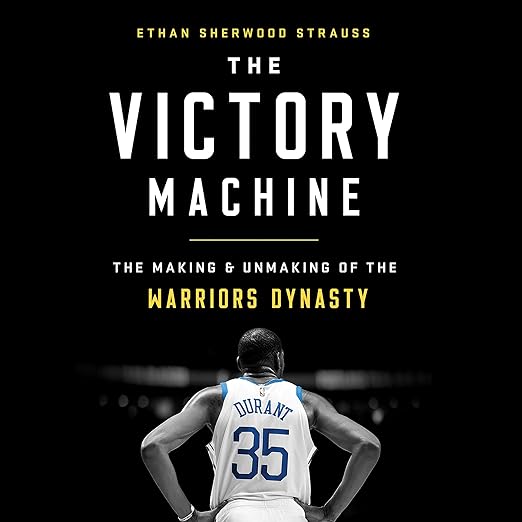
Quick Take
- Narration: Ethan Sherwood Strauss narrates his own book with the insider confidence of someone who was genuinely in the room, though his syntax occasionally creates the density his written prose is known for
- Themes: dynasty economics and human cost, Kevin Durant’s complicated departure, the Darwinian mechanics of professional sports organizations
- Mood: Sharp, knowing, and tinged with genuine affection for a team that couldn’t hold itself together
- Verdict: The only book that covers the Warriors dynasty from inside access, and worth it for that reason alone, though its depth is uneven across its six hours.
I came to The Victory Machine later than most Warriors fans, after the dynasty had already collapsed and the 2019 NBA Finals injury had become something people discussed in the past tense. There is a particular melancholy in reading, or listening to, a book about an organization at the moment when you already know how the story ends. Ethan Sherwood Strauss had access that most journalists never get, genuine proximity to the people and decisions that built the Golden State Warriors into the most commercially successful franchise in the sport, and watching him deploy that access as narrator of his own audiobook is an unusual and frequently rewarding experience.
Not everything works equally well. But what works, works considerably better than most sports books I have heard.
How Joe Lacob Bought a Dynasty He Did Not Know He Was Getting
The Warriors story, as Strauss tells it, begins with an ownership acquisition that looks improbable in retrospect. Joe Lacob bought a team that had spent decades as one of the least successful franchises in professional basketball, in a market that had other entertainment options, at a price that seemed, at the time, like a questionable decision. The book traces how the organization went from that starting position to five consecutive Finals appearances, three championships, and the most valuable brand in the NBA.
Strauss is not interested in the basketball itself as much as he is interested in the organization: the decisions, the relationships, the financial pressures, the ego dynamics, and the way that sustained winning changes everyone involved in it. The reviewer Steve Zissou gives the book’s first quarter five stars and says the rest hovers between three and four. I think that assessment captures the book’s actual shape. The early sections, which cover Lacob’s acquisition, the franchise’s rebuild, and the dynamics that produced the championship culture, are the most original and most carefully constructed. The Kevin Durant sections are fascinating but complicated by the difficulty of fully explaining what Durant was thinking and feeling through access that was, by Durant’s own nature, limited.
The Price of Winning, Told from the Inside
What Strauss adds to the public record is texture. The reviewer Mitchell Shane describes the book as the business side of the NBA filtered through the personalities of the Warriors dynasty, written in witty economical prose. That is accurate. Strauss has the journalist’s skill of finding the human detail that makes an organizational dynamic comprehensible. He is interested in how the smallest moments define success or failure for years, a claim the synopsis makes and that the book largely substantiates.
The sections on Steve Kerr, on the unsung people who worked behind the scenes, and on the way relentless winning wears down players and executives over time are where the book’s access translates most directly into genuine information. Reviewer Steve Zissou notes that Warriors fans will come to understand their favorite players at a deeper level and become acquainted with people they would not otherwise know existed. That is the value proposition that insider access makes possible, and Strauss delivers on it consistently in the book’s strongest passages.
Strauss Narrating Strauss
Author-narrated audiobooks are a distinct category with distinct trade-offs. Ethan Sherwood Strauss is a professional writer and journalist, not a professional narrator. His delivery has the cadence of someone comfortable speaking publicly about ideas rather than the trained vocal performance of an audiobook narrator. Reviewer R. Dawson found his syntax, and his assumption that the reader has intimate knowledge of context, made for difficult reading in places. Those observations translate to the audio version as well.
Strauss’s sentences sometimes require more active attention than a traditionally narrated audiobook demands. He does not slow down for the uninitiated. The trade-off is that his insider confidence is audible in a way it could not be with a professional narrator who did not live this story. When he describes a moment from inside the Warriors organization, you hear the person who was actually there. That quality is worth the occasional syntactic density.
What the Book Covers and What It Leaves Aside
At six hours and thirty-five minutes, this is a notably compact treatment of a dynasty that spanned the better part of a decade. Strauss does not try to be comprehensive. He focuses on the moments and relationships that illuminate how the machine was built and why it could not be sustained. The book is thin on detailed game analysis, on-court strategy, and play-by-play history. Those things are documented extensively elsewhere. What this book offers is organizational psychology and business dynamics, told by someone who watched them unfold at close range.
If you want the complete story of the Warriors dynasty from every angle, this is not your single source. If you want to understand how the organization actually functioned, what the people inside it were thinking, and what the cost of winning at that level looks like from the inside, this is the book that exists for that purpose.
Frequently Asked Questions
Does The Victory Machine require deep knowledge of basketball to follow, or is it accessible to casual fans?
Reviewer R. Dawson notes that Strauss sometimes assumes intimate contextual knowledge that not all readers will have. Casual fans will follow the broad narrative of the dynasty’s rise and fall, but some passages and references will land more fully for listeners who followed the Warriors closely during the championship run. Basic familiarity with the team and its key players is helpful.
How much of the book focuses on Kevin Durant specifically?
Durant’s controversial departure is one of the book’s major organizing events, and Strauss uses it as a lens for examining how the dynasty’s internal dynamics evolved under the pressure of sustained success. However, the book covers the full arc from Joe Lacob’s acquisition through the 2019 Finals collapse, with Durant as a significant but not exclusive focus.
Is there anything in this audiobook that has been reported to be inaccurate or contested by the people involved?
As a journalistic account written by a reporter with access, some characterizations and scenes will inevitably be contested by subjects. Strauss’s framing of certain organizational dynamics and personality conflicts, particularly around the Durant situation, reflects his perspective and access rather than a complete accounting that all parties would endorse.
Strauss narrates his own audiobook. How does his performance compare to a professional narrator?
Strauss has the insider authority of someone who was genuinely present for the events he describes, which adds an authenticity a professional narrator could not replicate. His delivery is knowledgeable and at times witty, consistent with his written voice. The trade-off is that he does not have a professional narrator’s vocal technique, and his denser sentences require more active listener engagement than a trained reader would demand.