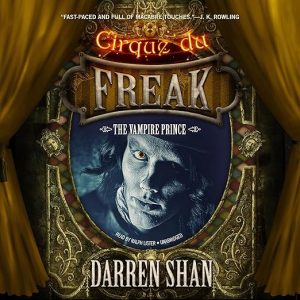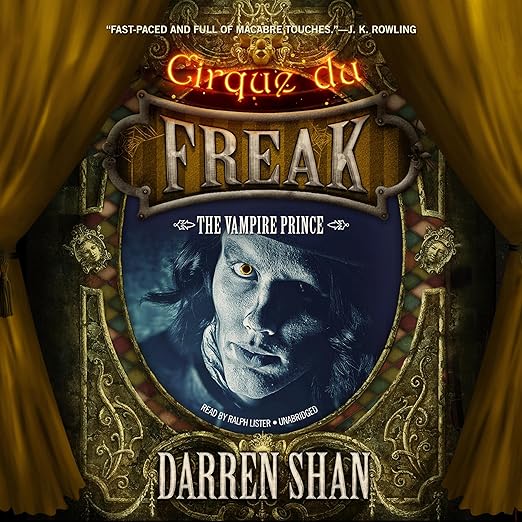
I came to The Vampire Prince through a slightly unusual route: I had been reviewing a batch of YA fantasy and wanted to understand why the Cirque du Freak series, which began publication in 1999, still commands a devoted readership among both its original teenage audience and their children. The sixth book, which Darren Shan himself describes as the final volume of the Vampire Mountain arc while noting that the Saga continues, offered a concentrated version of what makes this series work. By the end of four hours and thirty-three minutes, I understood the loyalty.
The premise of The Vampire Prince is efficient and brutal: Darren, branded as a traitor after killing a vampire general under circumstances that were neither simple nor entirely his fault, is hunted by the vampire clan that once accepted him. He is simultaneously trying to prove his innocence and prevent a catastrophe that threatens the entire clan. The dual pressure, personal survival alongside collective crisis, gives the book a momentum that does not let up. Shan is not gentle with his protagonist, and the willingness to place Darren in situations where there is no comfortable exit is what distinguishes this series from safer YA fare.
The Review
The accusation of treachery that drives this volume is not a simple misunderstanding that can be resolved through explanation. It sits in a more complicated moral space, the kind of situation where what Darren did was wrong by the clan's rules even though the circumstances were genuinely ambiguous, and Shan refuses to simplify it. This ethical complexity is unusual in YA fiction of this period, and it is one of the reasons the series has held up better than contemporaries that offered cleaner moral landscapes. Darren is not entirely innocent, and the book does not pretend otherwise. What it argues instead is that the clan's response to that ambiguity reveals something about the limits of their own justice.
The vampire prince of the title, Mr. Tiny's intervention, and the political maneuvering within Vampire Mountain are handled with the kind of plotting economy that long series train their writers toward. By the sixth book, Shan knows exactly which details his readers hold from previous entries and which need reinforcement, and he deploys this knowledge efficiently. There is no significant repetition of earlier material, which is a more difficult achievement than it looks.
What Makes The Vampire Prince Worth Hearing
Lister brings a controlled gravity to the narration that suits this specific series. Cirque du Freak is darker than its age rating sometimes suggests, one reviewer noted that the story is quiet dark and not for young children, and Lister reads it as serious rather than spooky, which is the right call. The difference between YA horror that respects its audience and YA horror that patronizes it is largely a question of whether the darkness is real or decorative, and Shan's darkness is real. Darren faces actual loss, actual moral compromise, and actual physical danger in ways that require a narrator who takes those stakes seriously.
His performance of Darren's inner monologue is particularly effective. The character's voice in this series is first-person retrospective with an awareness that the events are significant, and Lister carries that weight without making the narration feel heavy or self-important. At four hours and thirty-three minutes, the runtime is lean, which suits a book that is fundamentally about pressure and momentum.
The Caveats
This is emphatically not a book to start with. The Vampire Prince is the sixth entry in a series with twelve volumes total, and it resolves a three-book arc that began with Tunnels of Blood and built through The Vampire's Assistant and Vampire Mountain. New listeners who start here will be lost within the first fifteen minutes. For readers who have been following Darren's journey, the payoffs here are significant: character relationships established across multiple previous entries resolve in ways that have genuine emotional weight, and the setup for the subsequent Vampire War arc is handled with care.
One reviewer who had read the series multiple times described the sacrifice and resilience in this volume as what keeps them returning. That attachment across re-reads is the mark of fiction that operates on more than plot level, and it is born from the accumulated investment the series demands from its readers. Shan does not offer shortcuts.
The resolution of Darren's status within the vampire clan is handled with a plotting sophistication that the broader YA fantasy market does not always exhibit. Shan does not resolve the traitor accusation through simple exoneration. The mechanics of how Darren re-establishes his standing within the clan's hierarchy involve both the political maneuvering he has learned from watching vampire princes and a genuine test that costs him something real. This willingness to make the narrative cost legible, to show that belonging to the vampire world has a price that Darren actually pays, is what keeps the series operating on a register above comfortable adventure fiction. The Saga of Darren Shan is asking real questions about identity and belonging, and the Vampire Mountain arc's conclusion is where those questions produce their clearest answers so far.
Who Should Pick Up The Vampire Prince
This free audiobook is available for Audible members and delivers four and a half hours of consistently well-crafted YA horror. Lister's narration is dependable and appropriately serious, the plot is tightly constructed, and the emotional stakes of Darren's situation are genuine rather than manufactured. For readers who are invested in the Saga of Darren Shan, The Vampire Prince delivers the arc conclusion it promises and sets up the subsequent volumes with a confidence that comes from a writer who knew exactly where the full twelve-book story was going from the beginning. That coherence is rarer than it should be, and it is one of the things that makes this series worth the commitment it asks for.
Do I need to have read all five previous Cirque du Freak books before listening to The Vampire Prince?
Yes. This is the sixth book in a twelve-volume saga and the final entry in a three-book Vampire Mountain arc. Starting here without the prior context will make the plot largely incomprehensible and strip the emotional stakes of their meaning.
How dark is The Vampire Prince compared to other YA fantasy?
Darker than the vampire fantasy genre average. Shan places Darren in situations with genuine moral complexity and real consequences, and the violence is not sanitized. One reviewer explicitly noted it is not suitable for young children despite the YA label.
Is Ralph Lister's narration consistent with earlier volumes in the series?
Lister has narrated multiple entries in the Cirque du Freak series and brings a consistent gravity and first-person authority to Darren's voice. Listeners familiar with his work in earlier volumes will find the transition here seamless.