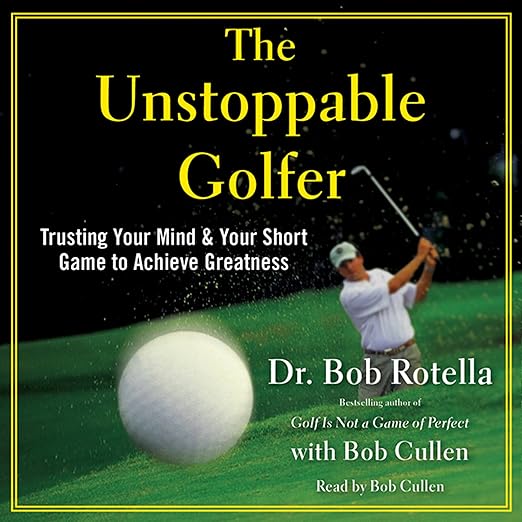
Quick Take
- Narration: Bob Rotella narrating his own work is an asset; his delivery is direct and clinical in a way that matches the prescriptive nature of the material, without the energy of a performance coach.
- Themes: The mental short game, concentration and target focus, surrendering conscious control to allow acquired skill to function
- Mood: Calm and instructive, occasionally repetitive in the best way, the way a good mantra is repetitive
- Verdict: The most practically useful golf psychology audiobook for players who already have short game mechanics and need to understand why those mechanics desert them under pressure.
I don’t golf. I want to be transparent about that immediately, because it seems relevant when reviewing a book by the man who has helped clients win 74 major professional titles since 1984. But The Unstoppable Golfer is not primarily about golf. It is about the psychology of executing a practiced skill under pressure, which is a problem I recognize from every domain I’ve ever attempted to perform in. By the time Bob Rotella gets to the chapter on memory and its role in physical performance, he’s describing something that applies as readily to public speaking or playing piano as to chipping from a sand bunker.
That said, Rotella absolutely knows his audience, and the audience is golfers. Specifically, it’s golfers who can play reasonably well in practice and struggle to replicate that on the course. The central claim of the book is both simple and difficult to actually implement: the short game, the putts, chips, pitches, and bunker shots that comprise more than two-thirds of a golfer’s strokes, is primarily a mental challenge. Not a mechanical one. And the mind’s job during a shot is to focus on one thing: the hole.
Our Take on The Unstoppable Golfer
Rotella has the credibility to make this argument without it sounding glib. The client list embedded in the synopsis, Keegan Bradley, Padraig Harrington, Darren Clarke, Davis Love III, Graeme McDowell, is not decoration. These are people who have won major championships, and Rotella worked with them specifically on the psychological dimension of their games. When he describes what it means to commit completely to a routine and then release the outcome, he’s describing something these players actually do.
The book’s structure is straightforward. Rotella identifies the mental habits that destroy short game performance: fear, doubt, outcome fixation, the paralysis that comes from thinking about mechanics during execution. He then offers the corrective practices: target focus, routine commitment, the kind of acceptance he calls taking whatever happened to the golf ball as information rather than judgment. These aren’t complicated ideas. Part of Rotella’s value as a communicator is that he doesn’t complexify what should be simple, even if the simple thing is hard to actually do.
One reviewer described the book as learning how not to think in golf, and that’s the cleanest summary I’ve encountered. The problem most golfers face over a three-foot putt is not mechanical. Their mechanics worked fine on the practice green. The problem is what happens to mechanics when consciousness gets involved: the micro-corrections, the outcome anxiety, the attempt to steer a shot rather than simply execute it. Rotella’s entire practice is built around removing that interference.
Why Listen to The Unstoppable Golfer
Rotella narrating his own material is the right choice for this book. His delivery is measured and direct, with the slightly clinical quality of someone who has said these things many times to many different people and knows which words carry weight. He isn’t performing enthusiasm; he’s transmitting conviction. That difference matters for content that asks you to change ingrained habits of mind. You want to believe the source.
At six and three-quarter hours, the book is calibrated for repeat listening, which Rotella implicitly encourages. The principles he lays out aren’t designed to be absorbed once and then applied. They’re designed to be internalized over time, which means the audio format is particularly appropriate. Listeners who drive to the course or practice range can absorb the material in the context of actually going to play, which is the ideal activation environment.
The science sections, where Rotella draws on memory research and the brain’s handling of physical tasks, add useful credibility to what might otherwise read as motivational coaching. He isn’t simply telling you to be confident; he’s explaining why conscious overthinking disrupts the motor programs that practice has built. That neurological grounding gives the prescriptions a basis beyond anecdote.
What to Watch For in The Unstoppable Golfer
The book is deliberately repetitive in its core prescriptions. Rotella returns to target focus, routine commitment, and acceptance across multiple chapters, from different angles and with different professional examples. Listeners who find this frustrating are fighting the book’s method: the repetition is intentional pedagogy. These are ideas that need to be heard from multiple angles before they become automatic. If you’re expecting continually new content throughout the six-plus hours, you’ll feel the repetition more acutely than if you treat each chapter as a different approach to the same problem.
The book is also explicitly predicated on the assumption of acquired physical skill. Rotella is not teaching you how to grip a club or position your feet. He assumes you already know how to execute short game shots mechanically, and that the problem is what happens to that knowledge under pressure. New golfers who haven’t yet built the mechanical foundation will find the psychological advice hard to apply, because there’s nothing solid underneath it yet to unleash.
The professional anecdotes are consistently interesting and specific. Rotella doesn’t use clients as generic inspiration figures; he uses them as case studies. The details of how a particular player overcame a specific yipping problem, or how a tour professional rebuilt confidence after a putting collapse, are more useful than abstract principles precisely because they show the application in practice.
Who Should Listen to The Unstoppable Golfer
Mid-handicap to low-handicap golfers who have identified the short game as their primary performance limiter will get the most from this book. Players who shank chips and miss three-footers despite knowing mechanically what to do are exactly Rotella’s target audience. The book will give them a framework and a practice method for addressing the mental component of that gap.
Casual golfers who play a few times a year for fun will find the ideas interesting but may not have the practice volume to apply them effectively. Rotella’s methods require consistent application in actual playing conditions, not just occasional exposure. For serious recreational players, the book is a meaningful investment. The reviewer who broke 80 for the first time shortly after reading it, in only two weeks, is an outlier but a persuasive one.
Frequently Asked Questions
Do I need a certain handicap level before this book’s advice becomes applicable?
Rotella explicitly says the book assumes you have acquired mechanical competence in the short game, at least enough that your mechanics work in low-pressure conditions. Players who are still learning basic chipping and putting technique will find the psychological advice hard to apply. A developing recreational golfer with some course experience is about the right entry point.
Does Rotella’s self-narration affect the listening experience compared to a professional narrator?
Favorably, in this case. Rotella’s delivery is measured and conviction-carrying rather than performative. For prescriptive content that you’re meant to internalize, hearing the author’s own voice gives the material a direct quality that a surrogate narrator would have to work to replicate.
How does The Unstoppable Golfer differ from Rotella’s earlier Golf Is Not a Game of Perfect?
The Unstoppable Golfer focuses specifically on the short game, the putts, chips, pitches, and bunker shots, where Golf Is Not a Game of Perfect covers the mental game more broadly. If you’ve already read the earlier book and want deeper work on scoring shots specifically, this is the more targeted follow-up. Rotella’s core philosophy is consistent across both.
The book mentions probing the science of memory and brain function. How technical does that content get?
Not very. Rotella references memory research and motor learning theory at a level accessible to a general audience, using it to explain why thinking about mechanics during a shot disrupts execution. He doesn’t go into neuroscience in academic depth. The scientific references support the practical advice without becoming a separate subject.