Quick Take
- Narration: This edition uses a Virtual Voice AI narrator, which is worth knowing before you purchase, the production lacks the warmth a human narrator would bring to material aimed at teenagers.
- Themes: Self-confidence and identity, navigating high school social dynamics, financial literacy for young people
- Mood: Practical and encouraging, structured more like a workshop than a narrative listen
- Verdict: Solid self-help content for teenagers and their parents, but the AI narration is a real limitation for material that depends on connection and warmth to land.
I want to be straightforward about something before getting into the content itself: The Ultimate Teen Life Skills Toolkit uses a Virtual Voice AI narrator. That is listed in the metadata and is visible on the Audible product page. For a self-help guide aimed at teenagers, material that works best when it feels like a conversation with someone who genuinely means it, this is a meaningful limitation. I have listened to several Virtual Voice productions, and while the technology has improved, there is a particular warmth and spontaneity that human narration provides for this genre that AI synthesis does not yet replicate. If that matters to you, the print book may serve better.
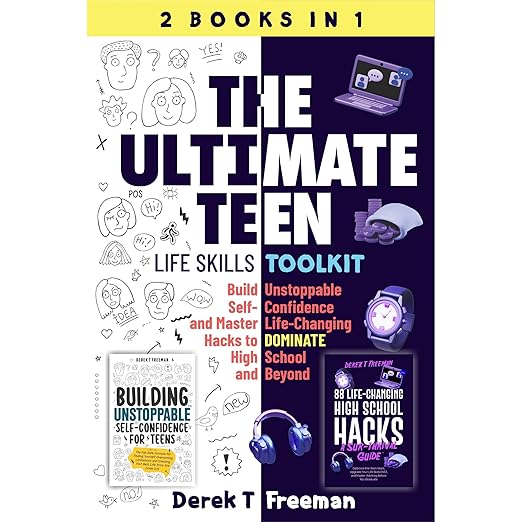
With that said, the content of the two-book compilation that makes up this toolkit is genuinely well-constructed. Derek T. Freeman combines his first two books in the Teen Sur-Thrival series, Building Unstoppable Self-Confidence for Teens and 88 Life-Changing High School Hacks, into a single five-and-a-half-hour listen. The result is dense in the best sense: practical, specific, and built around the kinds of challenges that most high school students actually face rather than an idealized version of adolescence.
Our Take on The Ultimate Teen Life Skills Toolkit
The first book, focused on self-confidence, is the stronger of the two halves. Freeman’s framework for separating yourself from your negative thoughts, what one reviewer described as the section that most resonated with their own teenage memory, is rendered clearly and practically. The anti-bullying material is not platitudinous. Freeman offers six specific techniques rather than general encouragement to be resilient. The section on what he calls being the ruler of your kingdom, controlling who has access to your inner circle, is something I wish someone had handed me at fifteen in more concrete terms.
The second book, the 88 hacks, is organized categorically rather than narratively, which suits the format but also highlights the audiobook’s structural limitation. A numbered list of 88 items is easier to navigate in print, where you can flip to what you need, than in audio, where you experience it linearly. Listeners who want to return to specific hacks will need to use chapter markers. That said, the content itself, covering financial literacy that is not taught in school, relationship maintenance frameworks, and time management strategies, is practical and clear.
Why Listen to The Ultimate Teen Life Skills Toolkit
Parents looking for something to give a teenager who is struggling with self-confidence or the social complexity of high school will find this more substantive than many competing titles. The real-life stories Freeman uses are described by reviewers as feeling like conversations with a wise mentor rather than lectures, which is exactly the register this kind of material needs to find. A grandparent who bought this for a teenager dealing with body image issues and low confidence reports genuine positive response. That kind of testimonial is worth more than aggregate ratings in the self-help genre.
What to Watch For in The Ultimate Teen Life Skills Toolkit
The title’s framing as a Sur-Thrival Guide signals its tone accurately: Freeman is not promising to eliminate difficulty, only to equip listeners with better tools for navigating it. That framing is honest in a way that good self-help for teenagers often is not. One thing worth knowing: this is book three in the Teen Sur-Thrival series, though it functions as a standalone compilation of the first two books and listeners do not need the earlier volumes to get full value here.
Who Should Listen to The Ultimate Teen Life Skills Toolkit
Teenagers who learn well from practical, numbered frameworks rather than narrative will find this format useful. Parents who want to understand what a thoughtful self-help guide for this age group looks like will find it worth a listen. Those who need the warmth and spontaneity of human narration to absorb material aimed at emotional development should consider the print edition instead. High school teachers and counselors looking for supplementary material will find the anti-bullying and confidence sections particularly well-structured.
Frequently Asked Questions
Is the Virtual Voice narrator a significant drawback for this type of content?
For self-help material aimed at teenagers, yes, more than it would be for fiction or reference content. The warmth and genuine engagement of human narration matters when the subject is building confidence and emotional resilience. The content itself is solid, but listeners who find AI narration distracting should consider the print edition.
Do you need the earlier books in the Teen Sur-Thrival series to benefit from this compilation?
No. This toolkit compiles books one and two of the series into a single volume and is completely self-contained. You can start here without any prior familiarity with Freeman’s work.
Is this more useful for teenagers or for parents?
Both, differently. Teenagers will get the most from the self-confidence and social navigation material in book one. Parents may find equal value in understanding the frameworks being taught, which can inform their own conversations with their teens. Several reviewers specifically mention buying this for a teenager struggling with a specific issue.
How does the 88 hacks section work in audio format?
The hacks are organized by category and read sequentially. The format works better in print for easy browsing, but Audible chapter markers help locate specific categories. Listeners who want to revisit particular hacks will need to navigate manually rather than simply flipping to a page.