Quick Take
- Narration: Jonathan Beville handles the CIA operative voice with authority, keeping the Saharan action sequences spatially clear without losing the quieter character moments.
- Themes: Rogue operative vs. institutional corruption, moral code under pressure, West African geopolitics
- Mood: Tightly wound and propulsive, with moments of genuine moral ambiguity
- Verdict: A confident series debut that will satisfy fans of Jason Kasper and Vince Flynn, built around a protagonist with enough complexity to sustain a long arc.
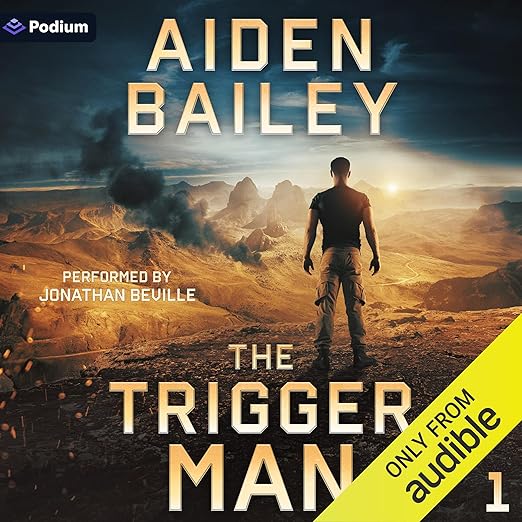
I finished The Trigger Man on a Thursday evening and immediately looked up whether book two was available. That is the most useful thing I can tell you about this debut. Aiden Bailey has constructed a CIA operative thriller that follows genre conventions closely enough to feel familiar but builds its central character with enough specificity to distinguish him from the crowd of former-special-forces protagonists who populate this shelf. Mark Pierce is not a blank-slate action hero. He has a moral code that the plot systematically tests, and watching that code hold or bend under pressure is what keeps the 10-plus hours moving.
The premise sets Pierce on a mission to eliminate Victor Vautrin, an arms dealer supplying terrorist groups in West Africa whose weapons may trigger a brutal civil war. Two additional objectives are layered on: rescue kidnapped tourists and recover eleven million dollars of stolen CIA money. Three simultaneous goals in the Sahara, and someone in his own organization does not want him to complete any of them. When Pierce realizes the game is rigged, he goes rogue, which is both a genre expectation and the point where Bailey separates himself from more predictable entries in the field by paying genuine attention to the moral and personal cost of that choice.
Our Take on Mark Pierce as a Series Protagonist
The CIA operative who only kills people who deserve it is a familiar moral shorthand, but Bailey uses it with intention rather than as an excuse to sidestep complexity. Pierce’s strict code creates genuine dramatic tension because readers understand exactly when he is about to violate it and what that costs him internally and professionally. One reviewer described him as a man made hard by life, circumstances which we hopefully will discover more about as the series progresses. That backstory is parceled out carefully: enough revealed to ground him in this first volume, enough withheld to sustain future installments without the mystery feeling artificially manufactured. Pierce makes decisions with consequences, and Bailey respects those consequences rather than using plot convenience to erase them in the next chapter.
Why Listen to the West African Setting
Not every CIA thriller takes its geographic setting seriously. The Trigger Man does. The Saharan crossing is rendered with enough specificity to feel genuinely researched: the heat, the logistics, the political fault lines between factions that the arms trade exploits for profit. One reviewer found the North African detail and accumulation of place names somewhat tedious in the middle section, and it is a fair observation. Bailey leans into local color in ways that occasionally slow the narrative momentum. But readers who appreciate thrillers with geographic texture rather than a generic action-movie backdrop will find this investment worthwhile, and the sympathetic character Oumar, noted by one reviewer as a strong addition, represents the human cost of geopolitical games in ways that ground Pierce’s mission in something beyond professional obligation.
What to Watch For in the Conspiracy Layer
The thriller’s second act reveal, that powerful players are engineering a war rather than preventing one, is not shocking in a genre where institutional corruption is taken as given. What Bailey does well is connect the macro conspiracy to Pierce’s specific moral situation. The men who rigged the game have interests that clash with Pierce’s code in ways that make the confrontation feel personal rather than procedural. The ending leaves enough deliberately unresolved to set up the next installment, which one reviewer found frustrating and another found exactly right for a series opener. The calibration is closer to the latter assessment.
Who Should Listen to The Trigger Man
If you have read the Scot Harvath series, the Gray Man novels, or Jason Kasper, this is a natural next pick. The series is positioned explicitly in that lane and delivers on the comparison. Listeners who prefer character-driven spy fiction in the le Carre tradition will want something else, as Pierce operates in a world of moral absolutes and physical action rather than institutional ambiguity and slow-burn maneuvering. But for readers who want competent CIA action with a protagonist they can invest in across a multi-book arc, The Trigger Man is a strong series opener.
Frequently Asked Questions
Is The Trigger Man the first book in its series, or do I need background from earlier Aiden Bailey work?
It is the first book in the Trigger Man series and functions as a complete introduction to Mark Pierce. No prior Bailey reading is required.
How does the West African setting compare to similar thrillers set in familiar European or US locations?
Bailey treats the Saharan geography and West African political landscape with more specificity than most genre entries. One reviewer flagged the detail as occasionally slowing momentum, but it also gives the novel a texture that generic action backdrops lack.
Does Pierce’s moral code feel credible given he is a government assassin, or is it wishful characterization?
Reviewers consistently find it credible because Bailey uses it as a source of conflict rather than a comfortable shorthand. Pierce’s code is tested rather than preserved, which makes it feel earned rather than decorative.
How does Jonathan Beville’s narration compare to other military thriller narrators in the Jason Kasper or Gray Man lane?
Beville brings authority and physical presence to Pierce without the over-earnest intensity that can flatten CIA operative characters. He handles ensemble scenes cleanly, though the North African names and locations are equally dense in audio form as on the page.