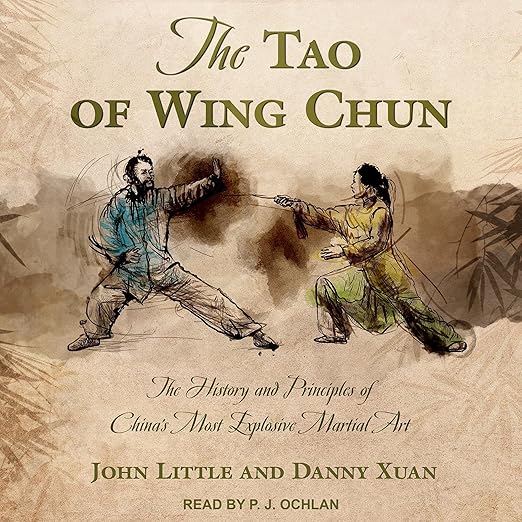
Quick Take
- Narration: P.J. Ochlan’s precise, measured delivery suits the book’s analytical tone, handling technical terminology cleanly without sounding clinical.
- Themes: Biomechanics as martial philosophy, the irrelevance of size and strength, 300 years of encoded knowledge
- Mood: Intellectual and unhurried, more seminar than sparring session
- Verdict: The most analytically rigorous book on Wing Chun available in audio, best for practitioners or serious martial arts students willing to sit with theory before looking for application.
I have a complicated relationship with martial arts audiobooks. Most of them are either too technical to follow without visual aids or too philosophical to be of any practical use. When a friend who trains at a Wing Chun school in London told me The Tao of Wing Chun was the one book she wished she had encountered in her first year of training, I was skeptical enough to make a note and curious enough to eventually listen. I got to it on a long weekend in February, mostly while walking the canal paths near my apartment, and I finished it in three sittings.
Danny Xuan has been studying and teaching Wing Chun for decades, and this collaboration with martial arts writer John Little carries the weight of that experience throughout. The book’s central argument is original enough to warrant attention: Wing Chun, Xuan contends, was not designed by accident. It was engineered, holistically and deliberately, according to the laws of physics, human biomechanics, and what he calls the principle of economy. Unlike most fighting systems that reward size, strength, or athleticism, Wing Chun was designed to make optimal use of whatever body the practitioner already has. That is not a new claim in martial arts marketing, but Xuan and Little are the first, as they put it, to actually decode the techniques and explain why they are structured the way they are.
Our Take on The Tao of Wing Chun
The book works best when Xuan is analyzing specific principles rather than narrating history. The sections on centerline theory, on simultaneous attack and defense, and on the relationship between relaxation and power transfer are genuinely illuminating, even in audio without any visual demonstration. What Xuan has that most technical writers in this space lack is the ability to explain why something works at a conceptual level, not just what to do. He connects Wing Chun’s approach to simultaneous striking and blocking to basic physics in a way that makes immediate intuitive sense, and that kind of explanatory depth is rare in the genre.
P.J. Ochlan narrates with the kind of measured precision the material requires. He does not try to inject energy into passages that are meant to be contemplative, and he does not rush the technical explanations. For a book that often reads like a rigorous academic argument, this is exactly the right approach.
Why Listen to The Tao of Wing Chun
One reviewer with a background in Japanese martial arts describes the book as "extremely beneficial in my understanding of the theory and practicality of the art." Another, clearly enthusiastic, calls it "the best book out there on Wing Chun, period." Both assessments come from practitioners, and that context matters. The book speaks most directly to people who already train or who are seriously considering doing so. As a standalone introduction to Wing Chun for a complete outsider, it can feel dense and occasionally circular. But for someone who has been on the mat for six months and wants to understand the underlying logic of what their sifu is teaching them, this is extraordinarily valuable.
What to Watch For in The Tao of Wing Chun
The overwriting problem that one reviewer identifies is genuine, and it is most noticeable in the philosophical passages connecting Wing Chun to Taoist principles. Xuan and Little are not wrong that the connection exists, but they revisit it several times more than necessary, and the prose in those sections swells without adding clarity. A more ruthless editor would have cut perhaps twenty percent of the book’s runtime without losing anything essential. In audio, where you cannot skim, these passages can test your patience in a way they might not in print. Ochlan delivers them faithfully, but there is only so much a narrator can do with text that is repeating itself.
The history sections, covering Wing Chun’s origins in the Shaolin tradition and its transmission over three hundred years, are solid if not groundbreaking. They provide useful context but are not the book’s strongest material.
Who Should Listen to The Tao of Wing Chun
Wing Chun practitioners at any level will find something here, and first-year students in particular will benefit from the biomechanical framework Xuan provides. People curious about martial arts philosophy who do not currently train will find the theoretical sections engaging, though the payoff is more intellectual than practical without physical context. Anyone looking for a how-to guide with step-by-step technique breakdowns should look elsewhere; this is a book about the why, not the what.
Frequently Asked Questions
Is The Tao of Wing Chun useful if I train a different kung fu style?
Yes, especially the biomechanics and centerline theory sections. One reviewer who primarily trained Japanese martial arts found it illuminating for understanding Chinese systems more broadly. The physics-based framework transfers across styles.
Does the audiobook format work for a book about a physical martial art?
Better than you might expect, because Xuan’s focus is on principles and concepts rather than step-by-step technique. The explanations of why techniques work translate well to audio. Demonstrations of how to execute them, obviously, do not.
How does P.J. Ochlan handle the Chinese terminology and names?
Ochlan is consistent and confident with the Wing Chun vocabulary. He does not attempt an accent, which keeps the narration clean. Cantonese and Mandarin terms are delivered clearly enough to be useful.
Is the overwriting that some reviewers mention noticeable enough to derail the listening experience?
It is present, particularly in the philosophical sections, but it does not derail the experience if you are genuinely interested in the subject. Listeners expecting a leaner, faster read may be frustrated. Practitioners patient with theory will find the repetition more reinforcing than irritating.