Quick Take
- Narration: Stacy Gonzalez handles Elena’s interiority well, the internal struggle between what Elena knows is sensible and what her body keeps doing when Nicolas is in the room comes through in the performance without tipping into breathlessness.
- Themes: Forbidden desire within organized crime hierarchies, family loyalty versus individual want, moral grayness as romantic appeal
- Mood: Slow-burn tension with extended pining, the frustration is intentional and largely earned
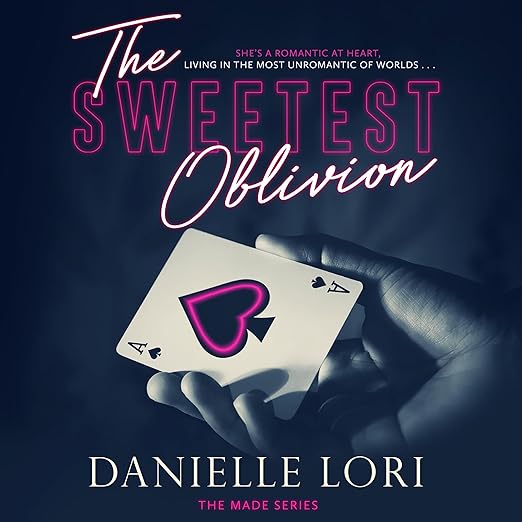
- Verdict: The Sweetest Oblivion delivers on its central promise of a morally complex Mafia hero and a slow burn that does not rush its resolution, though Elena’s characterization will divide readers along predictable lines.
Our Take on The Sweetest Oblivion
Mafia romance occupies a peculiar corner of the fiction landscape, it requires readers to find the organized crime setting romantic rather than disturbing, and to care about characters who operate entirely outside conventional ethics. Danielle Lori does not try to soften this reality or apologize for it. The Sweetest Oblivion takes place in New York’s underworld with a matter-of-factness that tells you immediately this is not a world where the hero will eventually renounce violence and go straight. That commitment to its own terms is part of what makes it work for its audience and why the series has built the following it has.
Elena Abelli, Sweet Abelli, as she is nicknamed, the docile and charming mafia principessa, watches her sister get arranged into a marriage with Nicolas Russo, the boss whose reputation is dark even by the standards of the world they inhabit. Their first encounter ends with an accidental glare on Elena’s part. From there the book is essentially about the distance between what Elena knows to be correct and what she keeps finding herself feeling, and the slow erosion of the line between them. Lori is patient about this erosion in a way that the genre does not always require of itself.
Why Listen to The Sweetest Oblivion
Nicolas Russo is the strongest element in the book, and several reviewers have noted this even as they had mixed feelings about Elena. He is described as multidimensional, perceptive, calculated, ruthless, prideful, and emotionally intelligent in ways that surprise given his exterior. One reviewer specifically said Nicolas saved the book for them, and that assessment is understandable, Lori has written a morally grey male lead who is convincingly formidable rather than simply brooding, and who is interesting to inhabit in close third-person in ways that feel earned rather than manufactured from genre convention.
The forbidden dynamic is handled with genuine patience. This is a slow burn that takes its time, and the tension between what Elena wants and what she is permitted to want, her sister is engaged to this man, the family politics are complex, the cost of any transgression would be real, gives the attraction actual weight. The pining is extended, sometimes to the point of frustration, but that frustration is the point. Lori is clearly aware of what the slow burn promises and she does not undercut it prematurely to satisfy reader impatience.
The Mafia setting is genuinely rendered rather than used as generic backdrop. Lori knows the internal logic of Mafia family structure, the hierarchy, the rules around loyalty and discretion, the specific way women occupy their positions within that world, well enough that the constraints on Elena feel real rather than contrived. The book earned its audience through its consistency with its own world rather than by softening the edges to make the setting more palatable to readers who might otherwise resist it.
What to Watch For in The Sweetest Oblivion
Elena is a genuinely polarizing protagonist. The reviewer who described her as a scatter-brained walking disaster is capturing a real feature of the characterization, Elena’s indecisiveness and her tendency to create problems through impulsiveness will read as charming to some and maddening to others. The counterpoint is that her docile exterior concealing a taste for darkness is the book’s central character arc, and the transformation is more convincing by the end than it appears at the midpoint. Readers who stick through the wobblier Elena sections typically find the arc justified.
This is the first book in the Made series, and it reads like one. Lori is establishing relationships and power dynamics that clearly carry forward, and the book ends without an epilogue, which disappointed at least one reviewer who wanted more resolution. Listeners should approach this as the opening chapter of a longer story rather than a complete standalone romantic arc. The series dynamic, different couples in the same Mafia world, means subsequent books can be read independently, but this first volume is clearly setting up more than it resolves.
Stacy Gonzalez’s narration handles the dual-perspective structure capably. The book is primarily Elena’s point of view but Nicolas gets sections, and Gonzalez differentiates the two registers enough to make the shifts clear. Her delivery of the Mafia world’s tense social dynamics, the scenes where Elena must perform docility while feeling entirely otherwise, has a particular quality that serves the book’s central irony about who the Sweet Abelli actually is underneath her public face.
Who Should Read the Made Series in Order and Who Can Skip Ahead
This is a standalone story within the Made series, you do not need prior knowledge of the world to follow it. But it is clearly designed as a series opener, and listeners who come in expecting full closure will find the ending more open than expected. The right audience is readers who enjoy slow-burn forbidden romance with morally complex male leads and who are willing to invest in an extended emotional journey toward a payoff that is genuinely earned. If your primary interest is in the Mafia world-building and the Nicolas characterization rather than the slow burn process itself, the patience required is real and worth factoring into your decision.
Frequently Asked Questions
How explicit is the content in The Sweetest Oblivion compared to other dark romance titles?
Reviewers describe the steam level at roughly 3 out of 5. This is not a closed-door romance, but it is not the most explicit entry in the dark romance genre either. The focus is substantially on tension and pining rather than physical scenes, which is by design given the slow-burn structure.
Is this book truly standalone or do the other Made series books need to be read first?
It is a standalone in terms of following Elena and Nicolas’s arc without prior reading. The world and some characters recur across the series, but The Sweetest Oblivion introduces its setting from the ground up. Subsequent books follow different couples in the same Mafia world.
How does Stacy Gonzalez’s narration handle the Mafia setting, does it feel appropriately toned for the material?
Yes. Gonzalez maintains a steady tone that avoids both melodrama and the flat affect that can undermine dark romance in audio. Her handling of Elena’s internal voice, the gap between public performance and private feeling, is one of the stronger aspects of the production.
Reviewers seem divided on Elena as a character, is she really as frustrating as some say?
She divides opinion genuinely. Elena’s impulsiveness and indecision are character traits that drive the plot and represent her arc toward recognizing her own darkness, but the journey to that recognition takes most of the book. Readers who find indecisive protagonists frustrating should be aware this is a significant feature of the first half. By the end, most readers find the transformation convincing.