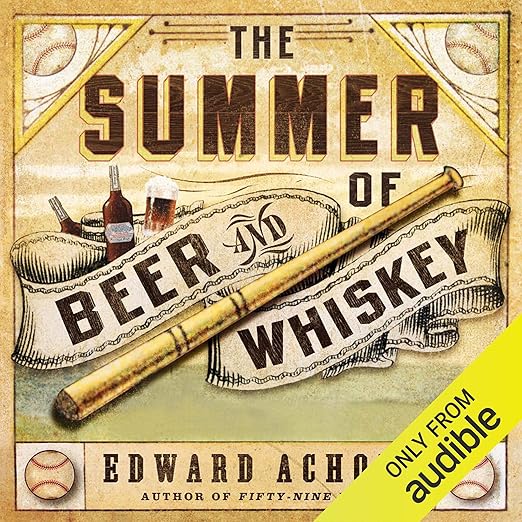
Quick Take
- Narration: Ax Norman keeps pace with Achorn’s lively prose without over-dramatizing it, a workmanlike performance that suits a history told with genuine affection.
- Themes: Baseball’s commercial reinvention, immigrant entrepreneurship in 19th-century America, populist sport vs. elite gatekeeping
- Mood: Cheerful and nostalgic, like a very good sports bar conversation that turns out to be historically instructive
- Verdict: A genuinely enjoyable piece of baseball history centered on an unlikely protagonist, the German immigrant beer magnate who may have saved the sport.
I came to The Summer of Beer and Whiskey knowing almost nothing about 19th-century baseball, which turns out to be the ideal condition for reading this book. Edward Achorn’s account of the 1883 American Association pennant race and the eccentric figure at its center, Chris Von der Ahe, the German-born beer garden proprietor who accidentally became one of the most consequential owners in baseball history, works precisely because it assumes you don’t know the story. It takes nothing for granted and loses nothing by that decision.
Von der Ahe’s origin story is the book’s comic engine. He bought the St. Louis Browns franchise, the organization that would eventually become the Cardinals, primarily as a mechanism for selling more beer. His knowledge of baseball at the time of purchase was negligible. His business instincts, however, were acute, and what he built with those instincts helped rescue a sport that was, by the late 1870s, genuinely dying. Corruption scandals, declining attendance, a National League that had managed to make a popular entertainment feel elitist and inaccessible, baseball in 1879 was in genuine trouble, and Achorn makes clear how close to permanent decline it was before Von der Ahe and his colleagues in the new American Association decided to do something different.
Our Take on The Summer of Beer and Whiskey
The American Association’s formula, Sunday games, alcohol sales, twenty-five-cent tickets, and a tolerance for players who were exciting precisely because they were reckless, is the book’s central argument dressed as history. Achorn isn’t subtle about the parallel to contemporary debates about who professional sports are for and at what price point. The Beer and Whiskey Circuit’s explicit rejection of the National League’s genteel pretensions maps onto recognizable contemporary tensions between the commercial and aesthetic dimensions of sport, and Achorn draws that line without overworking it.
Von der Ahe himself is a spectacular character, generous to the point of financial recklessness, promotional to the point of absurdity, emotionally transparent in ways that made him both beloved and exploitable. Achorn treats him with genuine affection rather than condescension, which is the right call. He was wrong about almost everything specific to baseball and right about almost everything that mattered about entertainment, and that combination produced a legacy more significant than any of his contemporaries would have predicted.
Why Listen to The Summer of Beer and Whiskey
For listeners who don’t already know 19th-century baseball history, this book provides genuine discovery. The details of how the game was played in the 1880s, barehanded, physically brutal, governed by rules that bear only partial resemblance to the contemporary game, are rendered with enough specificity to feel real rather than generic. One reviewer who described himself as a lifelong fan noted that he had “done little prior reading about baseball history prior to 1900” and found the account “informative” in ways he didn’t expect. That sense of genuine learning from a book that also entertains is harder to achieve than it sounds.
Ax Norman’s narration serves the material cleanly. He keeps pace with Achorn’s lively prose without overdramatizing the narrative or letting the comedy overwhelm the historical argument. The result is a listen that goes quickly despite covering a significant amount of ground, nine and a half hours that don’t feel like nine and a half hours.
What to Watch For in The Summer of Beer and Whiskey
This is specifically the story of the 1883 season and the American Association’s emergence as a rival to the National League. Listeners who come expecting a comprehensive history of 19th-century baseball will find the focus narrower than that, and deliberately so. Achorn uses the 1883 pennant race as a window onto a larger transformation, but the specific details of player statistics, game outcomes, and Von der Ahe’s ongoing adventures in ownership are what the book lingers on, not a panoramic survey of the era.
Readers who are already deep in baseball history may find the ground familiar. Achorn is writing for a general audience, and the explanatory work he does for newcomers occasionally means that well-versed fans will be waiting for the narrative to move past context they already have. For most listeners, that’s not a significant issue, the storytelling is engaging enough to sustain the pace regardless of what you already know.
Who Should Listen to The Summer of Beer and Whiskey
Baseball fans who have read the modern-era books and want to understand where the sport came from will find this rewarding. History readers interested in the commercial and cultural dimensions of American entertainment in the Gilded Age will discover more here than a sports history label might suggest. Anyone who finds the question of who professional sports serve, economically, culturally, socially, to be genuinely interesting will find Achorn’s treatment of the Beer and Whiskey Circuit surprisingly resonant. It’s a book about a man who knew nothing about baseball and understood everything about people, and that combination turns out to be a compelling story in any era.
Frequently Asked Questions
Do I need to be a serious baseball fan to enjoy The Summer of Beer and Whiskey?
No. Achorn writes for a general audience and does the explanatory work to bring non-fans into the material. The book is as much about American commercial and social history as it is about the sport itself.
How does Achorn handle Chris Von der Ahe as a historical subject, sympathetically or critically?
With genuine affection and some comedy, but not hagiography. Von der Ahe was often wrong about specifics and right about essentials, and Achorn treats that contradiction as the heart of the story rather than a problem to resolve.
Is the 1883 pennant race itself exciting to follow, even for listeners who already know the outcome?
Reviewers consistently found it engaging. Achorn structures the race with enough narrative momentum that the seasonal arc functions as a genuine story rather than a recitation of historical record.
How does this book compare to other baseball history audiobooks in terms of accessibility?
It sits comfortably in the readable, popular history category, similar in approach to well-crafted sports journalism rather than academic history. No specialist knowledge required, and the storytelling is prioritized over statistical analysis.