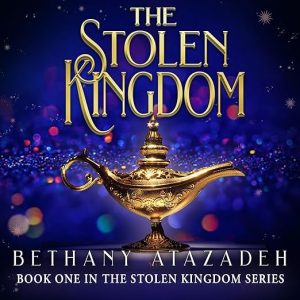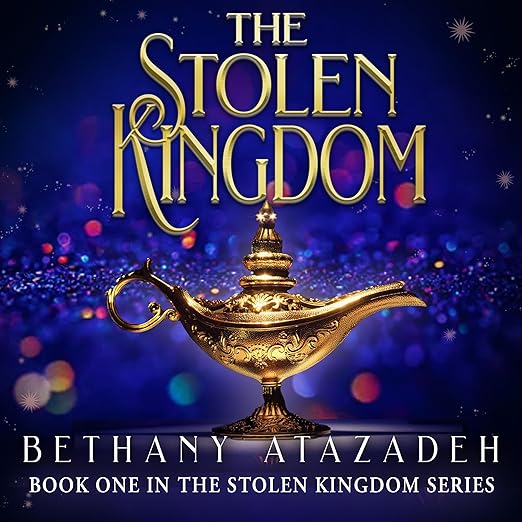
I have read more Aladdin retellings than I would like to admit. The story has proven irresistible to YA authors over the past decade, and the results have ranged from slavish Disney homage to barely-recognizable borrowings that use the premise as an excuse rather than a foundation. Bethany Atazadeh's The Stolen Kingdom falls decisively into the better category, and I say this as someone who arrived with genuine skepticism about whether there was anything left to do with this material. There is, it turns out, when you are willing to discard the parts that don't serve your story and build something genuinely your own.
The novel's central divergence from its source material begins immediately. Princess Arie is not a supporting character in someone else's adventure. She is the protagonist, and the story's primary threat is not poverty or social exclusion but a specific political danger: a neighboring king attempting to force her into marriage and steal her kingdom. Compounding her situation is a jinni's gift that has manifested before her eighteenth birthday, a forbidden ability she must hide or face execution. The stakes are real from the opening chapters, and Atazadeh establishes them with the efficient clarity that distinguishes strong YA world-building from the kind that drowns in its own detail.
Our Take on The Stolen Kingdom: An Aladdin Retelling
Arie's jinni gift is telepathic in nature, she can hear others' thoughts, and Atazadeh uses this ability with more sophistication than the premise might suggest. It is not simply a plot convenience. The gift creates genuine psychological complexity: Arie knows what people actually think of her, which is both useful and isolating in a court environment built on performance and concealment. Her relationship with the gift, her fear of it, her growing understanding of what it costs her and what it might provide, drives the character's internal arc with enough specificity that you care about her resolution independently of the external plot.
The world Atazadeh has built shares space between humans and supernatural beings, mermaids, dragons, and the elusive jinni themselves, and the mythology feels genuinely invented rather than assembled from familiar fantasy parts. One reviewer praised the world-building as wholly her own, and that assessment holds. The jinni culture and its relationship to human society is developed with enough internal consistency to suggest Atazadeh had built it carefully before putting it on the page rather than discovering it as she wrote.
Why Listen to The Stolen Kingdom: An Aladdin Retelling
The publisher's synopsis invites comparison to The Lunar Chronicles, The Cruel Prince, and Six of Crows, which is a marketing gambit that carries significant risk. Readers who love those books come with high expectations and specific taste. Atazadeh does not quite match the tonal sophistication of Six of Crows or the feminist complexity of The Cruel Prince at their respective peaks, and it would be unfair to her to measure against them directly. What she does match is the energy: the propulsive adventure plotting, the cast of reluctant allies who develop into something like a found family, the romance that earns its tension through genuine character conflict rather than manufactured misunderstanding.
The crew of jinni hunters and thieves who become Arie's unlikely partners are one of the book's genuine pleasures. Gideon, who several reviewers single out by name, is the kind of secondary character who makes you impatient for their moment at the center of the story. The ensemble dynamic is well-managed, and Atazadeh gives each member enough specificity that they feel like individuals rather than genre archetypes.
What to Watch For in The Stolen Kingdom: An Aladdin Retelling
Merphy Napier has become one of the most trusted voices in YA fantasy audiobooks, with a following that actively seeks out titles she narrates. Her performance on The Stolen Kingdom is characteristic of what makes her reliable in this genre: she brings genuine intelligence to Arie's narration, suggesting a young woman who is afraid without being consumed by her fear, and who is calculating her options rather than waiting for rescue. Her handling of the action sequences is energetic without becoming frantic, and the book's faster-paced scenes benefit from her controlled pacing.
The eight-and-a-half hour runtime is well-calibrated for the story's ambitions. The novel earns its length without the pacing problems that afflict many YA fantasies that mistake length for depth. Atazadeh moves things forward consistently, and the ending, while clearly designed to launch the subsequent volumes in the series, arrives at a satisfying enough point that listeners do not feel abandoned mid-story.
Who Should Listen to The Stolen Kingdom: An Aladdin Retelling
This is the first book in a four-part series, and it establishes rather than resolves. Listeners who prefer self-contained stories should be aware of that structure. Those who are happy to invest in the beginning of something that will develop across multiple volumes will find The Stolen Kingdom a confident and pleasurable opening. Come to it if you want an Aladdin adaptation that treats the source material as a suggestion rather than a script. Come to it if the crew-of-thieves dynamic appeals to you, or if you want a YA heroine whose gift is genuinely double-edged. Skip it if you want your fantasy retellings to stay close to the original template.
Common Questions
How closely does The Stolen Kingdom follow the Aladdin story, will fans of the original recognize the key plot points?
Atazadeh describes the adaptation as loose, and that is accurate. The core inspiration, a young person navigating social restriction with the help of a jinni, is present, but the story has been substantially reimagined. The protagonist is a princess rather than a street thief, the romantic lead is not an equivalent of the genie, and the plot follows entirely original political stakes. It is not a scene-by-scene retelling.
Merphy Napier is listed as the narrator, is she well-matched to this particular story given her YA fantasy reputation?
Yes. Napier's established strengths in YA fantasy narration align well with what The Stolen Kingdom requires. She handles Arie's internal conflict around her hidden gift with the right combination of intelligence and fear, and the ensemble cast of jinni hunters and thieves is differentiated clearly enough to track across eight-plus hours.
Is this a standalone story or does it end on a cliffhanger that requires reading the next volume?
The book is the first in a four-part series and is designed to launch a larger story. It reaches a satisfying enough stopping point that listeners will not feel stranded, but the major mysteries and relationship arcs are clearly positioned to continue. Listeners who prefer fully self-contained stories should know that going in.
The synopsis compares this to Six of Crows and The Cruel Prince, is that comparison accurate or is it primarily a marketing claim?
The comparison is aspirational marketing more than a precise equivalent. The ensemble dynamic and adventure plotting share something with Six of Crows, and the fantasy world with political stakes has Cruel Prince adjacency. But Atazadeh is not working at the same level of moral complexity or prose sophistication as those comparisons. The energy is similar; the ambition is comparable; the execution is a tier below the most celebrated examples of the genre.