Quick Take
- Narration: Soneela Nankani’s performance is precise and well-matched to the material’s political intelligence, lending Enitan’s voice a dignity that the prose earns.
- Themes: Colonial resistance and personal vengeance, queer identity in normative space, the cost of empire
- Mood: Propulsive and morally serious, with moments of quiet beauty
- Verdict: A genuinely distinctive debut space opera that earns its Publishers Weekly starred review, with Nankani’s narration elevating already strong material.
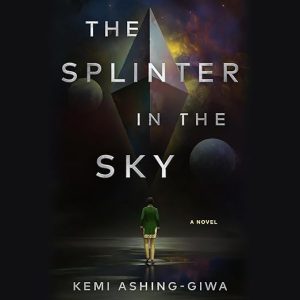
I was somewhere between the second and third hour when I stopped thinking about The Splinter in the Sky as a debut novel and started thinking about it as a novel. Kemi Ashing-Giwa’s first book has the qualities that reviewers tend to reach for when they want to distinguish ambitious literary science fiction from genre product. The worldbuilding is specific rather than sprawling. The protagonist, Enitan, has a life that exists before the plot begins rather than being conjured by it. And the central conflict, between a young tea expert whose quiet ambitions are shattered by an imperial atrocity, is grounded in the kind of institutional violence that has textures and histories, not just a single villain.
Soneela Nankani narrates, and I want to say something specific about her performance rather than the generic observation that she is good. Nankani understands that Enitan’s intelligence operates primarily through observation and restraint, and she voices that quality rather than performing the emotion the character is withholding. It is a technically difficult choice and she executes it consistently across nearly fourteen hours.
Our Take on The Splinter in the Sky
The novel belongs to a tradition that N.K. Jemisin established more firmly in literary science fiction with the Broken Earth trilogy: using the conventions of speculative fiction to examine colonial power structures with specificity rather than allegory. Ashing-Giwa’s Vaalbaran Empire is not Rome with the serial numbers filed off. It has its own logic, its own cultural textures, its own bureaucratic vocabulary, and Enitan navigates all of it as someone who has spent her life learning how systems of power produce their own blindspots.
The tea expertise is not decorative. Enitan’s work as a tea specialist is her cover, her credential, and the economic knowledge base that lets her move through the imperial capital in ways a more obviously threatening figure could not. The choice to make her protagonist’s skill something quiet and cultured, requiring intimate social access, is one of the book’s structural cleverness that not all reviewers have flagged explicitly.
Why Listen to The Splinter in the Sky
For listeners who have found recent literary science fiction either too focused on style at the expense of plot or too reliant on action at the expense of ideas, this book occupies productive middle ground. The pace is fast enough that a reviewer noted it did not go on and on about inner feelings. The ideas are substantive enough that another reviewer connected the book directly to contemporary conversations about empire and the pain of colonization. Ashing-Giwa earns that connection rather than assuming it.
The queer normative world-building is handled with particular confidence. Rather than foregrounding Enitan’s identity as the book’s defining characteristic, Ashing-Giwa constructs a universe in which the configuration of her relationships is unremarkable within her own culture, creating interesting space to explore what becomes remarkable when she enters the imperial world with its own different assumptions.
What to Watch For in This Debut
One thoughtful review flagged the typical first-novel issues: a plot that occasionally runs too straight a line, a moral that gets driven home rather than allowed to land obliquely, and emotional switches in the protagonist that can feel abrupt rather than earned. These are real observations. The book is best experienced not as a polished genre product but as a highly intelligent debut that is doing several ambitious things simultaneously and succeeding at most of them. The narrative convenience of a few plot turns is the price of Ashing-Giwa’s worldbuilding ambition.
Who Should Listen to The Splinter in the Sky
This book is for listeners who want their science fiction politically engaged and their protagonists pursuing vengeance with intelligence rather than violence. Fans of Nnedi Okorafor and N.K. Jemisin’s earlier work will find the tonal proximity the publisher advertises to be accurate. Readers who need extensive subplots and wide ensemble casts may find the focused scope slightly austere. Those willing to commit to one woman’s journey through an empire she is dismantling from within will find nearly fourteen hours that consistently justify the investment.
Frequently Asked Questions
Is The Splinter in the Sky a standalone or the first book in a series?
It is a standalone novel. The All Souls universe reference in other parts of this batch is unrelated. Ashing-Giwa’s book closes its own narrative without setting up a sequel, which is relatively rare for debut science fiction and worth noting for listeners fatigued by open-ended series.
How does Soneela Nankani’s narration handle the political and world-building vocabulary of the Vaalbaran Empire?
Nankani is one of the more reliable narrators working in literary science fiction, and her handling of invented terminology is consistent and unhurried. She gives the Vaalbaran vocabulary a weight that makes the empire feel real rather than decorative, which is critical given how much of the book operates inside its institutions.
Is the queer content central to the plot or peripheral?
The queer normative world-building is structural rather than thematic in the foreground. Enitan’s relationships are configured within a society where they are unremarkable, and the tension around identity emerges from the contrast with the Vaalbaran Empire rather than from internal conflict. It is woven into the world rather than treated as the story’s primary subject.
How graphic is the violence and political content for sensitive listeners?
The violence is present but not gratuitous. The most disturbing elements are structural, involving the mechanics of imperial control and the specific ways Enitan’s sibling disappears into an institution. Listeners comfortable with literary science fiction that includes political violence as context rather than spectacle will navigate this without difficulty.